

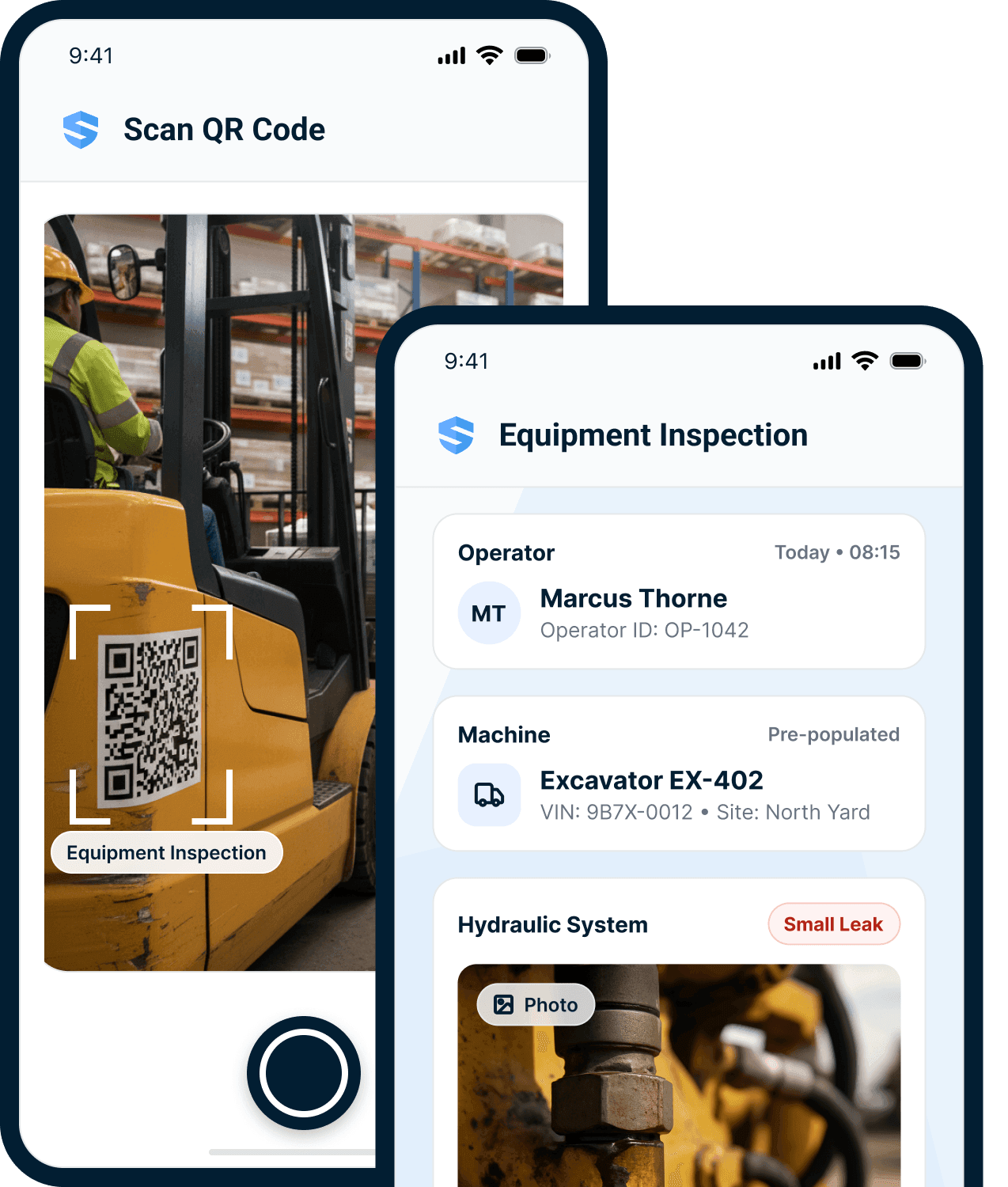
Confined space and hot work demand the procedure at the point of work. SALUS puts it there.
Your confined-space and hot-work program is solid. The question is execution at the entry: the permit filled on paper after the fact, the SDS for the refrigerant two trucks away, the gas-test reading remembered instead of logged. SALUS is the operational safety platform built for that gap. Crews capture at the source with one QR scan, in their language, offline in the mechanical room — and Rosie turns every captured fact into the assessments, programs, and live proof the whole company runs on, from the mechanic to the bid room.
Trusted by Viaduct Sheet Metal and mechanical and HVAC contractors across Canada.
- Requested by
- QR at the space entrance — not the trailer
- Atmosphere
- O₂ 20.9 · LEL 0 · CO 0 · H₂S 0 — readings required, recorded
- Entrants
- 3 — confined space certs verified at the request
- Rescue plan
- Attached and verified before the permit activates
- Zone check
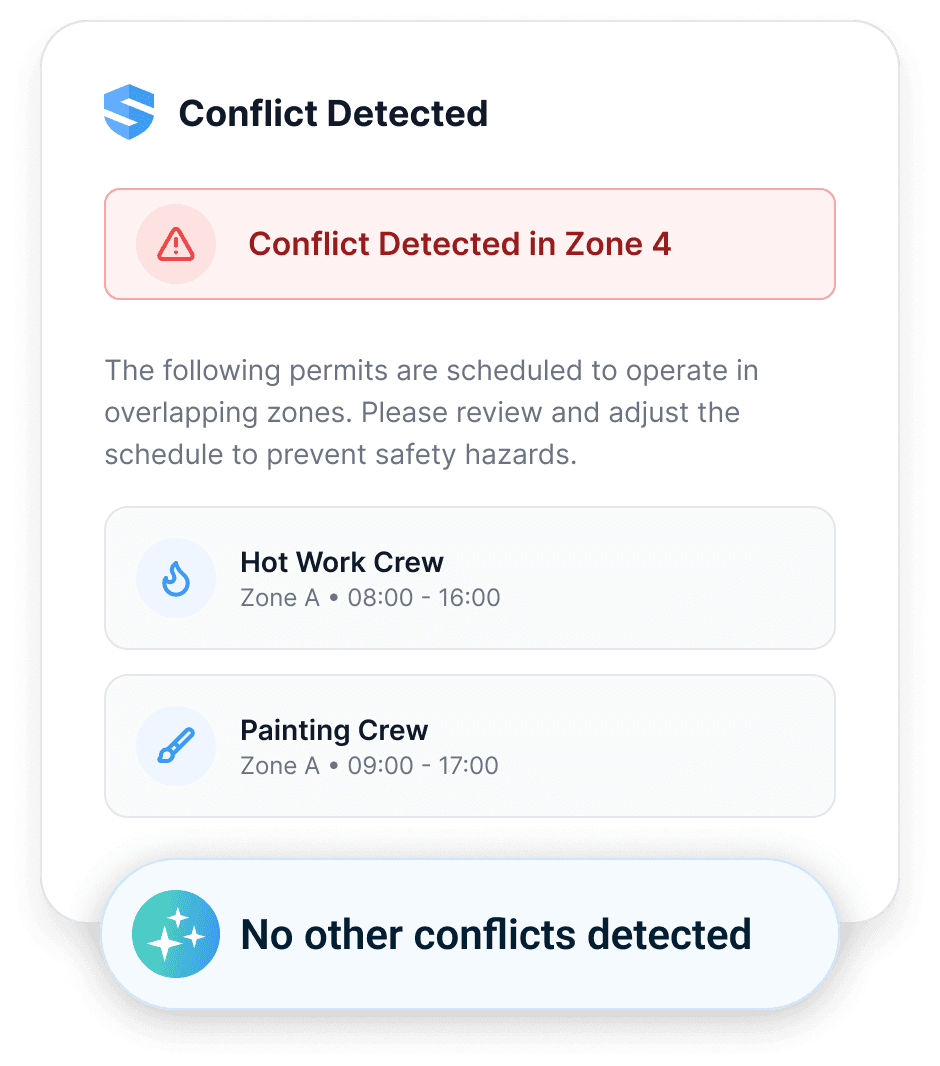
- No hot work in Zone A during the entry window
From the mechanical room to the bid · one QR scan
The mechanical room
The office
The bid room
One fact, traveling
Three problems. Only one is about paperwork.
Compliant and effective are different things. The forms existing is compliance. The procedure being at the point of entry — that's effectiveness, and it's where mechanical and HVAC safety programs actually break.
Your permits exist. They get filled after the entry.
The confined-space entry permit and the hot-work permit get filled on paper after the fact, or skipped, while the mechanic is already in the vessel or striking an arc on ductwork. A 40-question generic JHA doesn't produce the same protection as task-specific questions — the atmospheric test, the attendant, the fire watch — that force a real conversation about this space, today.
Hours a day on documentation nobody reads at the vessel.
Entry permits, hot-work permits, gas-test logs, SDS retrieval, daily reports. At $65–$90/hr fully loaded, that's $230–$315 per foreman, per day, on documentation that would be both more protective and faster if it were task-specific and digital.
You measure what happened. Not what's about to.
Your incident log tells you who got hurt last year. It doesn't tell you that one crew's confined-space permit completion dropped from 95% to 62% since the crew changed. Leading indicators predict incidents — but only if you can see them.
The fix isn't more program. It's the procedure, at the point of entry — in the mechanical room.
Even the self-described old-school workers settled into it quickly — full implementation took two weeks, not two months.
It starts with one scan before the mechanic enters the space.
6:12 AM. A technician QRs the vessel before entry. Everything below happens because of it.
The gap between "I should test the air" and "it was fine last time" is where mechanics get hurt.
Your crews have entered the space a thousand times — and that familiarity is the danger. SALUS puts everything at the point of work, faster than winging it: the same safety your program already specifies, with the friction gone. In a confined space, that's what prevention actually means.
- 6:02 AM
- Requested by QR at the space entrance — specific to this space
- 6:04 AM
- Atmosphere recorded: O₂ 20.9 · LEL 0 · CO 0 · H₂S 0 — mandatory fields
- 6:06 AM
- 3 entrants verified — confined space certs current
- 6:08 AM
- Rescue plan attached and verified
- 6:10 AM
- Permit active — visible to the safety director in real time
The confined-space and hot-work permit at the point of entry
Scan the QR at the vessel: the permit loads with the atmospheric-testing fields, the attendant assignment, the rescue plan, and the fire watch for hot work — in the field, offline if the mechanical room demands it. The reading gets logged, not remembered. The permit opens when the space is proven safe, not before.
- 6:02 AM
- Requested by QR at the space entrance — specific to this space
- 6:04 AM
- Atmosphere recorded: O₂ 20.9 · LEL 0 · CO 0 · H₂S 0 — mandatory fields
- 6:06 AM
- 3 entrants verified — confined space certs current
- 6:08 AM
- Rescue plan attached and verified
- 6:10 AM
- Permit active — visible to the safety director in real time
The hot-work permit travels with the task
Welding, brazing, or cutting on ductwork: the hot-work permit loads the fire watch, the extinguisher check, and the post-work monitoring — matched to the task, 10 seconds from the torch. No more permit filled at the truck after the sparks have flown.
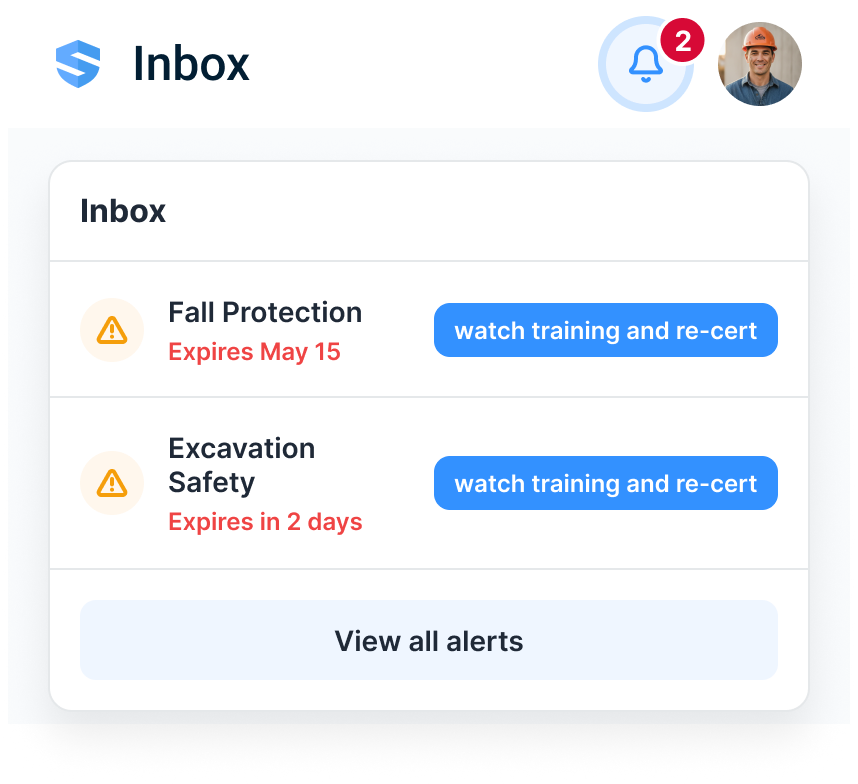
Confined-space entry gated to the qualified worker
Touch the worker's name: confined-space entry and gas-test qualification matched to this specific task — and an expired cert blocks the permit sign-off, surfacing the gap before entry. Expirations surface weeks ahead, with the refresher pushed to the worker's phone before anything lapses.
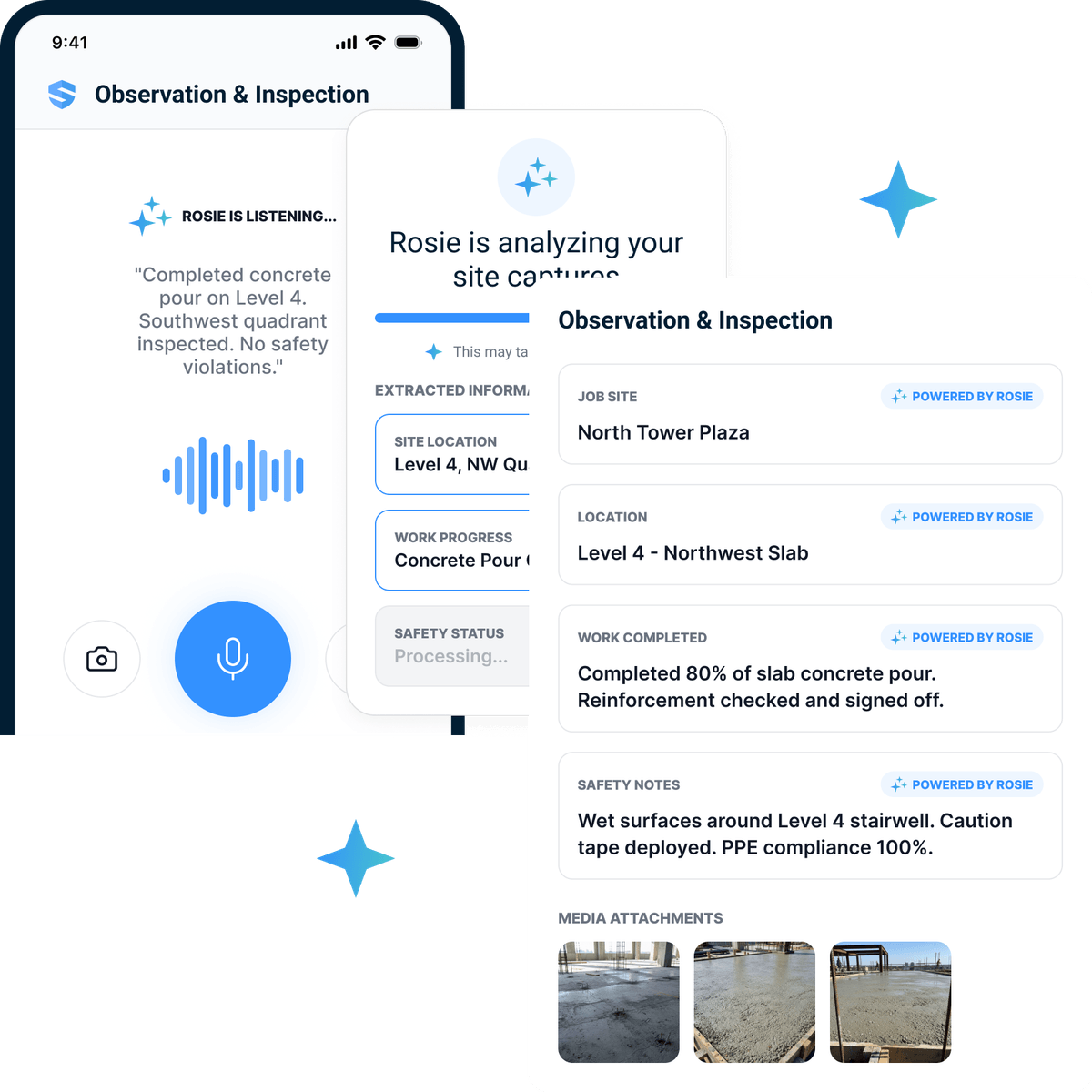
The assessment takes a photo and a sentence
The foreman talks or films the entry or the weld, and Rosie structures the assessment and the permit record — worker, task, and location context attached. It routes to a named person automatically and closes with a photo. The records that used to go unwritten become your leading indicators.
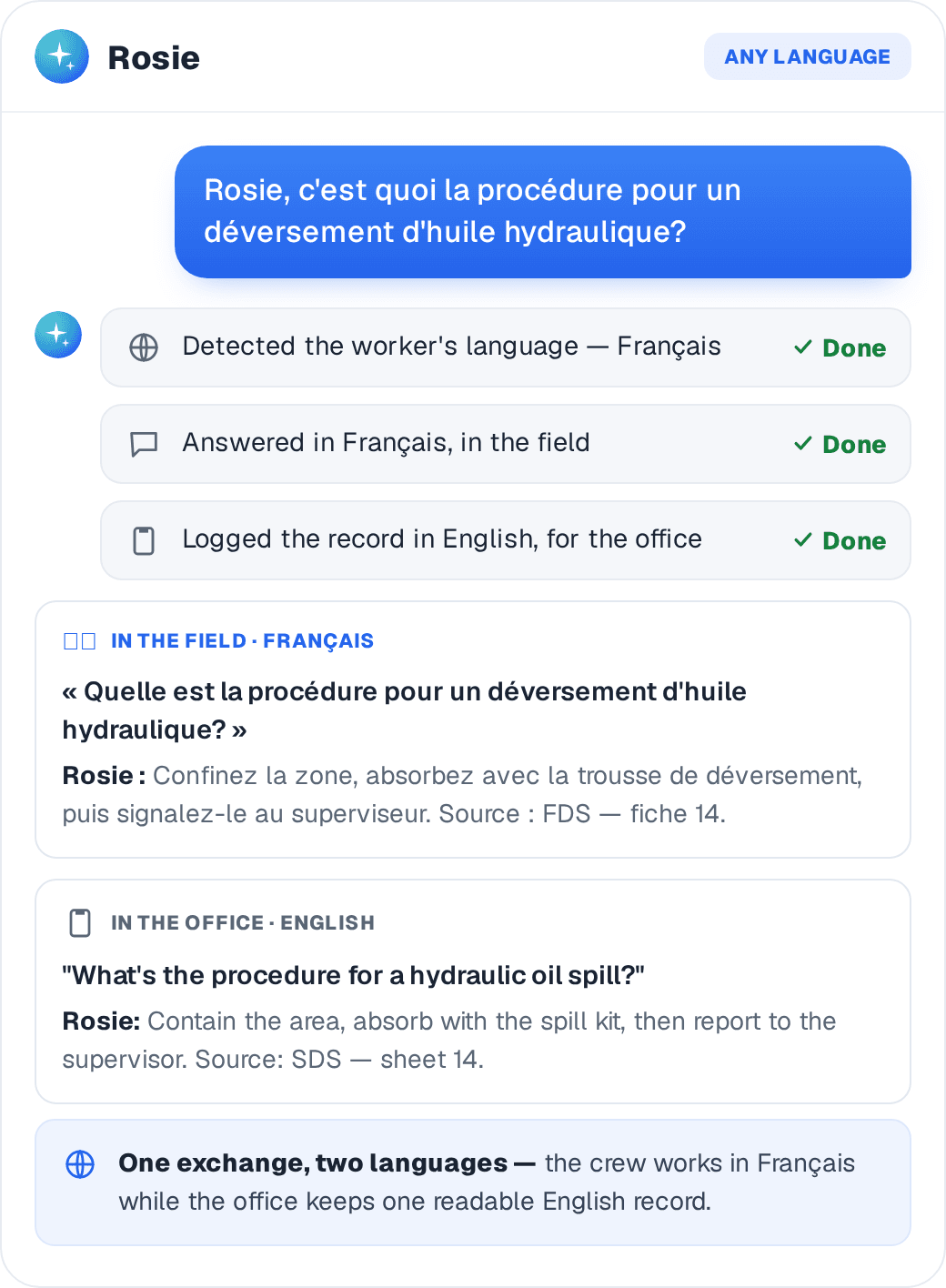
WHMIS answers, offline, in every language
The mechanic asks Rosie about the refrigerant, the solvent, or the gas — the SDS answer comes back offline, in their own language, at the point of use. Many Canadian crews work in more than one language, and a comprehension gap on a chemical is a safety gap.
The procedure at the point of entry, not the permit filled after — and provable to any auditor in seconds.
The same scan is now your safety director's eyes.
Every permit, cert, and gas-test log from every crew — one living record, watched continuously.
Stop compiling. Start preventing.
A mechanical safety director's nightmare isn't the hazard the crew sees — it's the gap nobody sees: the confined-space cert that lapsed mid-project, the SDS written for the old refrigerant, the crew whose permit quality has been sliding for three weeks. Because every crew captures at the source, the record is rich enough to watch itself — and Rosie watches it continuously. Leading indicators can predict the large majority of incidents before they happen. This is that data, building itself. 🍁 Across the rest of Canada, that record is the COR audit package and the provincial OHS evidence — and where gas and pressure systems are involved, the TSSA (Ontario) or Technical Safety BC documentation — assembled on demand. ⚜️ In Québec, it's the CNESST file and the comité de santé et de sécurité record under Bill 59, in French, with the CCQ and RBQ credentials tracked alongside.
Certs current before the worker enters
Confined-space and gas-test status verified against the task at every permit — and expirations surfaced weeks ahead with the refresher pushed to the worker's phone, so the gap never forms.
Corrective actions that close
Assigned to a named person — not 'the safety department' — tracked when viewed, closed with a photo. Average close time drops from 14 days to 3.5.
Updates at network speed
Revise an SDS, a hot-work procedure, or an entry SWP once and it's live on every site and every QR code immediately. No driving, no page-swapping, no stale revision in a truck.
Drift flagged this week
Confined-space permit completion dropping from 95% to 62% after a crew change shows up on your screen in 30 seconds — not in next quarter's incident review.
- "Which technicians have confined-space certs expiring in 30 days?"
- "Show hot-work and confined-space near-miss trends across all projects this quarter."
- "Write a toolbox talk for a confined-space entry in a mechanical room with the atmospheric-testing and rescue steps."


Four active sites have no submissions. SeaTac and Surrey are the highest priority because each has 71 workers on site without a hazard assessment on record.
- SeaTac
- 71 workers · no assessment
- Surrey
- 71 workers · no assessment
- Broadway Towers
- 2 locations · 9 workers total
Site leaders confirm work status and complete the missing assessments before affected tasks continue.
By Friday, that scan is winning the next mechanical package.
Crew-level facts become the live proof owners and GCs now demand.
The work you want goes to the contractor who can prove it — and the owner checks your evidence first.
Canadian owners and general contractors increasingly require COR certification and documented safety performance before you can bid — and they don't ask whether you have a confined-space program, they ask for the records: COR status, documented systems, daily compliance evidence. Every fact your crews captured at the entry is already that evidence. The Trust Portal shares it as a live link — confined-space cert currency, permit completion, corrective-action velocity — verifiable by any GC or owner in minutes, no SALUS account required. And there's an insurance dividend: documented control is what earns the rebate and the insurer's incentive.
- Prequal answered with a live link instead of a binder assembled the night before the deadline.
- Your experience rating protected at the execution level — every claim feeds the WCB or WSIB premium you pay, and a confined-space incident is where the worst claims come from.
- When the records request or the insurer's review comes, Rosie assembles the packet from the same field record — in minutes.
The due-diligence record is assembled. Daily hazard assessments cover 96% of active site-days, incident response averages 2.3 hours, and 23 fall-protection certificates need attention.
- Field evidence
- 12,847 forms · 96% active site-days covered
- Follow-through
- 94% of corrective actions closed
- Credential gap
- 23 fall-protection certificates expire within 30 days
The risk team reviews the source-linked packet before it is shared with the broker or insurer.
The due-diligence record is assembled. Daily hazard assessments cover 96% of active site-days, incident response averages 2.3 hours, and 23 fall-protection certificates need attention.
- Field evidence
- 12,847 forms · 96% active site-days covered
- Follow-through
- 94% of corrective actions closed
- Credential gap
- 23 fall-protection certificates expire within 30 days
The risk team reviews the source-linked packet before it is shared with the broker or insurer.
The evidence that wins the bid is already captured at the entry.
One scan before the entry. Proof everywhere it matters.
Capture once, at the source, with no friction — and let Rosie carry the fact to everyone who needs it, in whatever form they need it.
Built for the whole shop — not one desk in it.
The same captured facts serve everyone. Pick your seat and see exactly what SALUS takes off your plate.
Your safety director
Gets back · entry visibility and proof
One person, every confined space and hot-work task: certs renewed ahead, permits cross-checked, SDS current, and Rosie drafting the programs, packets, and answers.
Your foremen
Gets back · faster shift-ready work
Task-specific entry and hot-work permits, the SDS answer 10 seconds from the torch, answers in any language — and a record that proves the space was safe.
Your executives
Gets back · margin protection and rebate support
Your best foreman's confined-space judgment encoded at every site, the project about to go sideways flagged early, and the evidence that protects margin and supports the rebate and your experience rating.
Go deeper on what you just watched.
Digital Permits
Confined-space and hot-work permits with atmospheric-testing fields, attendant assignment, and fire watch.
Searchable SDS
WHMIS answers offline, in the worker's language, at the point of use.
QR Codes
The permit at the vessel. The SDS at the torch. 10 seconds, version-controlled, never skipped.
Certificate Management
Confined-space and gas-test status matched to the task — with renewals weeks before expiry.
Corrective Actions
Named individuals, photo closure, automatic escalation. Average close: 14 days → 3.5.
Trust Portal
Live compliance proof for the GC and the owner — the prequal binder, retired.
Mechanical, HVAC, and high-risk trades who made safety effective.

Viaduct Sheet Metal
Even the self-described old-school workers settled into it quickly — fully paper-free in two weeks, absorbing a 3x jump in form volume without adding staff.
Hot work · audit prep
Hot work, crane lifts, and concrete pours across dozens of sites — every form visible in real time, audits that took days now take minutes.

Harshest environments
Workers in the harshest environments on earth — Arctic well pads, remote drilling sites — figured the platform out on their own.
Trusted by contractors managing 400K users across 150K sites
Asked by mechanical and HVAC contractors, answered straight.
We already have a strong confined-space program. Why SALUS?
How does SALUS handle COR audits, gas/pressure regulators, and Québec's CNESST regime?
What's the difference between 'compliant' and 'effective'?
How does permit gating work without stopping the crew?
How does SALUS handle multilingual crews and SDS?
How painful is it to move off paper or our current system?
I'm an exec. Why should I care about safety software?
Confined space and hot work demand the procedure at the point of work. SALUS puts it there.
Bring your confined-space permit process, your SDS library, and your last prequal package — and watch one QR scan replace all three in a 15-minute demo.
Trusted by Viaduct Sheet Metal and mechanical contractors across Canada.