

Remote corridors, live excavations, no signal — and the documentation still has to hold.
Your excavation and ground-disturbance program is solid. The question is execution where the work actually is: a corridor with no signal, a trench that opened this morning, locates confirmed verbally instead of logged. SALUS is the operational safety platform built for that gap — and it works fully offline, because the corridor doesn't have bars. Crews capture at the source with one QR scan, in their language, in the field — and Rosie turns every captured fact into the assessments, programs, and COR record the whole company runs on, from the trench to the bid room.
Trusted by Wildstone Construction and heavy civil contractors across Canada — from BC to the Yukon.
- Competent person
- R. Mendez — at the trench, GPS-confirmed
- Soil class
- Type B — sloping verified, photo attached
- Protective system
- Trench box · depth 7'2" · ladder within 25'
- Utility locates
- Marks photo-verified · ticket #4471 active
- 2:10 PM
- Rainfall event — re-inspection triggered, completed 2:45
From the trench to the bid · one QR scan
The trench
The office
The bid room
One fact, traveling
Three problems. Only one is about paperwork.
Compliant and effective are different things. The forms existing is compliance. The procedure being at the trench — offline, where there's no signal — that's effectiveness, and it's where heavy civil safety programs actually break.
Your permits exist. They get filled when the crew gets back in range.
The excavation permit and the ground-disturbance checklist get filled on paper, or from memory once there's signal, while the trench is already open. A 40-question generic checklist doesn't produce the same protection as task-specific questions — the locates, the soil classification, the protective system — that force a real conversation about this excavation, today.
Hours a day on documentation nobody can submit from the corridor.
Excavation permits, equipment inspections, traffic-control plans, daily reports — and a remote site with no connectivity. At $65–$90/hr fully loaded, that's $230–$315 per foreman, per day, much of it spent driving back into range to submit paper that should have synced itself.
You measure what happened. Not what's about to.
Your incident log tells you who got hurt last year. It doesn't tell you that one corridor's excavation-permit completion dropped from 95% to 62% since the crew changed. Leading indicators predict incidents — but only if the data made it back from the field.
The fix isn't more program. It's the procedure, at the trench — offline, where the work is.
Crews on remote sites with unreliable connectivity, standing at printers — sorting paper into COR folders was a full-time job. That's gone.
Two things never change out here: no bars, and weather.
Every platform demos well in the office. Heavy civil happens on remote cuts with zero signal, under a sky that rewrites the day's compliance obligations at 2 PM. SALUS was architected for exactly these two facts — not adapted to them.
Offline isn't a feature. It's the architecture.
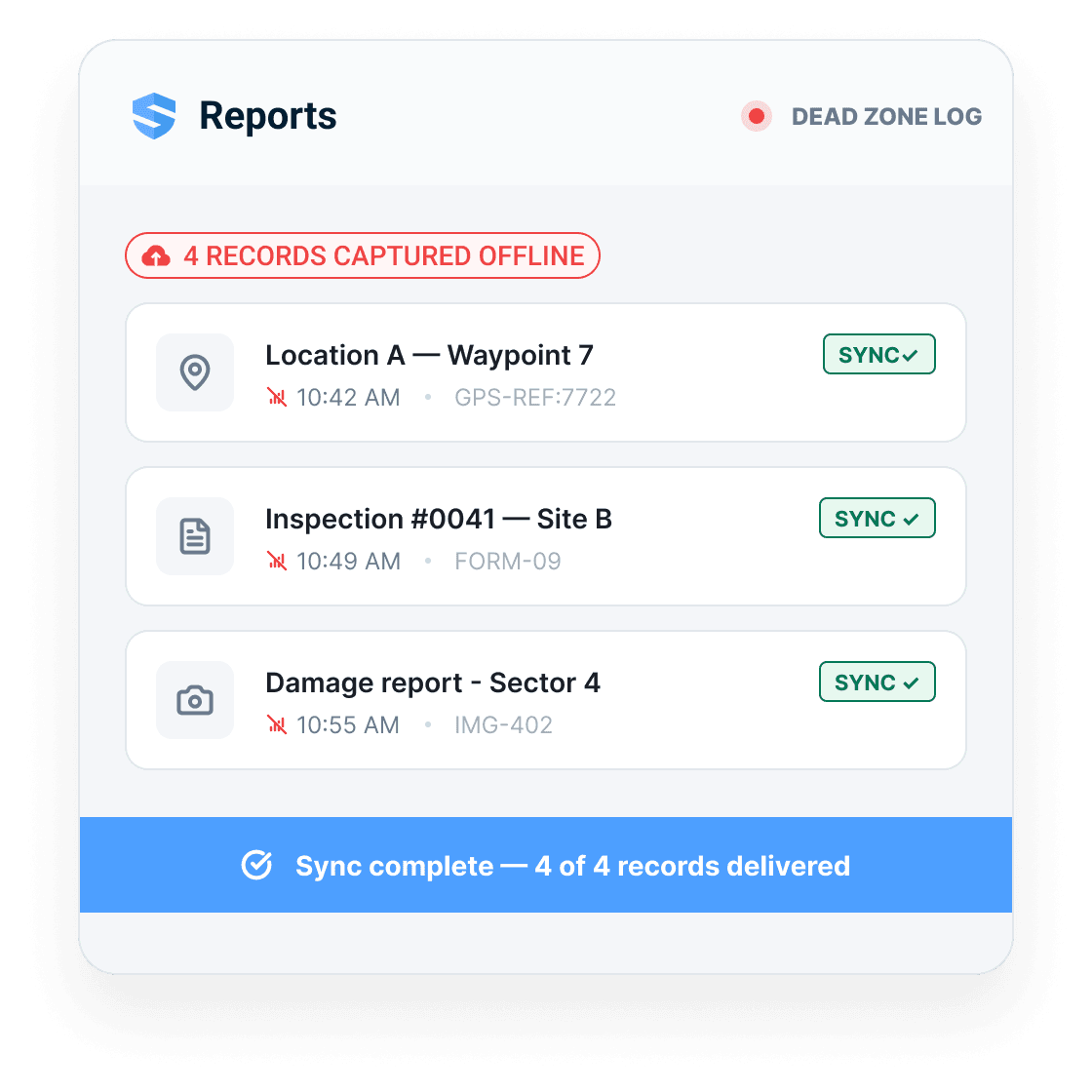
A large share of heavy-equipment inspections happen where phones show nothing — and adoption there is identical to always-connected sites, because the tool doesn't care. Every keystroke saves locally at the cut with a waypoint, and syncs within minutes of bars returning. The dead-zone log proves it: the record from mile marker 47 is as complete as the one from the yard.
The sky changes the rules. The system keeps up.
Rain triggers Subpart P re-inspection obligations at every affected excavation — and SALUS fires the alert, tracks completion, and flags the misses, county by county, automatically. Wind crossing thresholds raises site-condition alerts; stand-downs push to every phone with acknowledgment tracked by name. Rosie watches conditions across the whole map so nobody has to watch the radar and the spreadsheet at once.
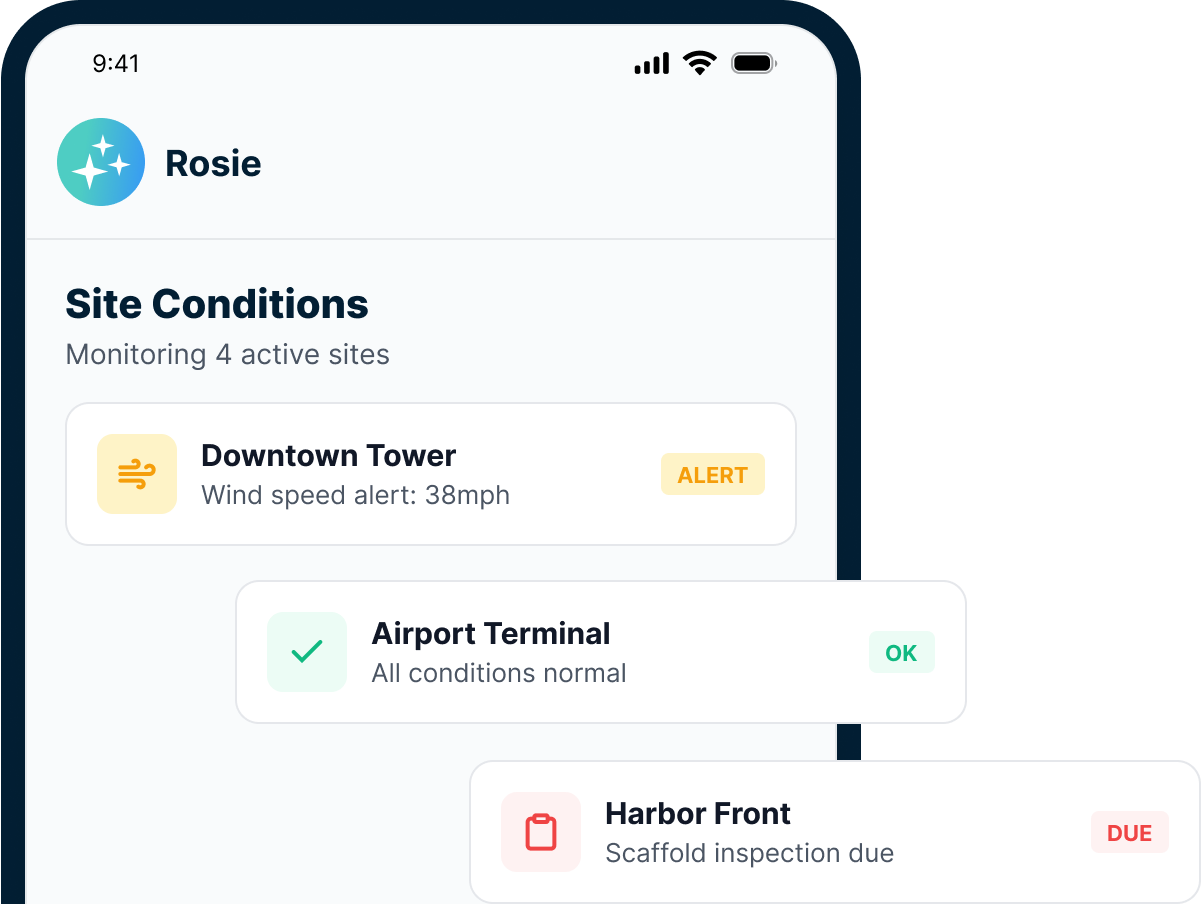
Captured at the cut. Synced at the bars. Re-inspected after the rain.
It starts with one scan before the crew breaks ground.
6:12 AM, a corridor with no signal. A foreman QRs the excavation before the dig. Everything below happens because of it — offline.
The gap between "the locates looked fine" and "it's logged" is where crews get buried.
Your crews have opened the trench a thousand times — and that familiarity is the danger. SALUS puts everything at the point of work, faster than winging it, and it all works with no signal: the same safety your program already specifies, with the friction gone. In a live excavation, that's what prevention actually means.
- 6:40 AM
- Checklist opened at the trench — GPS confirms location
- 6:43 AM
- Soil Type B — conditional logic loads sloping + box requirements
- 6:48 AM
- Photos: protective system, access ladder, spoil pile setback
- 2:10 PM
- Rainfall event — re-inspection alert fired automatically
- 2:45 PM
- Re-inspection complete — tracked, on the record


The excavation permit at the trench — locates, soil class, protective system
Scan the QR at the excavation: the permit loads with the locate confirmation, the soil classification, the protective-system selection, and the daily inspection — in the field, fully offline. The permit opens when the locates are confirmed and the protective system is set, not before. The reading gets logged at the trench, not reconstructed from memory back in range.
- 6:40 AM
- Checklist opened at the trench — GPS confirms location
- 6:43 AM
- Soil Type B — conditional logic loads sloping + box requirements
- 6:48 AM
- Photos: protective system, access ladder, spoil pile setback
- 2:10 PM
- Rainfall event — re-inspection alert fired automatically
- 2:45 PM
- Re-inspection complete — tracked, on the record
Everything works with no signal
This is the one that matters in a corridor: capture doesn't wait for bars. The permit, the inspection, the hazard report, the photo — all of it happens offline at the trench and syncs the moment the truck climbs back into range. The remote site stops being a documentation black hole.
Northgate Tower Block A is the priority. It has one serious open incident, 436 unassigned corrective actions, and 17 fall-protection certificates expiring within 30 days.
- Incident
- 1 serious open case · 13 total
- Actions
- 436 open · none assigned
- Credentials
- 17 fall-protection certificates expiring
The ranking supports the safety leader’s judgment; it does not replace site-specific review.
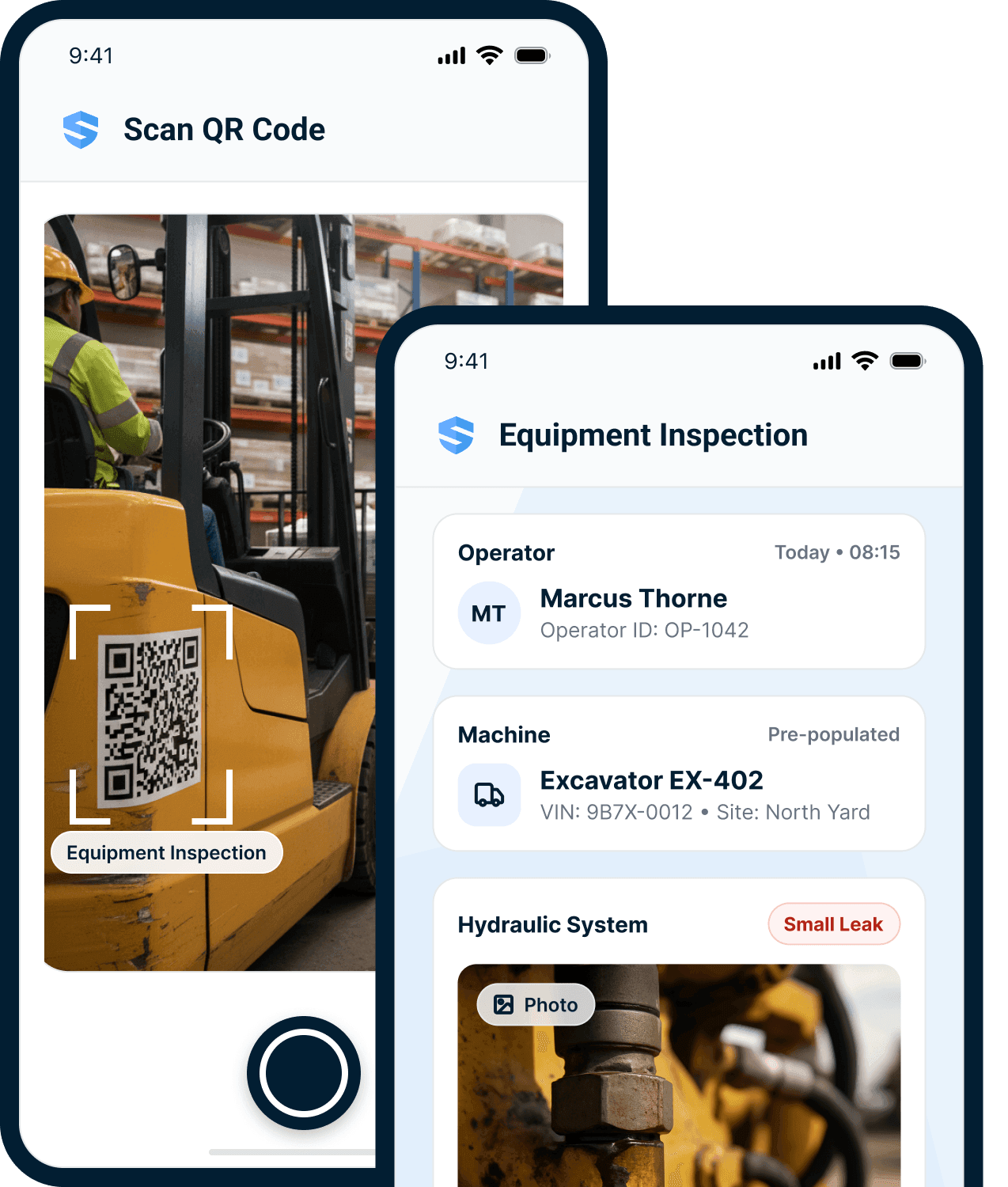
Equipment inspection tied to the operator
QR pre-use inspections on the excavator, the loader, the compactor — tied to operator credentials. A deficiency identified in the field routes to the maintenance team with a photo, and a critical failure flags the assignment before the machine moves dirt.
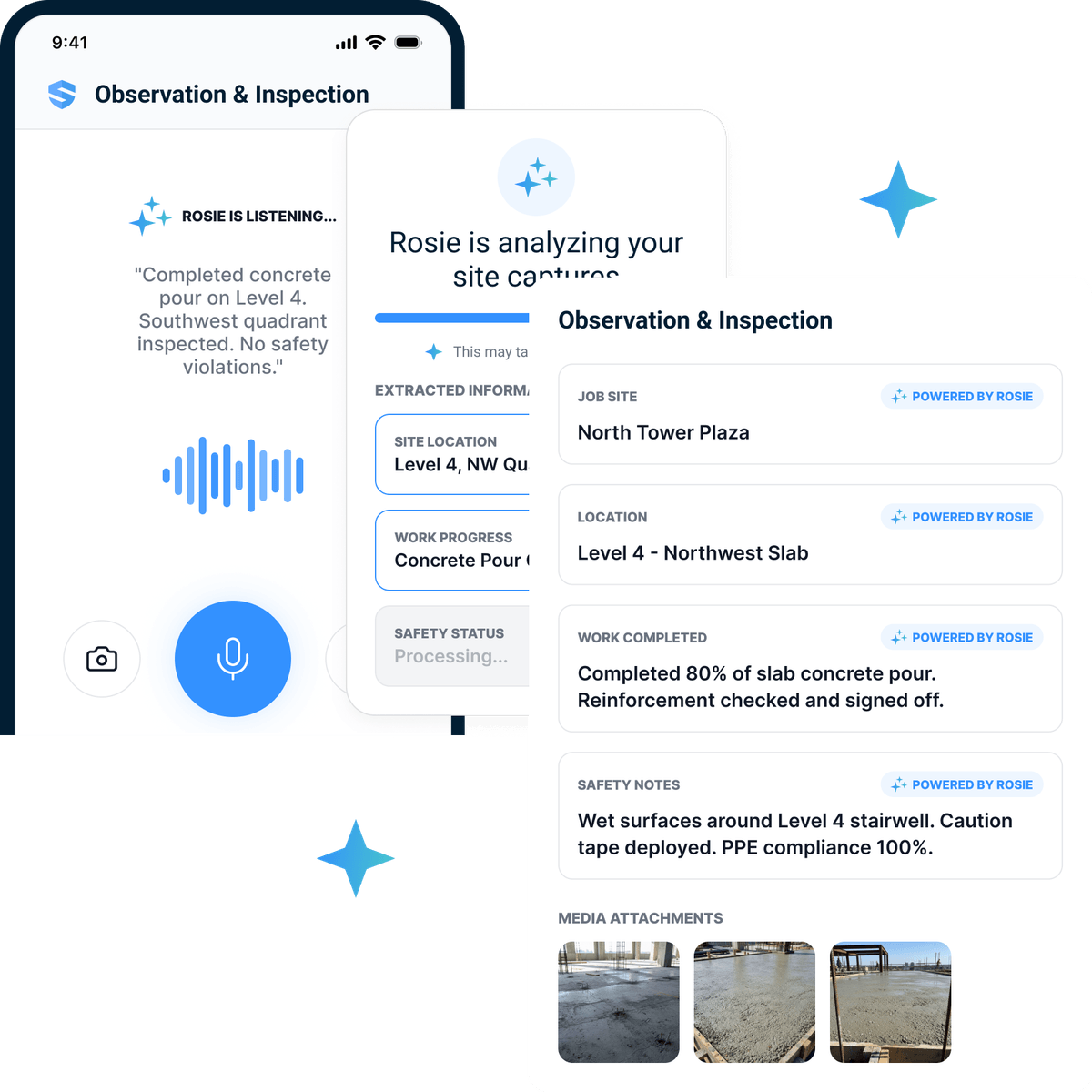
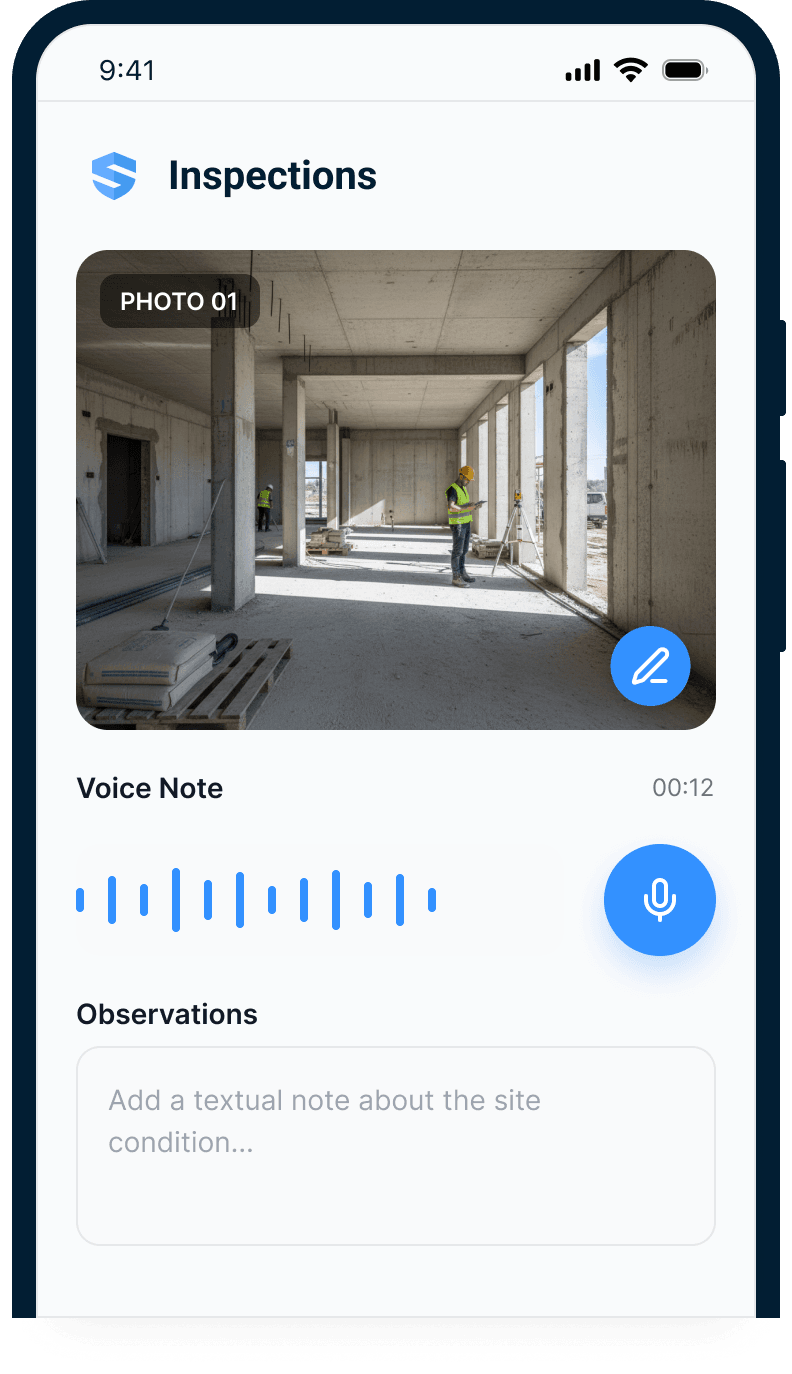
The assessment takes a photo and a sentence — in any language
The foreman talks or films the trench, and Rosie structures the assessment and the permit record — worker, task, and location attached. Many civil crews work in more than one language and handwritten forms come back illegible; voice-to-text gives the office the most accurate field data it has ever had.
Field answers, offline, at the trench
The crew asks Rosie about the soil class, the setback, the traffic-control setup, or the SWP — and the answer comes back offline, in their language, at the point of work. No signal, no waiting, no guessing.
At 40 ft of reach, the rated capacity is 2,500 lb with the load centered and the boom at or below 45°. Confirm the load weight before lifting.
- Rated capacity
- 2,500 lb
- Configuration
- 40 ft reach · centered load · boom ≤ 45°
- At 50 ft
- Capacity drops to 1,200 lb
The operator still verifies the actual load, attachment, and machine configuration before the lift.
The procedure at the trench, not the permit filled back in range — and provable to any auditor in seconds.
The same scan is now your safety director's eyes — across every province.
Every permit, inspection, and locate from every corridor — one living record, watched continuously, even the sites with no signal.
Stop compiling. Start preventing.
A heavy civil safety director's nightmare isn't the hazard the crew sees — it's the gap nobody sees: the excavation permit that never synced from a remote corridor, the equipment cert that lapsed mid-project, the crew whose inspection quality has been sliding for three weeks two provinces away. Because every crew captures at the source and it all syncs when they're back in range, the record is rich enough to watch itself — and Rosie watches it continuously. Leading indicators can predict the large majority of incidents before they happen. This is that data, building itself. 🍁 Across the rest of Canada, that record is the COR audit package and the provincial OHS evidence — with the locate confirmations from the provincial one-call held alongside — assembled on demand, even across two provinces at once. ⚜️ In Québec, it's the CNESST file and the comité de santé et de sécurité record under Bill 59, in French, with the Info-Excavation locate confirmations tracked the same way.
Two provinces, one dashboard
COR compliance across BC and the Yukon — or any two jurisdictions — managed from one platform, each audit's slightly different requirements assembled on demand instead of from two filing systems.
Corrective actions that close at a distance
Assigned to a named person — not 'the safety department' — tracked when viewed, closed with a photo, even when the site is a thousand kilometres away. Average close time drops from 14 days to 3.5.
Updates at network speed
Revise an excavation SWP or a traffic-control plan once and it's live on every site and every QR code the moment each crew next syncs. No driving pages out to the corridor.
Drift flagged this week
Excavation-permit completion dropping from 95% to 62% on one corridor after a crew change shows up on your screen in 30 seconds — not in next quarter's incident review.
- "Which corridors have excavation permits that haven't synced in 48 hours?"
- "Show near-miss trends for utility strikes and cave-ins across all sites this quarter."
- "Write a toolbox talk for a deep excavation with the soil-classification and protective-system steps."
Dozens of machines across 200 sites. One source of truth.
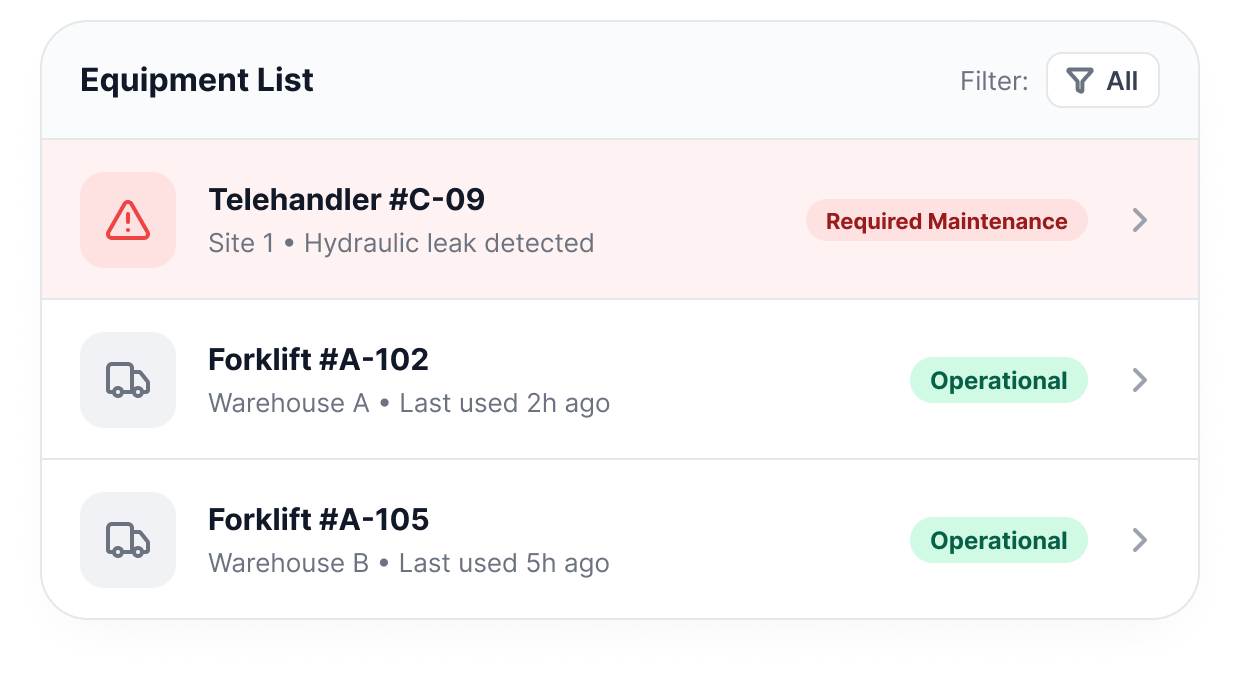
In heavy civil, the fleet is the program: the excavator that ran three days on a documented deficiency, the crane whose operator nobody re-verified, the dozer that went to failure because the work order lived on a clipboard. SALUS makes the machine itself the record — scan it for everything, and everything about it flows to one fleet view the shop and the safety office share.
The 6-minute walk-around
QR on the machine loads the inspection with equipment ID, operator, and GPS — 6.2 minutes instead of 18.8, with 94% fewer errors and a 96% audit pass rate versus 73% on paper.
Deficiency to shop, at the scan
Photos, severity, and parts needed route to maintenance the moment they're captured — and the out-of-service flag is visible to every operator who scans, on every site, instantly.
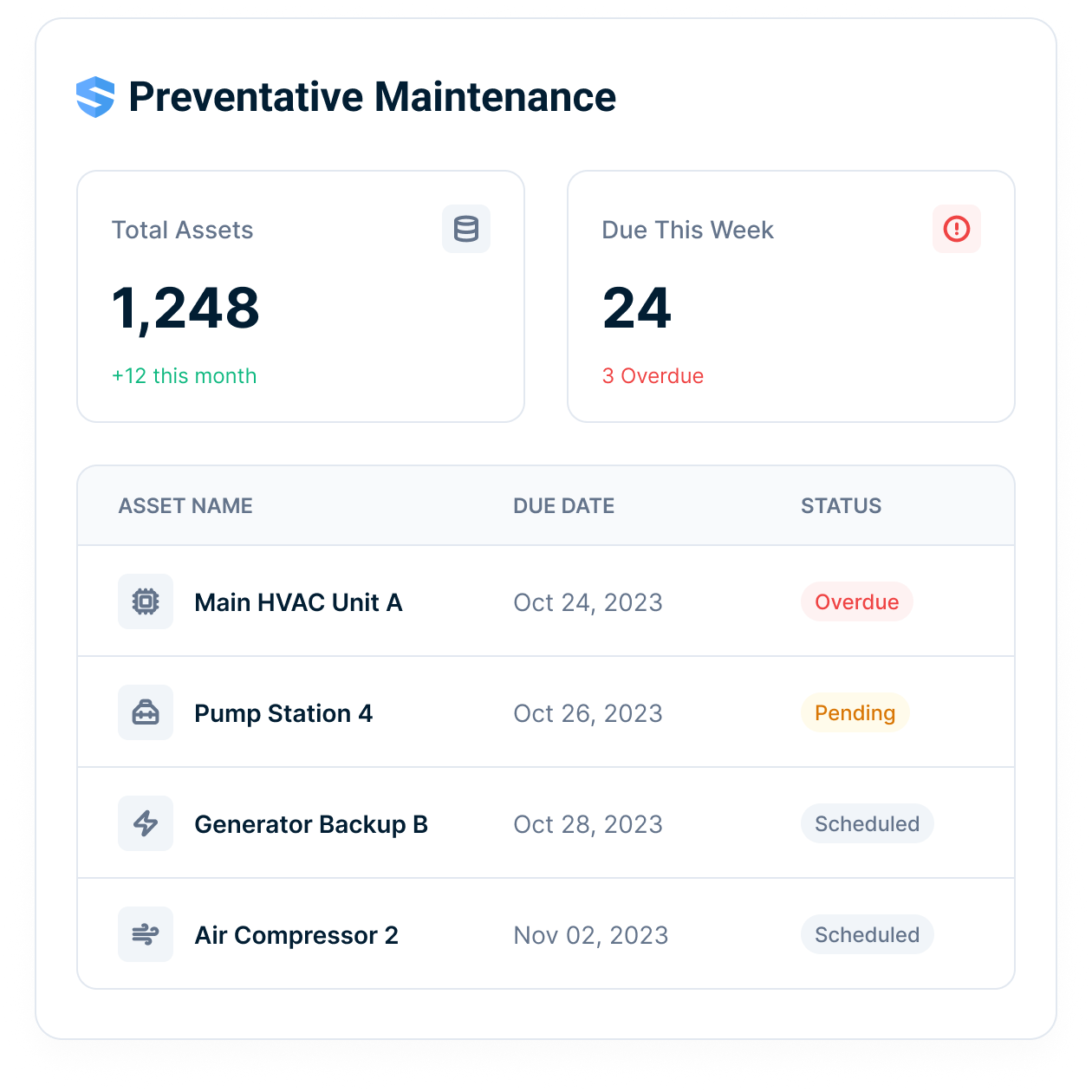
Maintenance before failure
The preventative view across the whole fleet: what's due this week, what's overdue, what's trending toward trouble — so machines get serviced on schedule, not after the blowout.
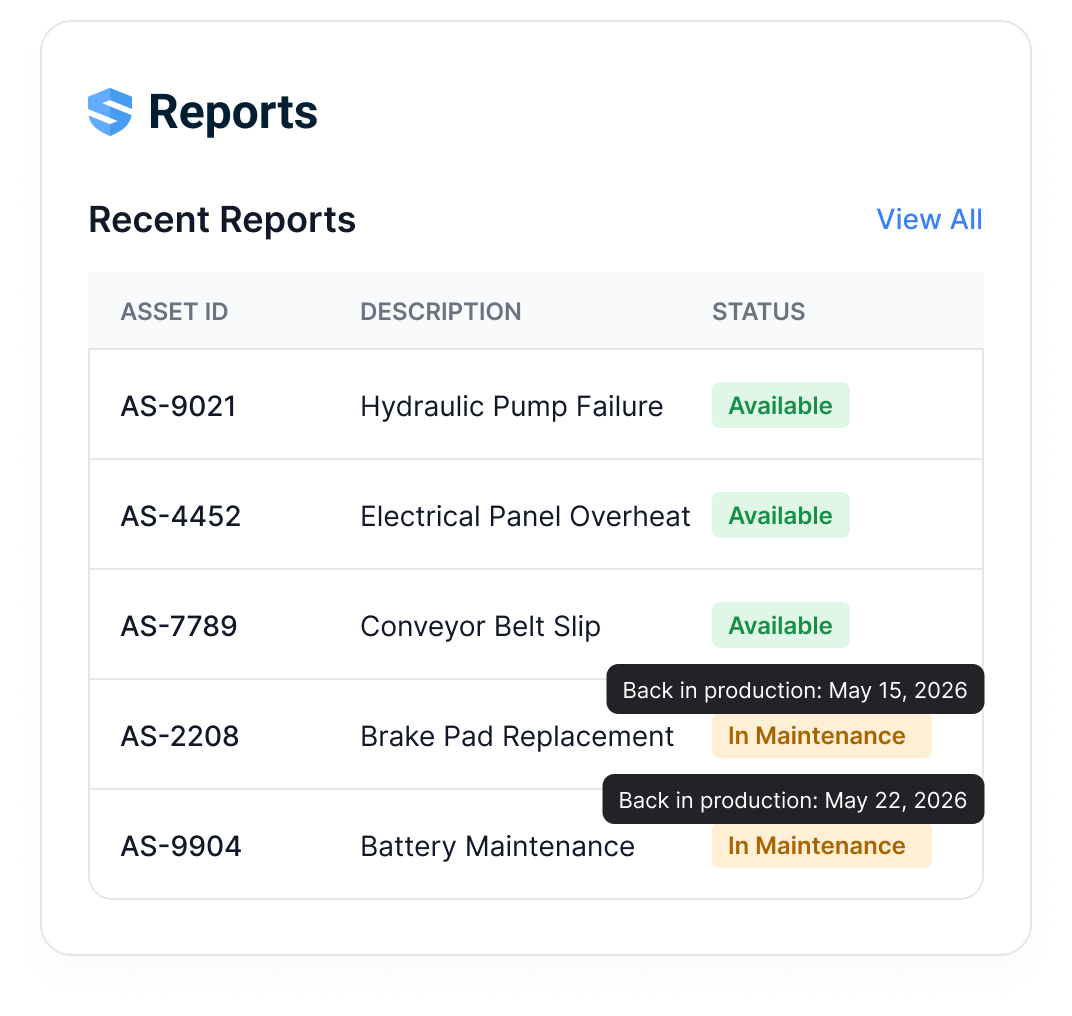
Status the schedule can trust
In maintenance, back-in-production dates, utilization — live by machine. The PM plans around real availability instead of radio calls to the shop.
Scan it for everything. The repair loop starts at the scan. The schedule plans on real status.
By Friday, that scan is winning the next corridor.
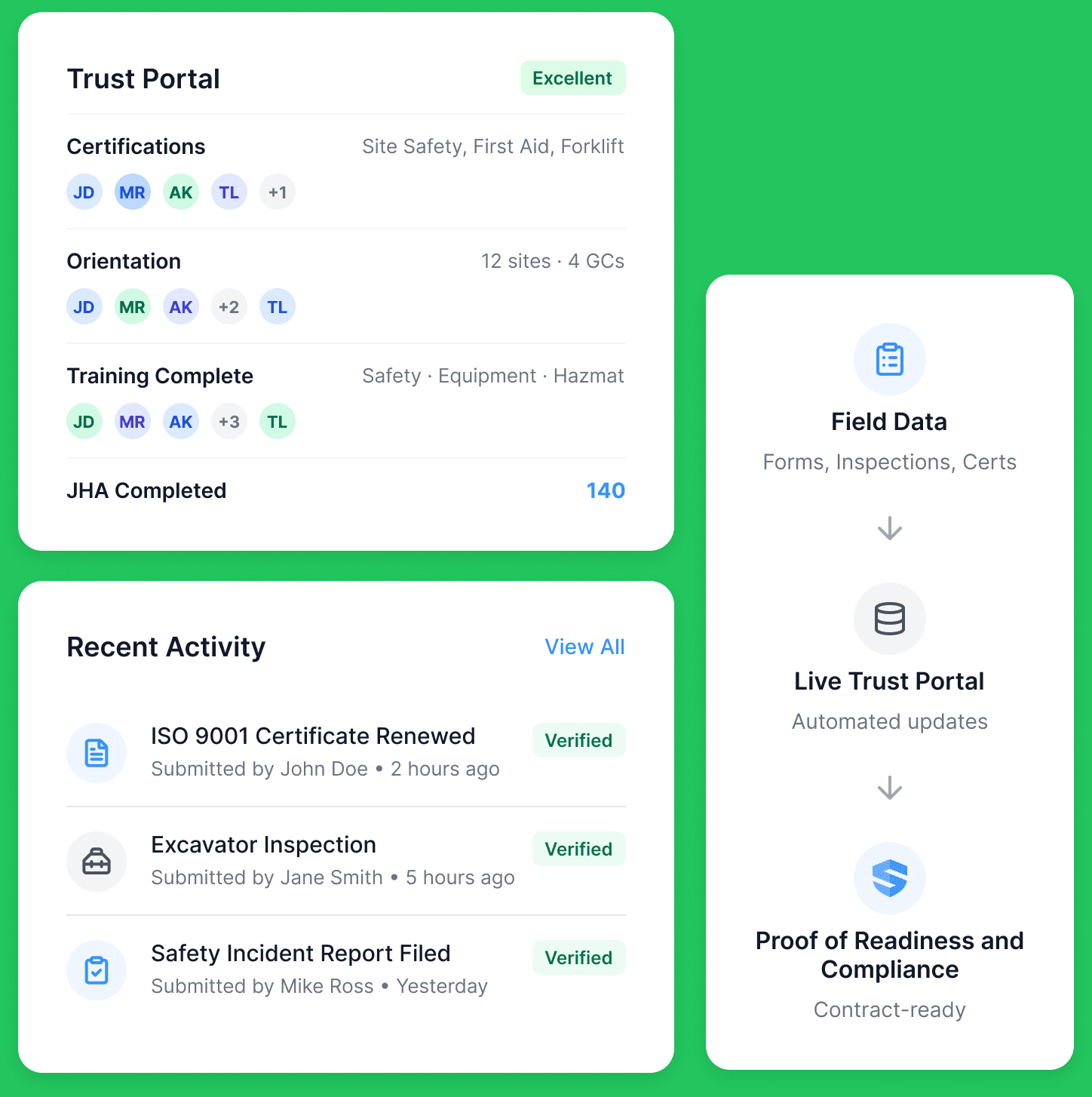
Crew-level facts become the live proof owners and GCs now demand — assembled from sites with no signal.
The work you want goes to the contractor who can prove it — and the owner checks your evidence first.
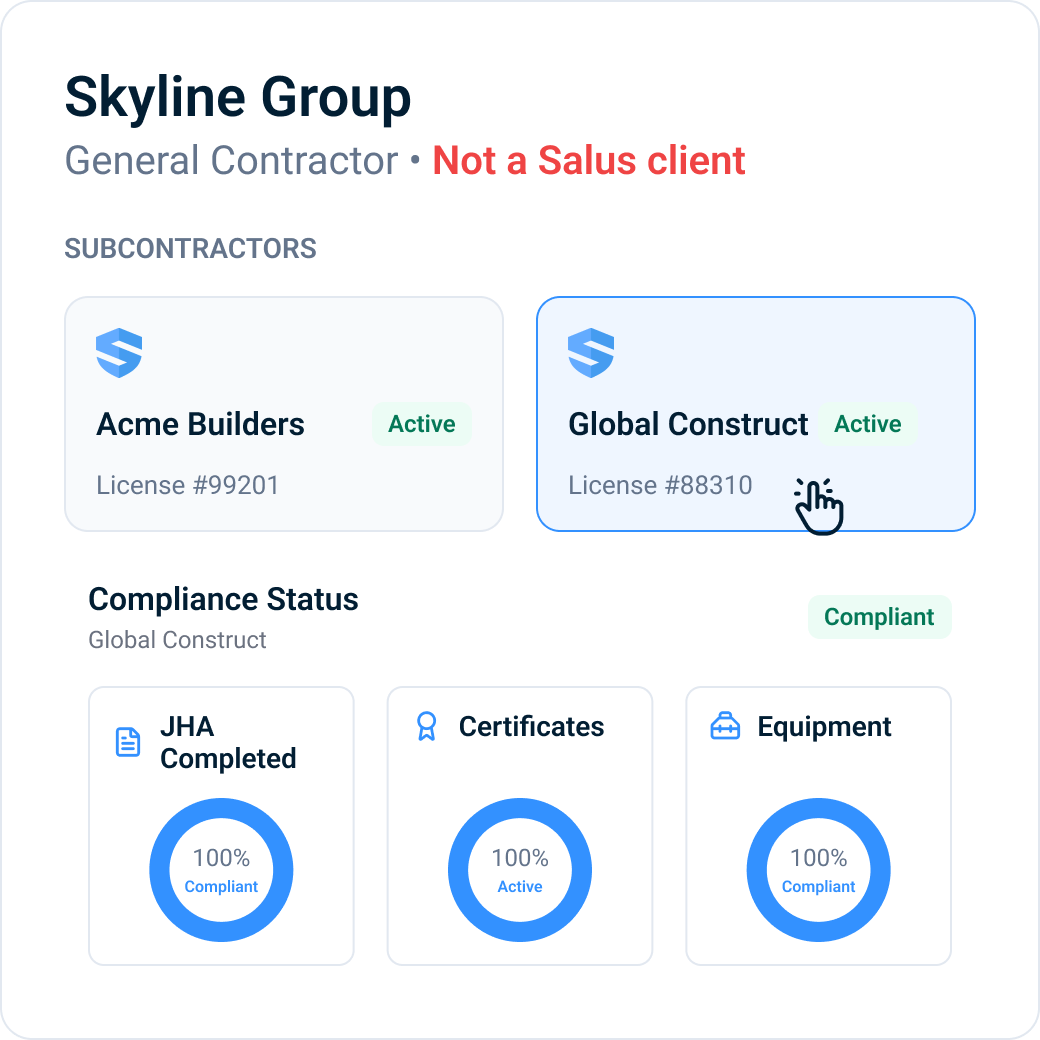
Canadian owners and general contractors increasingly require COR certification and documented safety performance before you can bid — and they don't ask whether you have an excavation program, they ask for the records: COR status, documented systems, daily compliance evidence across every site. Every fact your crews captured at the trench — even offline, even two provinces away — is already that evidence. The Trust Portal shares it as a live link, verifiable by any GC or owner in minutes, no SALUS account required. And there's an insurance dividend: documented control is what earns the rebate and the insurer's incentive.
- Prequal answered with a live link instead of a binder assembled from two provinces' filing systems the night before the deadline.
- Your experience rating protected at the execution level — every claim feeds the WCB or WSIB premium you pay, and a cave-in or utility strike is where the worst claims come from.
- When the records request or the insurer's review comes, Rosie assembles the packet from the same field record — in minutes, across every corridor.
The evidence that wins the bid is already captured at the trench.
One scan before the dig. Proof everywhere it matters — even with no signal.
Capture once, at the source, with no friction and no signal — and let Rosie carry the fact to everyone who needs it, in whatever form they need it.
Built for the whole operation — not one desk in it.
The same captured facts serve everyone. Pick your seat and see exactly what SALUS takes off your plate.
Your safety director
Gets back · two-province visibility and proof
One person, every corridor: permits synced from remote sites, equipment certs renewed ahead, COR ready across provinces, and Rosie drafting the programs, packets, and answers.
Your foremen
Gets back · faster shift-ready work, offline
Task-specific excavation and traffic-control permits, the soil-class answer at the trench with no signal, answers in any language — and a record that proves the dig was safe.
Your executives
Gets back · margin protection and rebate support
Your best superintendent's excavation judgment encoded at every site, the corridor about to go sideways flagged early, and the evidence that protects margin and supports the rebate and your experience rating.
Go deeper on what you just watched.
Offline Mode
Full capture with no signal — permits, inspections, and photos sync when the crew climbs back into range.
Digital Permits
Excavation and ground-disturbance permits with locate confirmation, soil class, and protective-system selection.
QR Codes
The excavation permit at the trench. The inspection on the machine. 10 seconds, version-controlled, never skipped.
Equipment
Pre-use inspections on the excavator and the fleet — tied to the operator, deficiencies routed with a photo.
Corrective Actions
Named individuals, photo closure, automatic escalation — closed at a distance. Average close: 14 days → 3.5.
Trust Portal
Live compliance proof for the GC and the owner — the prequal binder, retired, across every province.
Heavy civil, earthworks, and remote-site contractors who made safety effective.

Wildstone Construction
Remote sites across BC, the Yukon, and the Northwest Territories — crews stopped standing at printers, the full-time paper-sorting role went away, and two annual COR audits are now managed from one platform.

Earthworks · multilingual voice-to-text
A multilingual workforce that couldn't write legible incident reports voiced their way to the most accurate field data the company has ever had.
Remote BC, Yukon & NWT
Where connectivity is a luxury, crews kept capturing — you can't wait 48 hours for a fix when the work is in the Yukon.
Trusted by contractors managing 400K users across 150K sites
Asked by heavy civil and earthworks contractors, answered straight.
We work in corridors with no signal. Does SALUS actually work offline?
How does SALUS handle COR across two provinces, locates, and Québec's CNESST regime?
What's the difference between 'compliant' and 'effective'?
How does excavation-permit gating work without stopping the crew?
How does SALUS handle multilingual crews and illegible field reports?
How painful is it to move off paper or our current system?
I'm an exec. Why should I care about safety software?
Remote corridors, live excavations, no signal. SALUS makes the documentation hold.
Bring your excavation permit process, your equipment inspection forms, and your last prequal package — and watch one QR scan replace all three in a 15-minute demo, offline included.
Trusted by Wildstone Construction and heavy civil contractors across Canada — from BC to the Yukon.