



Electric Plus
Garage → 900
9.5/10 first-week rating
Chose SALUS over HammerTech. Scaled without degrading because the knowledge was in the system.
Your CSA Z462 program is solid. The question is execution at the panel: the LOTO procedure 200 metres away in a trailer binder, PPE self-selected from memory, qualified-worker status on a spreadsheet. SALUS is the operational safety platform built for that gap. Crews capture at the source with one QR scan, in their language, offline in the electrical room — and Rosie turns every captured fact into the answers, programs, and live proof the whole company runs on, from the foreman to the bid room.
Trusted by O'Connor Electric, Mazzei Electric, Stampede Electric, McBride Construction, and Electric Plus.
The circuit · one QR scan
The panel
The office
The bid room
One fact, traveling
Compliant and effective are different things. The forms existing is compliance. The forms changing what happens at the panel — that's effectiveness, and it's where electrical safety programs actually break.
Arc-flash victims often had a fully compliant program. A 40-question generic JHA doesn't produce the same protection as 12 task-specific questions that force a real conversation — contractors using robust pre-task engagement report far fewer recordable injuries.
Pre-task plans, energized-work permits, LOTO retrieval, cert verification, daily reports. At $65–$90/hr fully loaded, that's $230–$315 per foreman, per day, on documentation that would be both more protective and faster if it were task-specific and digital.
Your incident log tells you who got hurt last year. It doesn't tell you that one project's form completion dropped from 95% to 62% since the foreman swap. Leading indicators predict incidents — but only if you can see them.
The fix isn't more program. It's the program, executed — at the panel.
SALUS is the perfect marriage of both usability and capability. It has really great features for us as admin, but it's simple for my crews to use out in the field, too.
6:12 AM. An electrician QRs Panel L2-4. Everything below happens because of it.
Your crews have done LOTO a thousand times — and that familiarity is the danger. SALUS puts everything at the point of work, faster than winging it: the same safety your program already specifies, with the friction gone. On live systems, that's what prevention actually means.
Request energized work by QR from the switchgear. Equipment data auto-populates voltage, incident energy, and boundary — and the system matches the exact PPE: glove class, face shield, arc-rated clothing. No more self-selecting from memory, which is how a large share of burned workers got burned. Approved from the GC's phone in minutes.
Scan the QR at the panel: the current, version-controlled procedure with isolation points — in 10 seconds, on the phone, offline if the room demands it. The 200-metre trailer round trip that crews skipped under schedule pressure stops existing. The procedure is at the moment of the decision.
Tap the worker's name: qualification matched to this specific task and voltage class — not 'trained' on a spreadsheet that doesn't say for what. And SALUS keeps it from ever getting close: expirations surface weeks ahead, ranked by who's mobilizing where, with the refresher pushed to the worker's phone before anything lapses.
Six feet is the maximum unprotected working height on Westfield. Fall protection is required at 6 ft or above.
The project-specific rule and approved procedure govern the task; Rosie surfaces the record for field verification.
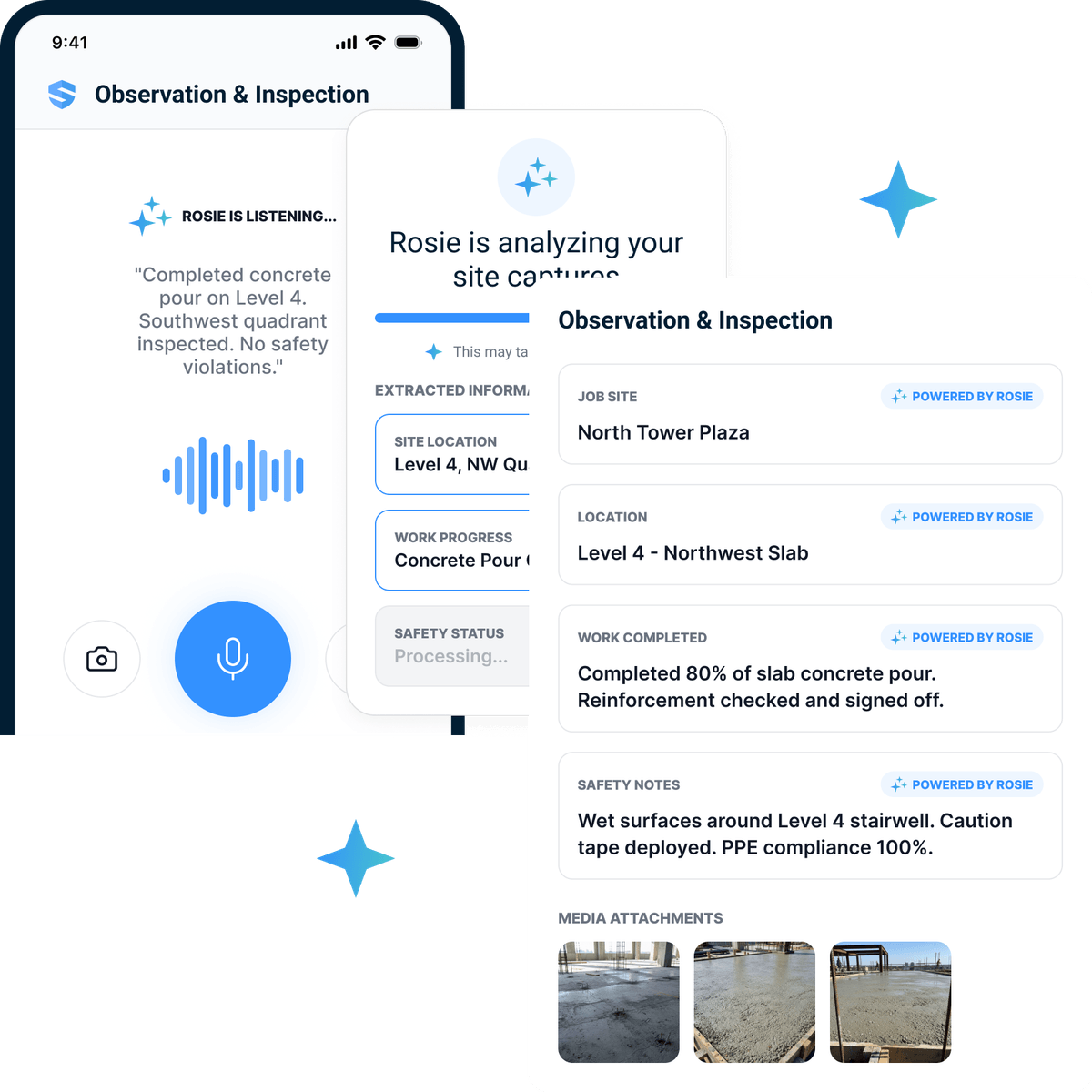
Photo, tag, describe — or just say it, and Rosie writes the record with worker, task, and location context attached. It routes to a named person automatically and closes with a photo. When reporting costs 90 seconds instead of a form and a walk, near-miss reporting goes up 625–745% — and the 70–90% that used to go unreported become your leading indicators.
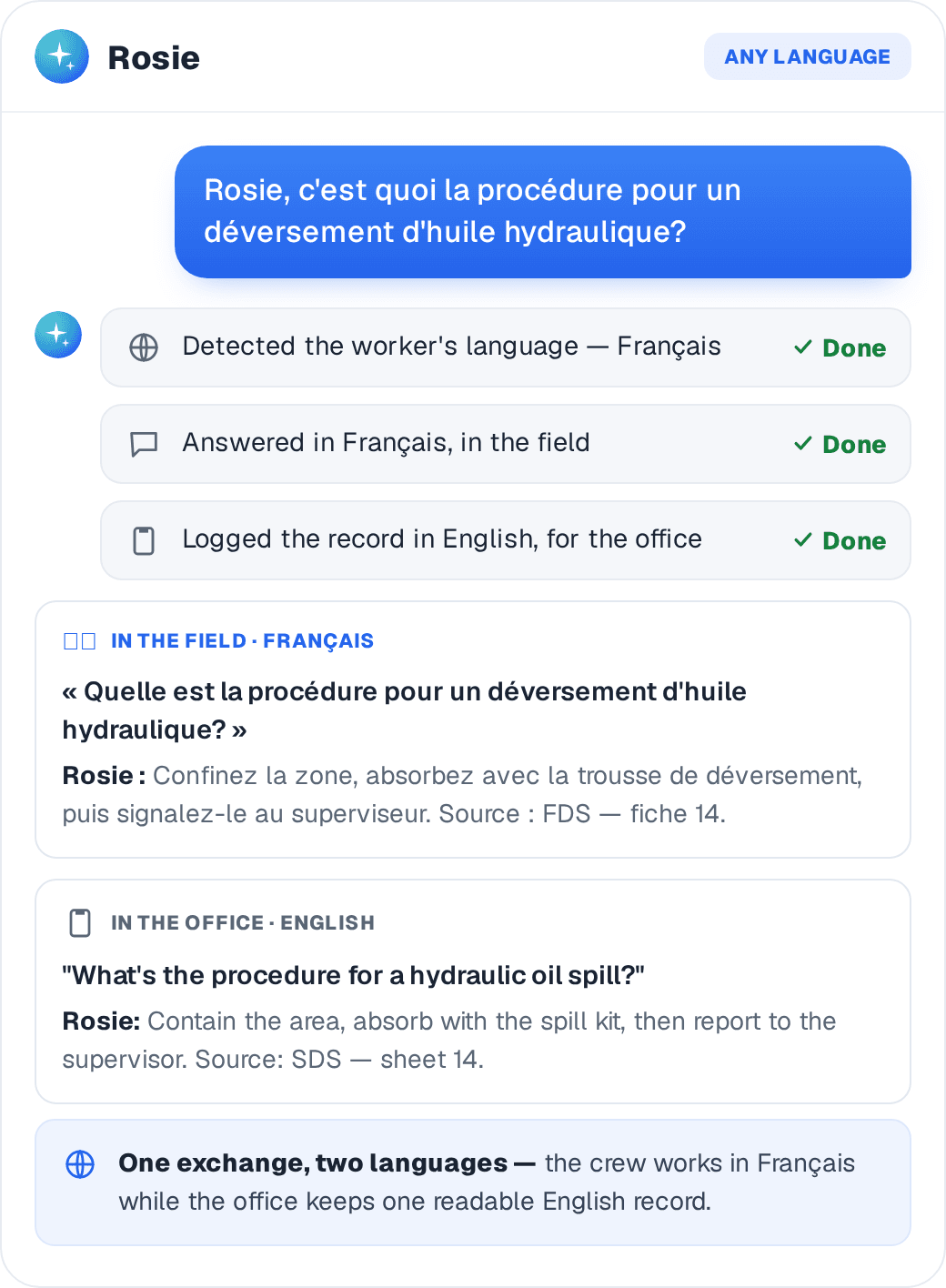
Many Canadian crews work in more than one language, and a comprehension gap is a safety gap. Workers complete forms and ask Rosie questions in their own language; the office reads everything in English, including the hazard text a worker actually types.
✓ 12 questions that matter · not 40 that don't
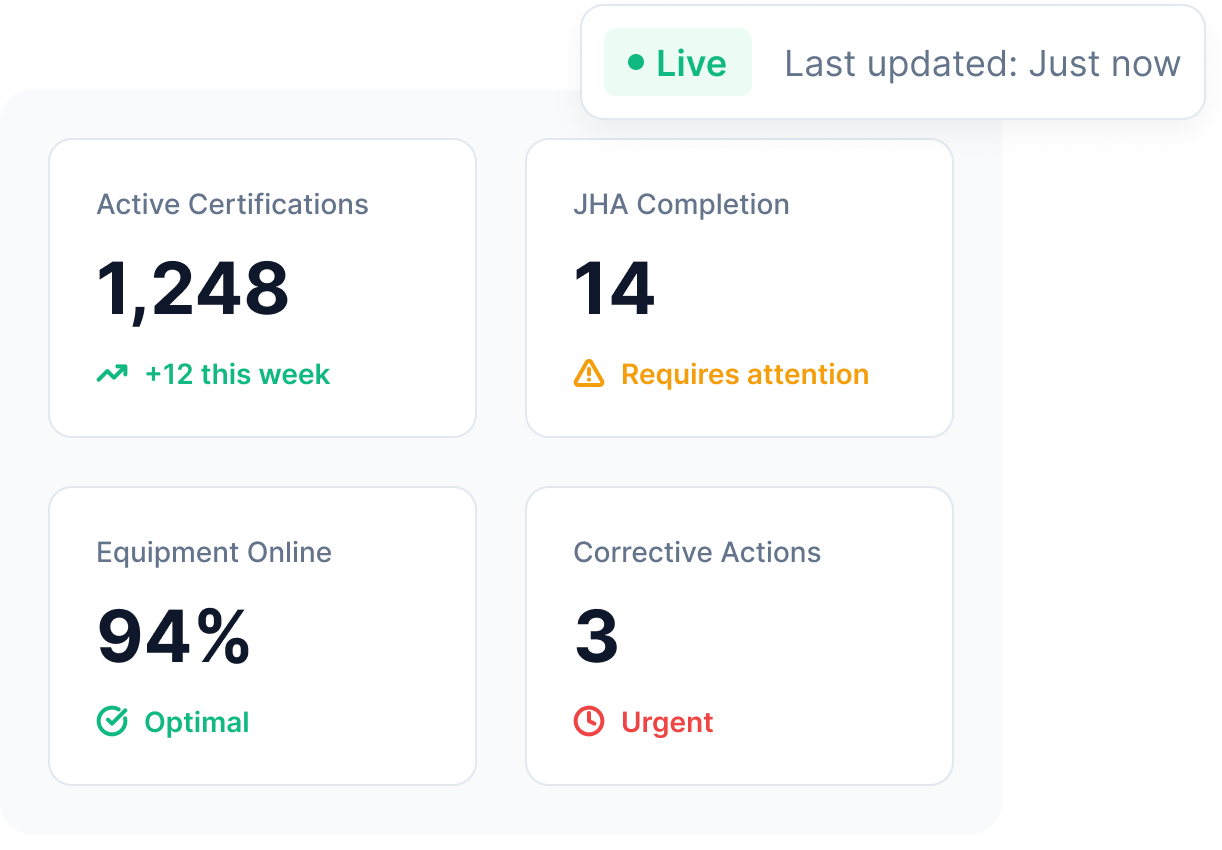
Every permit, cert, and capture from every crew — one living record, watched continuously.
An electrical safety director's nightmare isn't the hazard the crew sees — it's the gap nobody sees: the qualification that doesn't match the task, the SWP written for the last code cycle, the project whose form quality has been sliding for three weeks. Because every crew captures at the source, the record is rich enough to watch itself — and Rosie watches it continuously. Leading indicators can predict the large majority of incidents before they happen. This is that data, building itself. 🍁 Across the rest of Canada, that record is the COR audit package and the provincial OHS evidence, assembled on demand. ⚜️ In Québec, it's the CNESST file and the comité de santé et de sécurité record under Bill 59, kept in French.
Qualified-person status verified against the specific task at every permit — and expirations surfaced weeks ahead with the refresher pushed to the worker's phone, so the gap never forms.
Assigned to a named person — not 'the safety department' — tracked when viewed, closed with a photo. Average close time drops from 14 days to 3.5.
Revise a LOTO procedure or SWP once and it's live on every site and every QR code immediately. No driving, no page-swapping, no stale Rev 5 in a binder.
Form completion dropping from 95% to 62% after a foreman swap shows up on your screen in 30 seconds — not in next quarter's incident review.
Four active sites have no submissions. SeaTac and Surrey are the highest priority because each has 71 workers on site without a hazard assessment on record.
Site leaders confirm work status and complete the missing assessments before affected tasks continue.
Five gaps need attention: ground-level exclusion-zone enforcement, struck-by PPE, an all-clear protocol, a current review date, and pre-task verification.
The safety lead validates every recommended change before the approved procedure is replaced.
Crew-level facts become the live proof Canadian owners and GCs now demand.
Canadian owners and general contractors increasingly require COR certification and documented safety performance before you can bid — and they don't ask whether you have a safety program, they ask for the records: COR status, documented systems, daily compliance evidence. Every fact your crews captured at the panel is already that evidence. The Trust Portal shares it as a live link — CSA Z462 training currency, form completion, corrective-action velocity — verifiable by any GC or owner in minutes, no SALUS account required. And your best electrician's arc-flash judgment? Encoded into every form on every project, so the newest apprentice works from the veteran's playbook on day one.
The due-diligence record is assembled. Daily hazard assessments cover 96% of active site-days, incident response averages 2.3 hours, and 23 fall-protection certificates need attention.
The risk team reviews the source-linked packet before it is shared with the broker or insurer.
The evidence that wins the bid is already captured at the panel.
One scan at the switchgear. Proof everywhere it matters.
Capture once, at the source, with no friction — and let Rosie carry the fact to everyone who needs it, in whatever form they need it.
The same captured facts serve everyone. Pick your seat and see exactly what SALUS takes off your plate.
Gets back · circuit visibility and proof
One person, every energized circuit: certs renewed ahead, permits cross-checked, SWPs current, and Rosie drafting the programs, packets, and answers.
Gets back · faster panel-ready work
12-question pre-task plans, the LOTO procedure 10 seconds from the panel, answers in any language — and a record that proves the crew was ready.
Gets back · margin protection and experience-rating support
Your best foreman's arc-flash knowledge encoded at every site, the project about to go sideways flagged early, and the evidence that protects margin and supports your WCB/WSIB experience rating.
Conditional logic with CSA Z462 hazard libraries — 12 questions that matter, not 40 that don't.
Energized work with qualified-worker verification, PPE matched to incident energy, and zone conflict checks.
LOTO at the switchgear. SWPs at the panel. 10 seconds, version-controlled, never skipped.
Qualified-person status matched to the task and voltage class — with renewals weeks before expiry.
Named individuals, photo closure, automatic escalation. Average close: 14 days → 3.5.
Live compliance proof for the GC and the owner — the prequal binder, retired.

Two disconnected platforms into one. Risk patterns that were invisible when data lived in eCompliance and SiteDocs — now visible on one screen.
Pre-task huddles went from signing to conversation — the form only shows what matters today.
Any worker can show compliance on the spot. The system carries the knowledge.
Their auditor recommends SALUS to other contractors based on documentation quality.
Chose SALUS over HammerTech. Scaled without degrading because the knowledge was in the system.
Trusted by contractors managing 400K users across 150K sites
Bring your energized-work permit process, your cert spreadsheet, and your last prequal package — and watch one QR scan replace all three in a 15-minute demo.
Trusted by O'Connor · Mazzei · Stampede · McBride · Electric Plus