

Toolbox meeting software for Canadian OHS programmes.
Canadian construction teams need toolbox meetings that connect provincial OHS instruction with the hazards recorded in the day’s FLHA. SALUS brings the briefing, worker participation, and follow-up into the same safety record. Rosie helps draft the discussion from your site information and company procedures, then the supervisor reviews the content with the crew. QR attendance records who participated, while a concern raised during the meeting can become assigned work. Safety coordinators can review coverage across Canadian projects and keep the resulting evidence organised for the company programme, a joint committee review, or COR audit preparation.
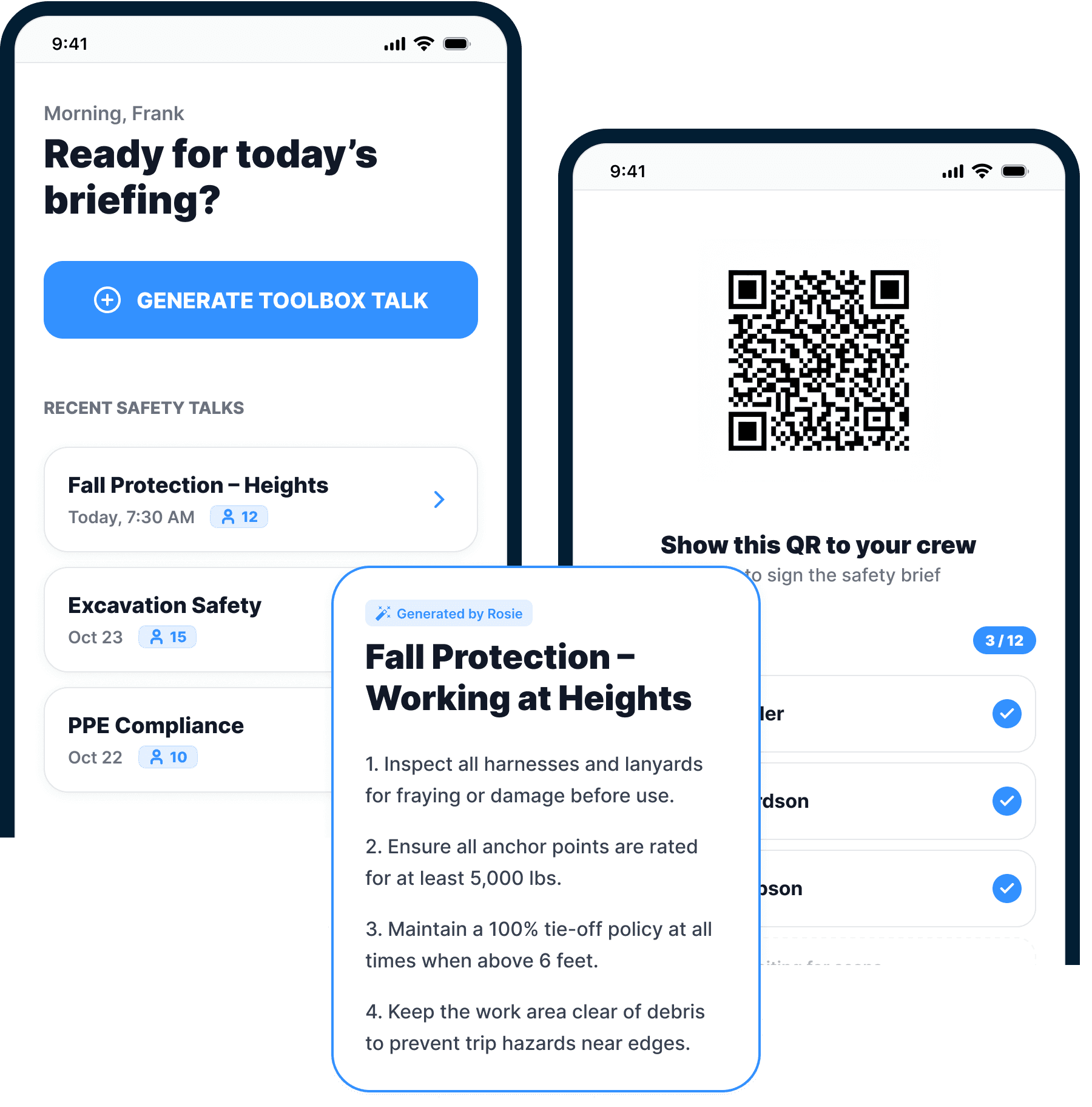
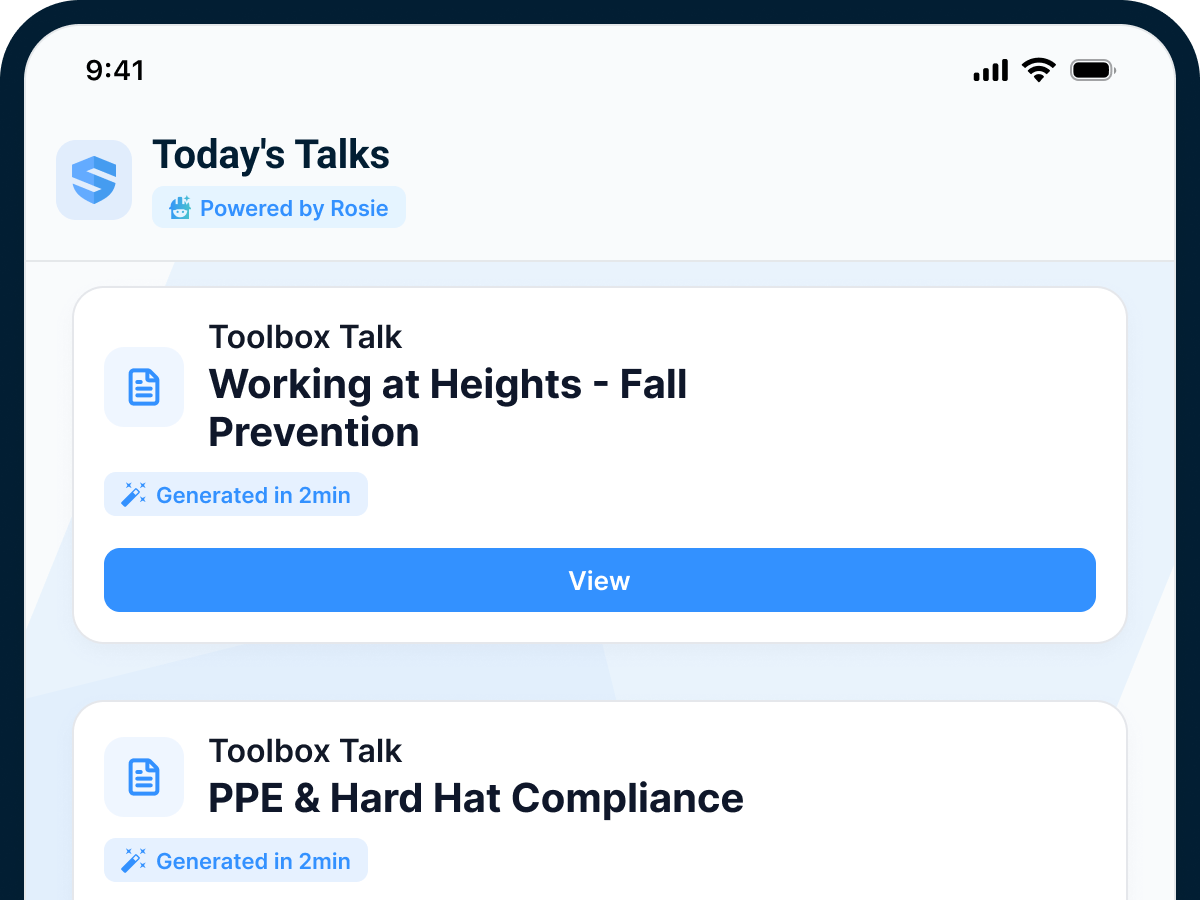
- 1,200+ hrs · What daily talks cost a 20-person crew each yearCrew time-on-task arithmetic: 20 workers × ~15 minutes × ~240 working days ≈ 1,200 hours a year. QR sign-in removes the clipboard lap and Rosie removes the prep — the talk still happens, the overhead doesn't.
- ~2 min · From request to signable talkStructured, signable, built from your own program — not a generic library.
Generated by Rosie. Signed by QR scan. Verified against the site list. Connected to the corrective actions that follow.
It may seem like a significant investment initially, but we saved the whole platform’s cost in printing alone – not to mention that everything is so much easier and more organized.


Stop recycling toolbox talks the crew has tuned out.
Start the meeting with the hazards in today’s FLHA.
A useful briefing reflects the work the crew is about to do. Bring the current assessment, weather changes, recent findings, and outstanding concerns into Rosie’s draft. The supervisor reviews the material against the site’s procedures before gathering the workers for a practical discussion of controls.
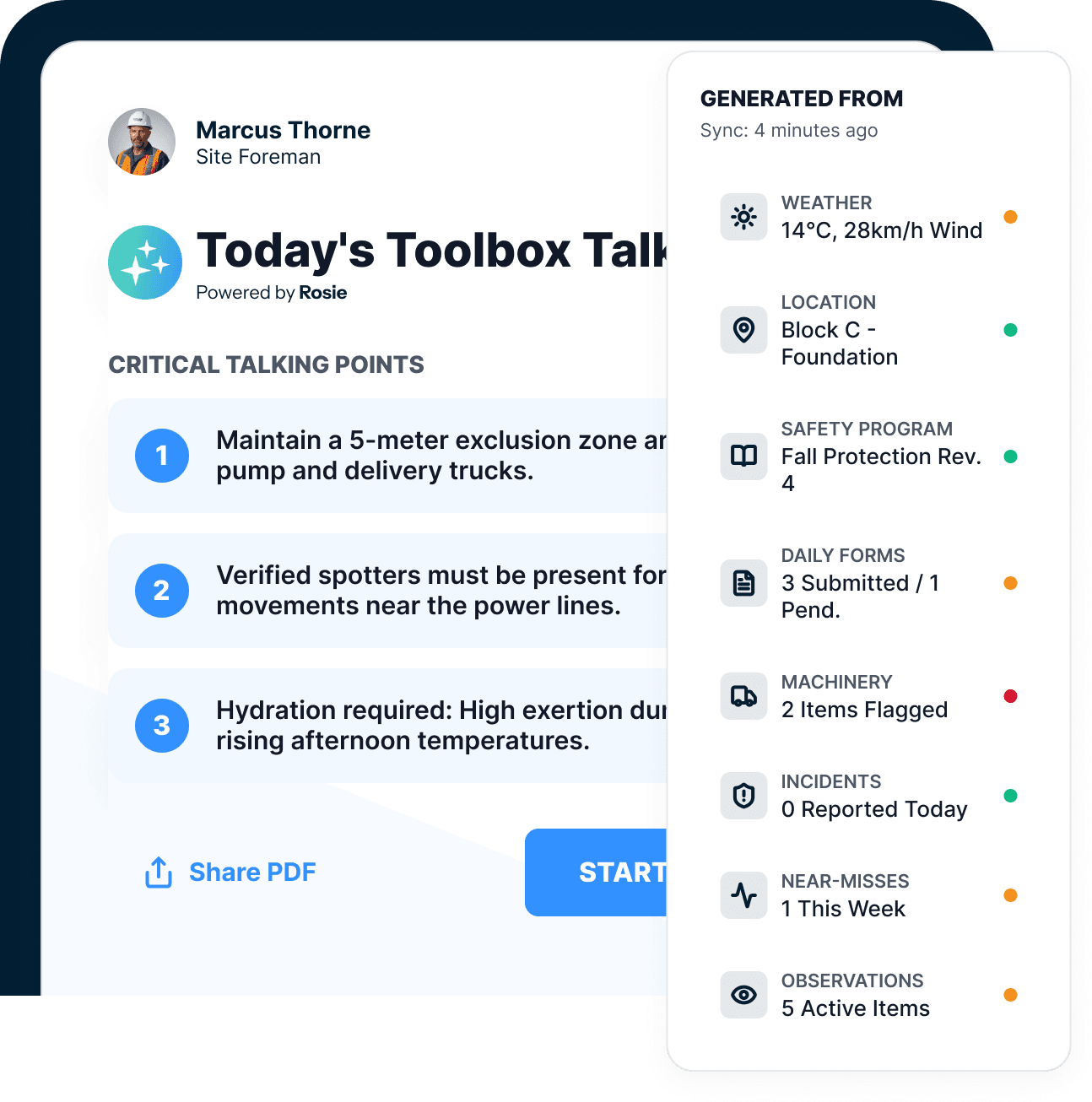
Read
Yesterday's findings, open actions, weather, incidents, near-miss trends.
Write
Critical talking points for this crew, this block, this morning.
Deliver
The foreman opens the phone and runs the talk.
The topic comes from the job, not a stale binder.
Use the company’s instructions as the starting material.
Foremen should be able to find the relevant procedure without searching several binders. Ask Rosie to prepare a discussion from the company’s documents, then check the draft for the work and province involved. The approved briefing remains tied to the programme your crews are expected to follow.
Six thousand documents read. Zero documents browsed.
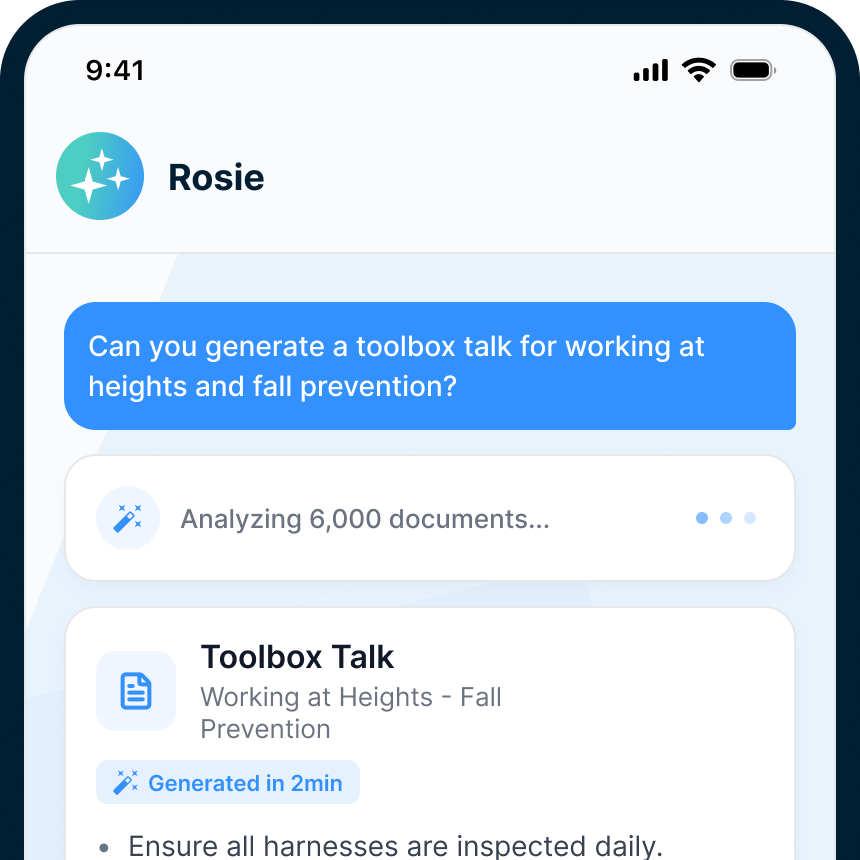
One request
Ask in plain language — no menus, no template hunting.
Whole library
Rosie reads the documents nobody has time to.
Your standards
Every point traces back to your own program.
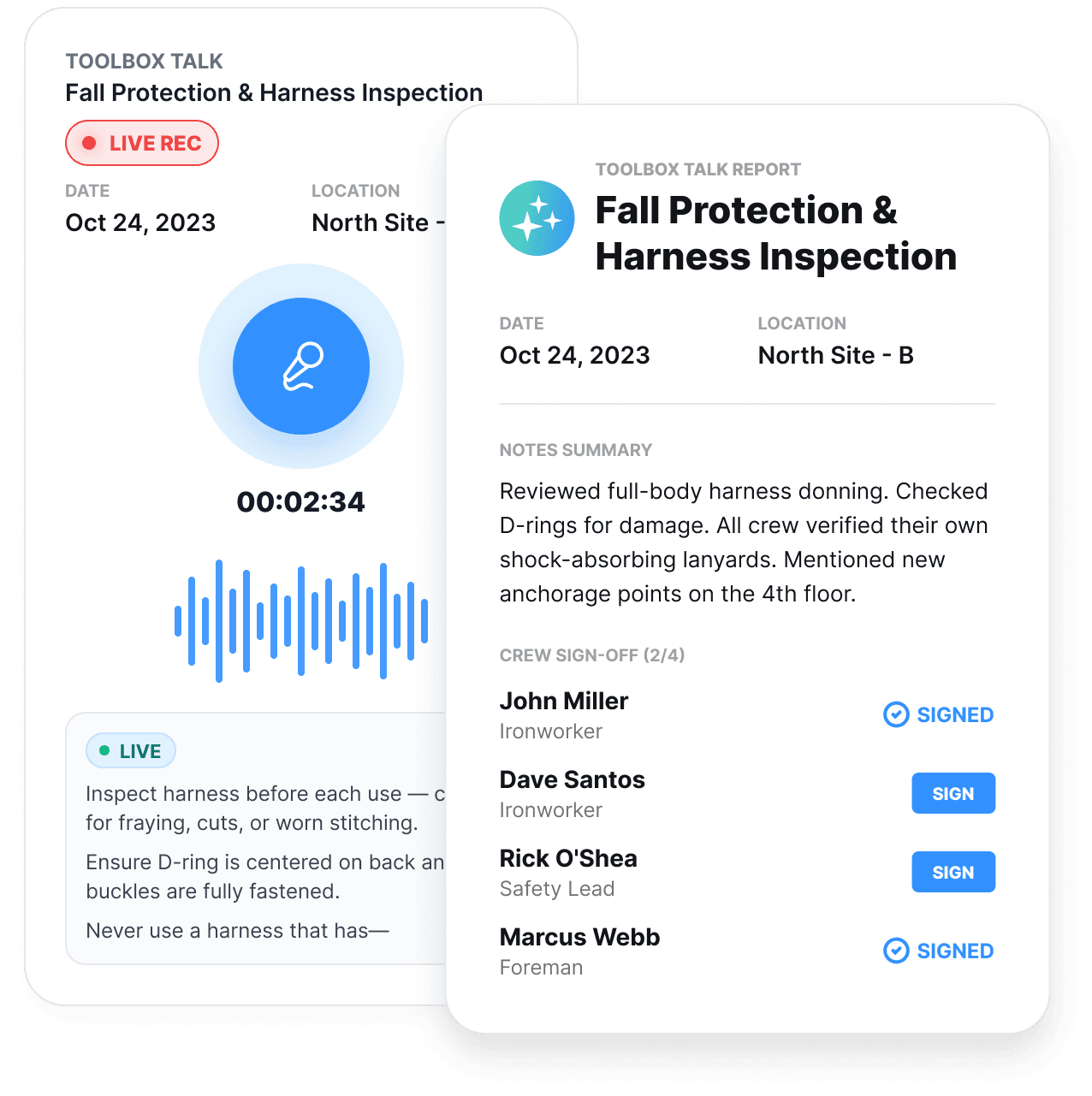
Preserve the discussion that happened in the field.
Some of the most useful safety instruction happens beside the equipment. Capture the walkthrough and review the resulting meeting notes so the record reflects what the supervisor actually explained. Include the participants and any questions that need another conversation before the crew starts the task.
The foreman never types. The record never slips.
A five-minute talk becomes a permanent record.
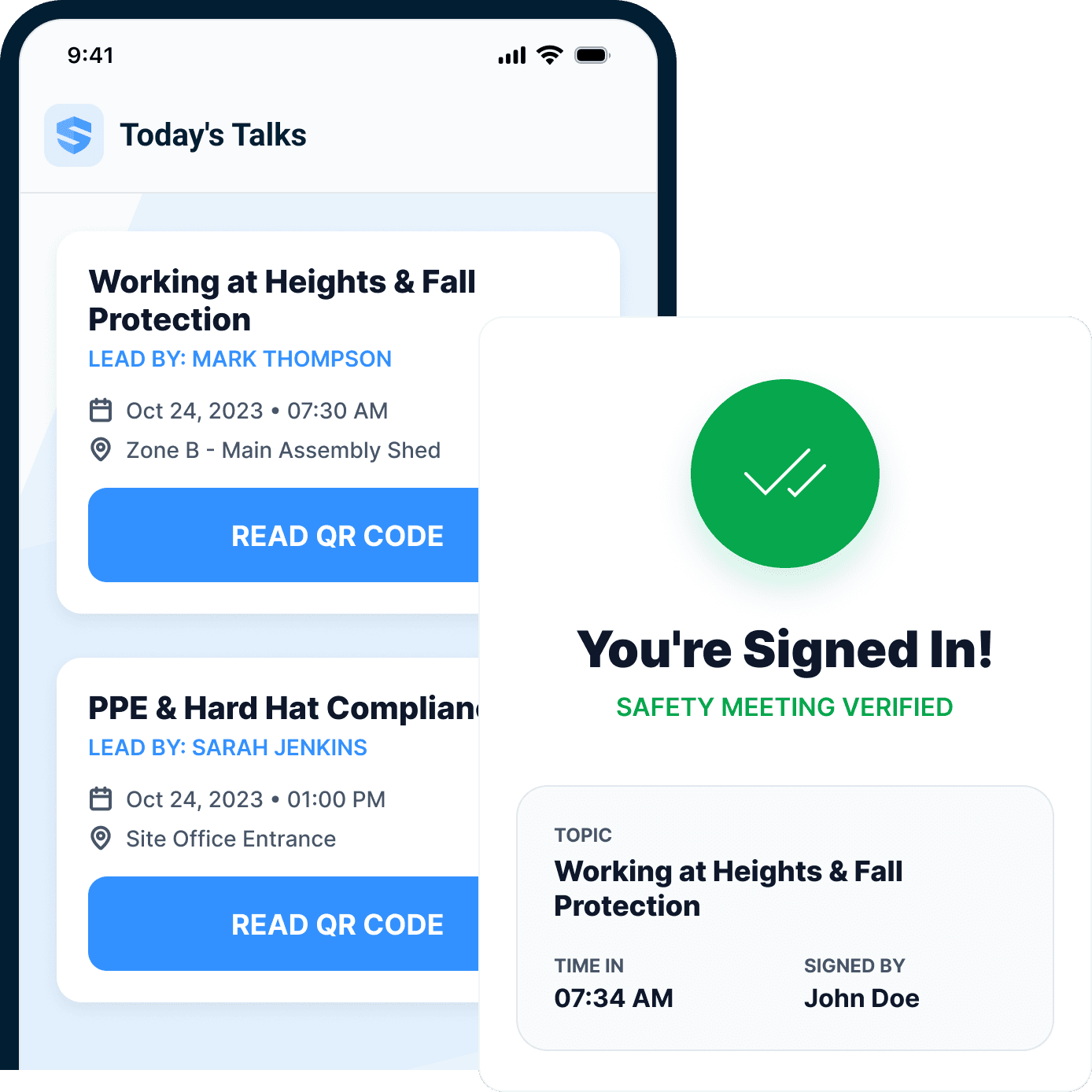
Keep attendance connected to the Canadian project.
Workers scan the meeting’s QR code and the sign-in stays with the topic, time, and site record. The safety coordinator can check participation without transcribing a paper sheet. Attendance identifies who took part; the supervisor still needs to confirm that the crew understood the instructions.
Scan. Signed. Working.
- Topic. Time. Name. Verified.
Give each raised concern a visible next step.
A worker’s question about access or a missing guard deserves a response after the meeting ends. Turn the concern into an action with a responsible person and the relevant context attached. The crew can see that reporting a problem leads to follow-up within the site’s OHS programme.
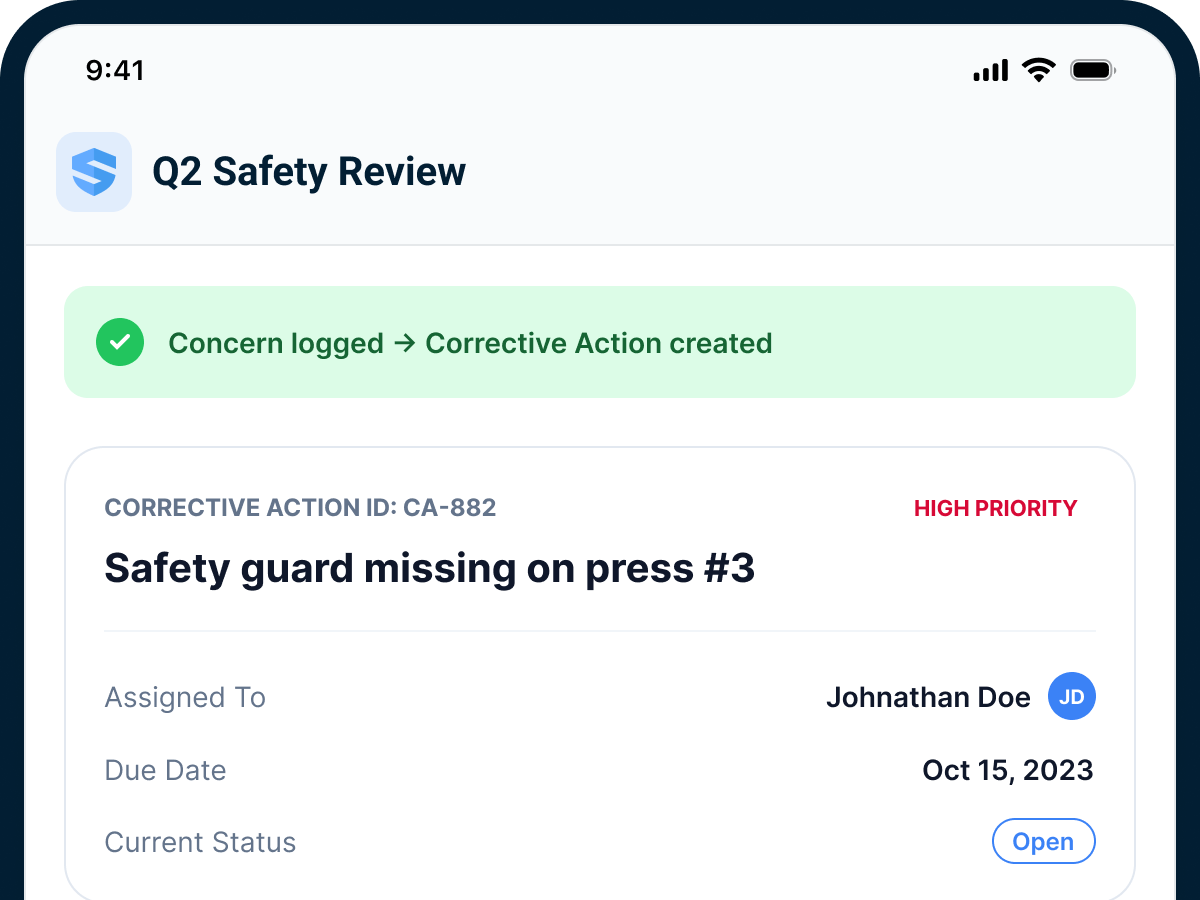
Raised
A hand goes up. The concern is logged with the meeting, not a notebook.
Assigned
A named owner, a priority, and a due date — before the huddle breaks.
Tracked
A status the whole crew can watch move — nothing disappears.
Closed
The fix lands in the same record as the concern. One chain.
Heard isn't handled. Owned, tracked, and closed is.
Prove coverage — verified attendance, crew by crew.
Review meeting coverage across the organisation.
Safety coordinators can review which crews met, what they discussed, and which concerns remain unresolved. Keep that history available for the company’s programme review and COR preparation. A consistent record helps explain the process without assuming that every province has identical meeting requirements.
Relevance at one site is a win. Coverage across thirty is a program.
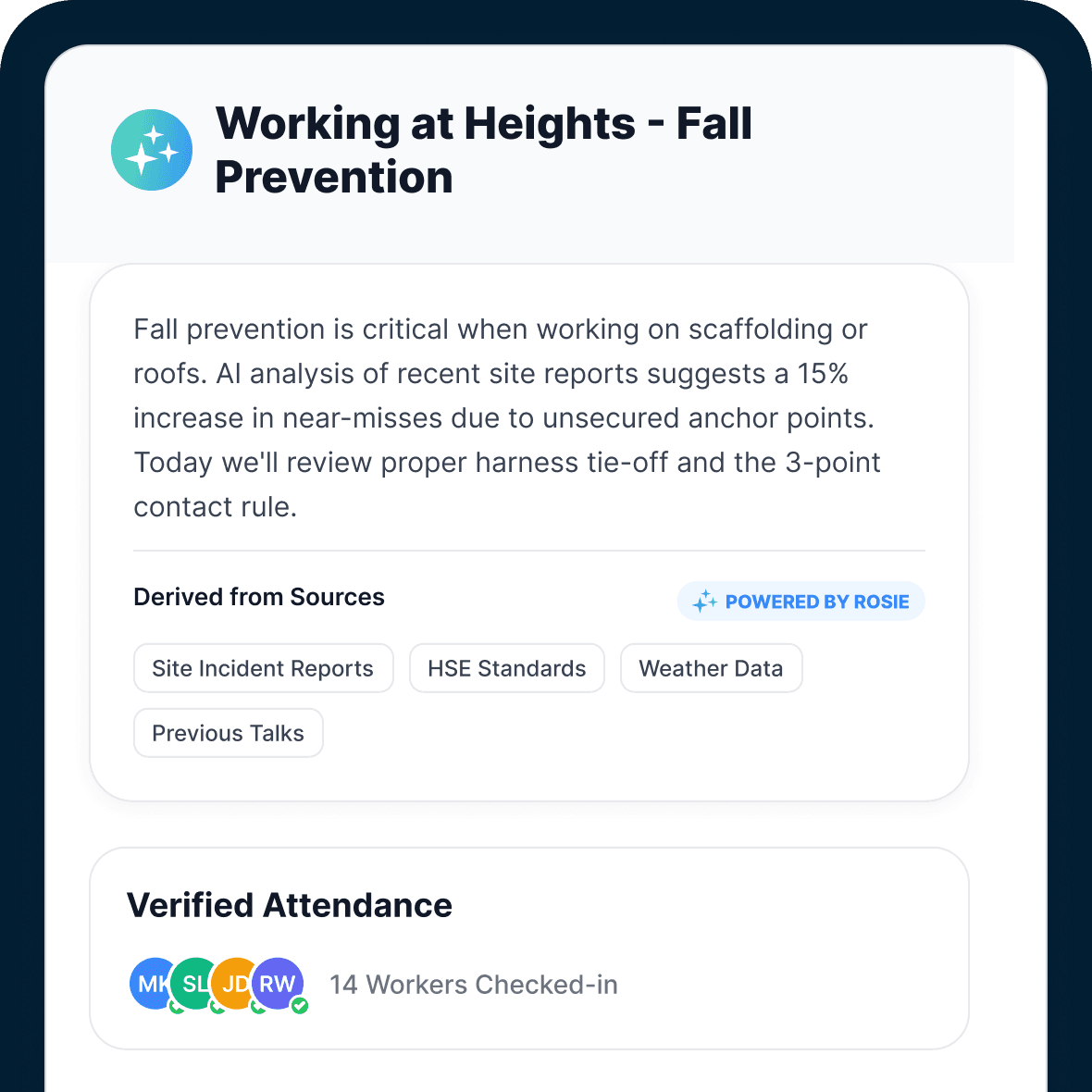
Make the discussion understandable to the people doing the work.
Canadian projects may bring together workers using French, English, and other languages. Use configured language support to prepare relevant material and give supervisors time to check the explanation. A translated topic becomes useful when the crew can discuss the controls and ask questions about its own tasks.
The office stops choosing between relevant and feasible.
Document safety discussions as part of the OHS programme
WorkSafeBC’s OHS programme requirements include worker instruction and supervision. Its provisions for smaller operations also call for regular monthly safety meetings and records of the matters discussed. Those requirements have a defined scope; they should not be turned into a claim that one meeting frequency covers every Canadian project.
Build the toolbox discussion around the current FLHA, changing work conditions, and concerns that workers can help explain. The supervisor reviews the material, discusses the controls, and checks whether the crew needs further instruction. Where the team uses French or another working language, make the explanation understandable rather than relying on the language of the attendance form.
Keep the meeting topic, participants, questions, and resulting actions together. For a contractor preparing for COR, that connected history helps show how communication and follow-up work within its safety management system. Use the applicable provincial rules and certifying partner’s criteria to decide what evidence to retain. SALUS helps organise the record; the employer and supervisors remain responsible for the instruction, programme, and conditions at the workplace.
Daily cadence without the overhead
Rosie writes from live site data and QR sign-in removes the clipboard lap, so the morning talk can happen without the prep chase.
Communication provable
Timestamped, verified sign-ins show who heard what, when, and where.
Turn concerns into closure
Raised issues become assigned corrective actions with owners, due dates, status, and closure proof.
The parts of a safety meeting that usually go missing.
Rosie-generated talks
Written from yesterday's findings, today's weather, open actions, and your own safety program.
QR code sign-in
Show the code, the crew scans, signed in — no clipboard, no waiting.
Verified attendance
Every sign-in checked against the site list, timestamped to the minute.
Multilingual support
The talk lands in the language each crew actually works in.
Concern-to-action flow
A concern raised in the meeting becomes an owned corrective action, same flow.
Coverage dashboards
Which crews met, on what topic, with what attendance — across the portfolio.
Safety meetings connected to action.
Go deeper from topic to proof.
A good toolbox talk needs a relevant topic and a provable record.
Toolbox talks and meetings: questions from Canadian contractors
Can an FLHA provide the starting point for a toolbox meeting?
Is there one required toolbox meeting frequency across Canada?
What meeting evidence can support a COR programme review?
Can SALUS create a toolbox talk from our own safety documents?
Can workers sign into a toolbox talk with a QR code?
What is verified attendance for a toolbox talk?
Can toolbox talks be delivered in French, Spanish, or another language?
Can a concern raised during a toolbox talk become a corrective action?
Can safety teams see toolbox talk coverage across projects?
What should we bring to a toolbox talk demo?
Bring last week's toolbox talk.
Rosie will make today's version.
Generate a site-specific talk, verify attendance, and turn one raised concern into an action.
Bring the current workflow. We will map the live version from field action to proof.