

Safety department of one. Responsibilities of ten. Covered.
A dozen GCs' sites. Every prequal standard. A hundred workers' certs. COR audits, programs, near-misses, more than one language — and one of you. SALUS is the operational safety platform built for exactly this job: your crews capture the facts in seconds, their records travel from GC to GC, the platform heads off lapses and conflicts before they reach the field, and Rosie — the AI Admin & Risk Assistant — drafts the documents, packets, and proof. You keep the judgment. And the field.
One specialty contractor safety professional, a dozen GCs' sites, every standard at once. Below is how it gets covered.
The ability to access real-time reports provides insurance incentives. With SALUS, binders are a thing of the past — I can show them what they need to see within 30 seconds.


The backlog is prioritized: Monday’s toolbox talks, the Level 4 records packet, six site reports, the $84K backcharge evidence, and the portfolio-risk brief are ready for review.
- Safety
- Toolbox talks · incident records · prequalification proof
- Operations
- Daily reports · SWP draft · backcharge chronology
- Leadership
- Portfolio exposure · insurance readiness · Trust Portal
Rosie drafts and assembles the work; accountable people review every decision and external package.
The backlog is prioritized: Monday’s toolbox talks, the Level 4 records packet, six site reports, the $84K backcharge evidence, and the portfolio-risk brief are ready for review.
- Safety
- Toolbox talks · incident records · prequalification proof
- Operations
- Daily reports · SWP draft · backcharge chronology
- Leadership
- Portfolio exposure · insurance readiness · Trust Portal
Rosie drafts and assembles the work; accountable people review every decision and external package.
Nobody can do this job alone. Watch it get covered anyway.
There is no safety program without adoption. SALUS earns it.
You can't be everywhere — so the program only works if the crew works it. SALUS doesn't mandate adoption; it trades for it. Give workers an FLHA that's actually about today's task instead of the 40 questions they've signed 200 times. Give them capture that takes seconds — a QR scan, a voice note, a photo, with Rosie doing the writing. Give them answers, not binders. When safety gives more than it takes, the crew uses it — and near-miss reporting climbs sharply.
No logins. No accounts. No friction.
One QR scan and they're working — no passwords, no registration, no training on the training tool. Offline included.
Relevant beats recycled
FLHAs and SWPs specific to today's task and conditions. Workers read what applies to them — that's what breaks pencil-whipping.
Answers in seconds, not binders
Equipment specs, SDS questions, procedures — Rosie answers concisely at the point of work, in the worker's language.
Their record, in their pocket
Worker profiles travel GC to GC — certs, training, and orientation history in one place, on their phone. Oriented once, ready anywhere.
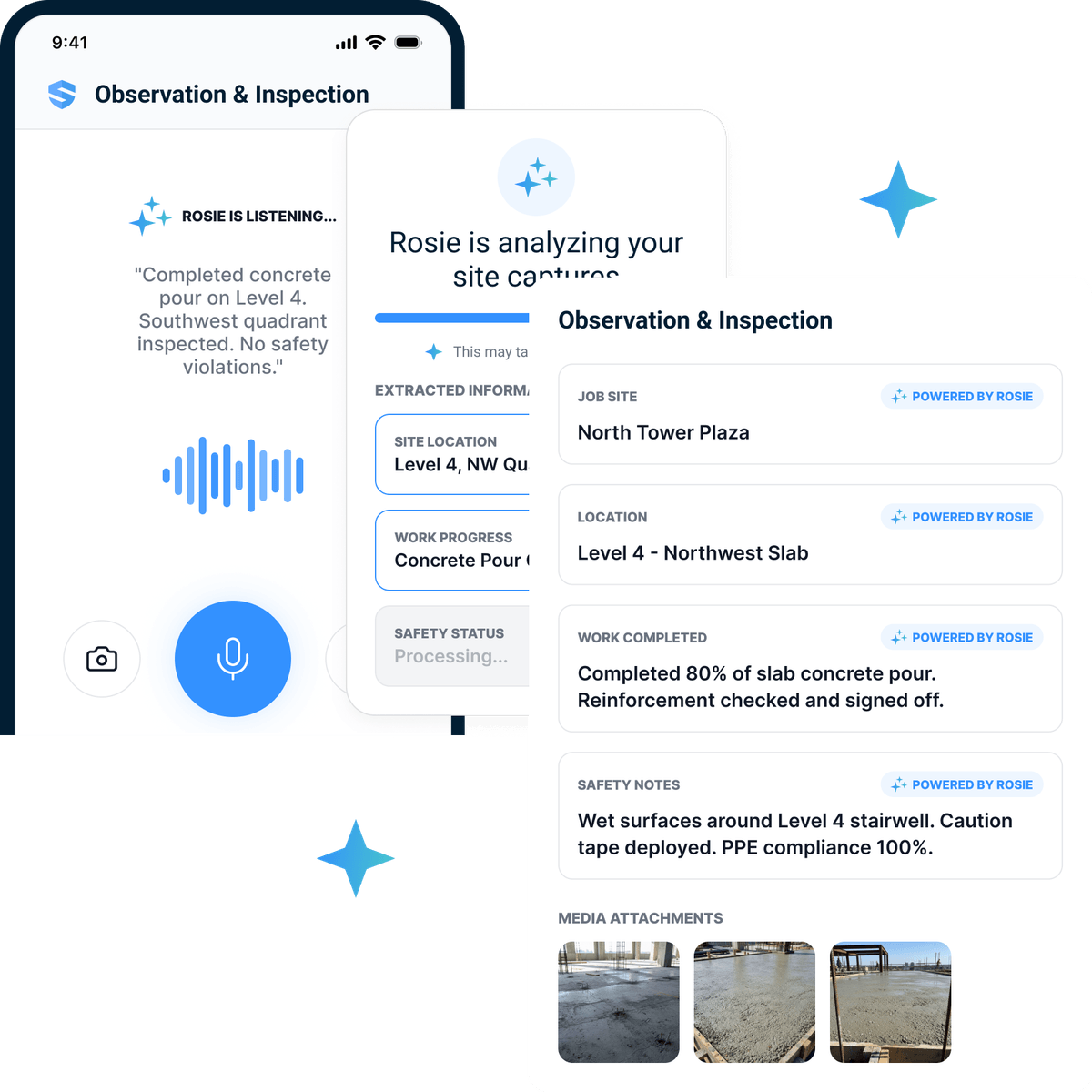
Captured rich. Kept current. Proven on demand.
Because the crew captures everything in the moment — orientations, inspections, permits, signatures, photos — your compliance record is the richest version of itself, built at the source. And the platform works that record ahead of time, so the lapse, the conflict, and the stale procedure never make it to the field.
- Detected
- Fall protection cert expires in 14 days
- Mobilizing
- Northgate Tower — crew starts Monday
- Action
- 10-min micro-training pushed to his phone
- Status
- Renewed Thursday · zero interruption
Renewals before fire drills
Expiring certs surface weeks ahead, ranked by who's mobilizing where. A 10-minute micro-training goes to the worker's phone — the cert renews before the crew ships, not after the fire drill.
- Detected
- Fall protection cert expires in 14 days
- Mobilizing
- Northgate Tower — crew starts Monday
- Action
- 10-min micro-training pushed to his phone
- Status
- Renewed Thursday · zero interruption
Permits that check each other
Digital permits cross-check automatically. Hot work scheduled next to the solvent crew gets caught at the request — not after both crews are working the same zone.
- Requested
- Welding on Level 2 risers — 1:00–3:00 PM
- Conflict
- Painting crew in Zone 4 — solvents, same window
- Caught
- At the request — before approval, before exposure
- Resolution
- Hot work moved to 3:30 PM · both crews notified
SWPs that never go stale
Rosie monitors regulations and near-miss trends continuously, flags the gaps in your procedures, and drafts the update — the program stays aligned with the field instead of aging in a binder.
Five gaps need attention: ground-level exclusion-zone enforcement, struck-by PPE, an all-clear protocol, a current review date, and pre-task verification.
- Field controls
- Exclusion zone + struck-by PPE
- Communication
- All-clear protocol
- Governance
- Current review + pre-task verification
The safety lead validates every recommended change before the approved procedure is replaced.
Reports on request
Insurance, a COR auditor, a GC — any report request pulls from the same living record in minutes, not from binders. The compliance you practise daily becomes the compliance you can show instantly.
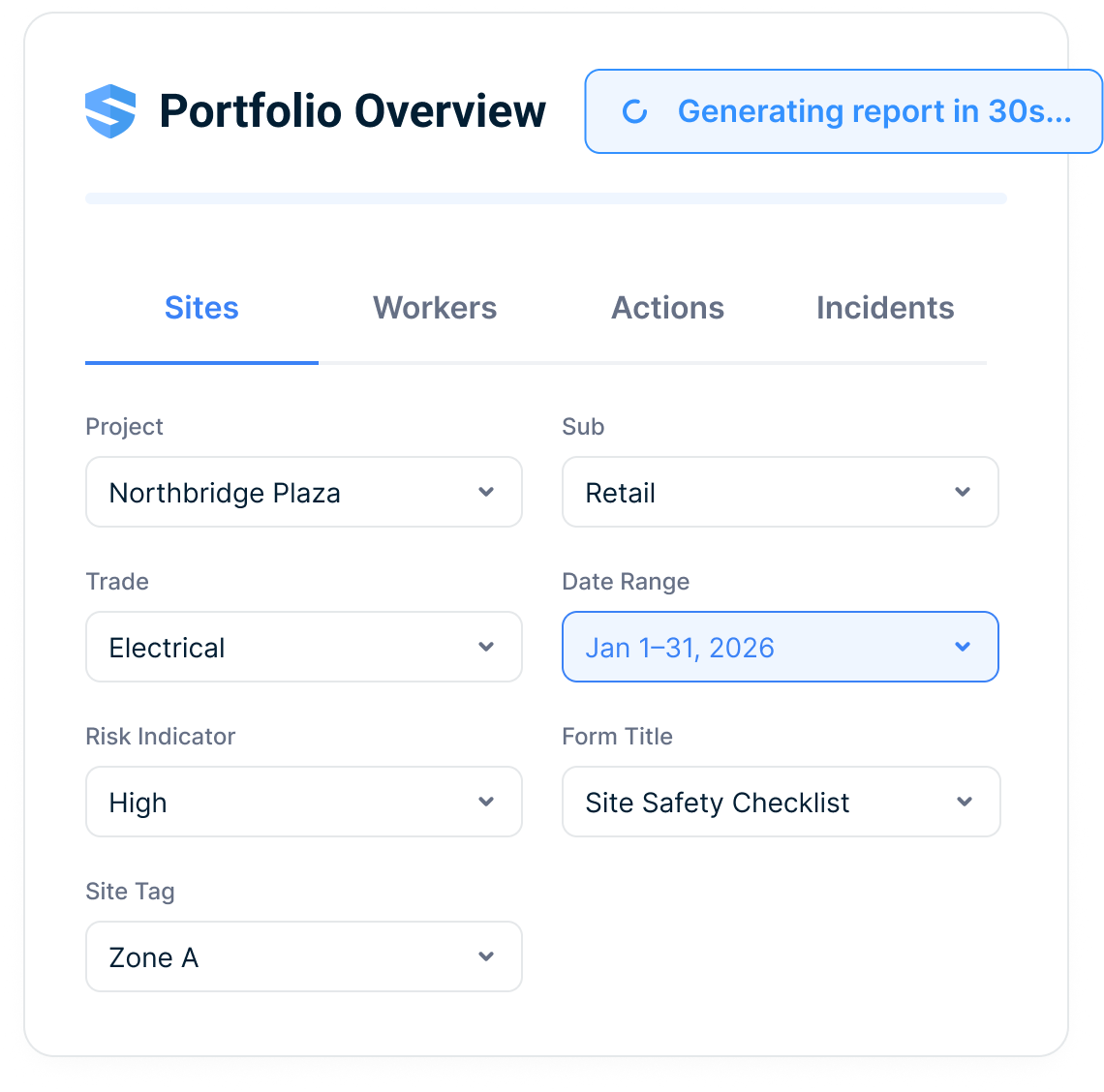
Every GC and every province wants it their way. Rosie drafts it their way.
New job, new GC, new province — and someone has to produce the site-specific program by Friday. Describe the job to Rosie, attach the GC's requirements, and a draft comes back in minutes, built from your master program and the regs that apply. Toolbox talks draft themselves from last week's near-misses. When a code changes, live-edit once and push to every site. You review and approve — the judgment stays yours, the lost week doesn't.
- Site-specific safety plans drafted GC-by-GC — their format, your standards, the applicable provincial OHS regs.
- SWPs and ad-hoc procedures for new hazards, drafted before the crew is blocked waiting on paper.
- Your existing form library converts in hours — conditional logic added, institutional knowledge intact.
The site-specific safety plan is drafted from the project scope, hazard profile, company standards, and GC requirements.
- Scope
- Project roles + task hazard profile
- Controls
- Site hazards + emergency procedures + PPE
- Readiness
- Training, orientation, and GC items included
A qualified safety lead reviews and approves the draft before it is issued to the site.
Yes. The draft contains nine sections and 24 site-specific hazard controls, aligned to Meridian’s requirements and ready for the safety lead’s review.
- Plan structure
- 9 sections · roles · emergencies · sign-off
- Hazard controls
- 24 project-specific controls
- Requirements
- Company standards + the provincial OHS regulator + Meridian
The safety lead reviews and approves the plan before it is issued to Meridian or the crew.
Whoever's asking, the proof already exists.
The asks never stop, and they never come from one direction: the GC's compliance request, the COR audit, the insurer's renewal questionnaire, the prequal package for the bid your estimators want, the owner's audit. The proof was never missing — it's in the forms, orientations, certs, and inspections your crews complete every day. Rosie assembles it in whatever shape the asker needs: timestamped, worker-identified, site-tagged. 🍁 Across the rest of Canada that's the COR audit package and your provincial OHS and WCB/WSIB evidence; ⚜️ in Québec it's the CNESST file and the prevention-program proof a mutuelle de prévention rewards — the same field record, assembled either way.
Regulatory records, automated
Provincial OHS incident records and WCB/WSIB reporting generate from incident records your crews already created. Audit season stops being archaeology.
Insurance, in 30 seconds
LMS: "Pick a job and tell me what you'd like to see — I can show them within 30 seconds." COR documentation review went from two full days to 1 hour 45 minutes.
Pre-qual, live
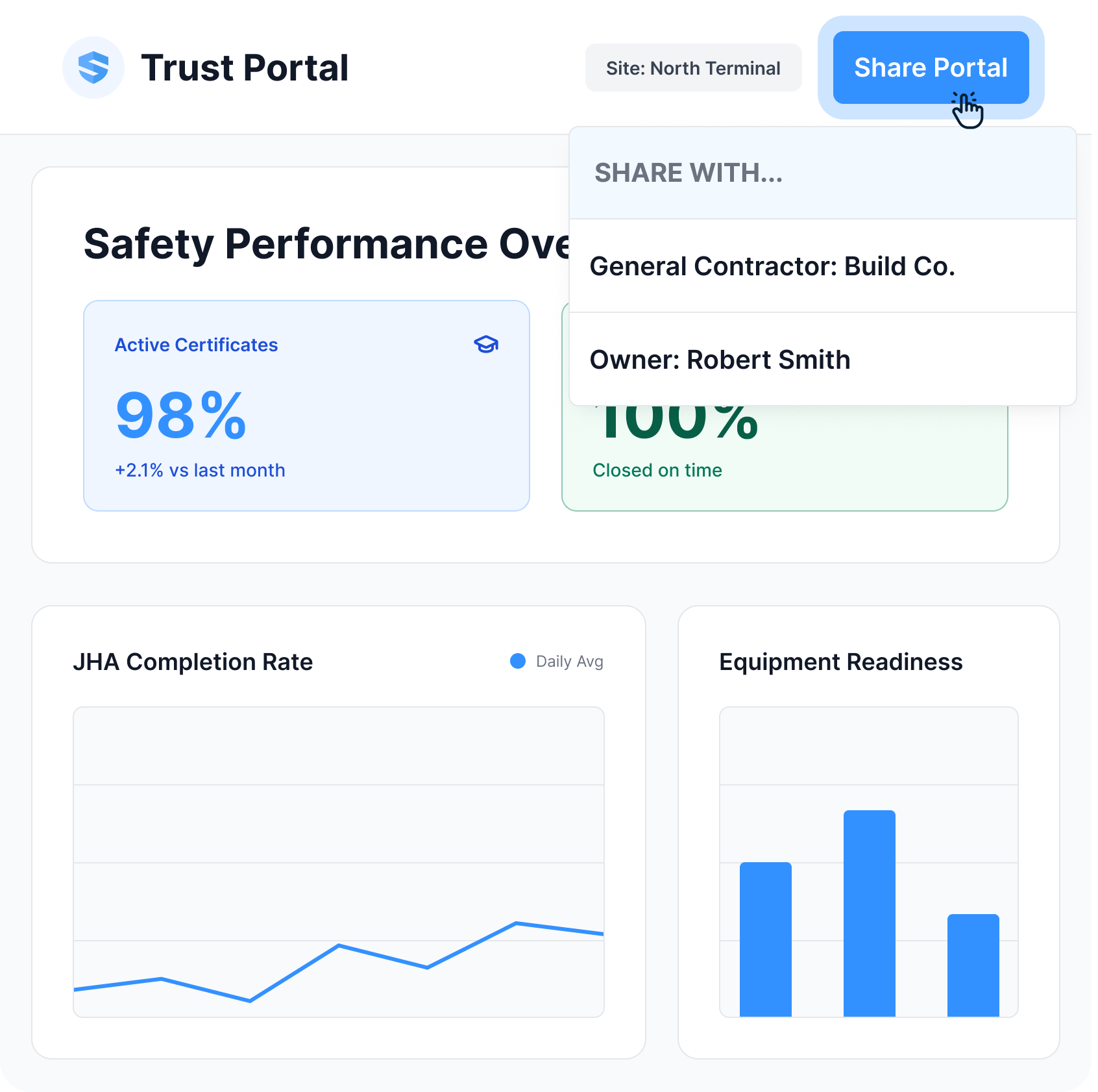
The Trust Portal is a live compliance link any GC or owner can verify — training, form completion, corrective-action velocity. The prequal binder, retired.
GC and owner audits
Packets assembled by what the request actually asks for — orientations, certs, inspections, corrective actions — from one traceable field record.
The due-diligence record is assembled. Daily hazard assessments cover 96% of active site-days, incident response averages 2.3 hours, and 23 fall-protection certificates need attention.
- Field evidence
- 12,847 forms · 96% active site-days covered
- Follow-through
- 94% of corrective actions closed
- Credential gap
- 23 fall-protection certificates expire within 30 days
The risk team reviews the source-linked packet before it is shared with the broker or insurer.
- Request
- Orientation, training & FLHA records — recordable incident
- Scope
- Site 7 · 3 crews · trailing 90 days
- Compiled
- 212 records — timestamped, worker-identified, site-tagged
- Status
- Packet exported · 11:54 AM · 12 minutes
Most serious incidents announce themselves. Rosie hears them.
Most serious incidents are preceded by unreported near-misses — patterns invisible at human scale. Rosie reads every form on every site, continuously. The crew whose hazard assessments went quiet after a foreman change. The site that's under-inspected this month. The corrective actions about to age out. Instead of reacting to whatever is loudest, you start your week knowing exactly where your field time prevents the next recordable.
Three projects need attention. Northgate Tower is the most exposed because of 436 unassigned corrective actions, one serious open incident, and a slipping schedule.
- Northgate Tower
- High safety · behind schedule · margin at risk
- SeaTac Terminal
- Medium safety · tight schedule · margin eroding
- Broadway Towers
- Medium safety · on track · healthy margin
This is a decision-support ranking; leaders review the linked evidence before acting.
Four active sites have no submissions. SeaTac and Surrey are the highest priority because each has 71 workers on site without a hazard assessment on record.
- SeaTac
- 71 workers · no assessment
- Surrey
- 71 workers · no assessment
- Broadway Towers
- 2 locations · 9 workers total
Site leaders confirm work status and complete the missing assessments before affected tasks continue.
Signed isn't the same as understood.
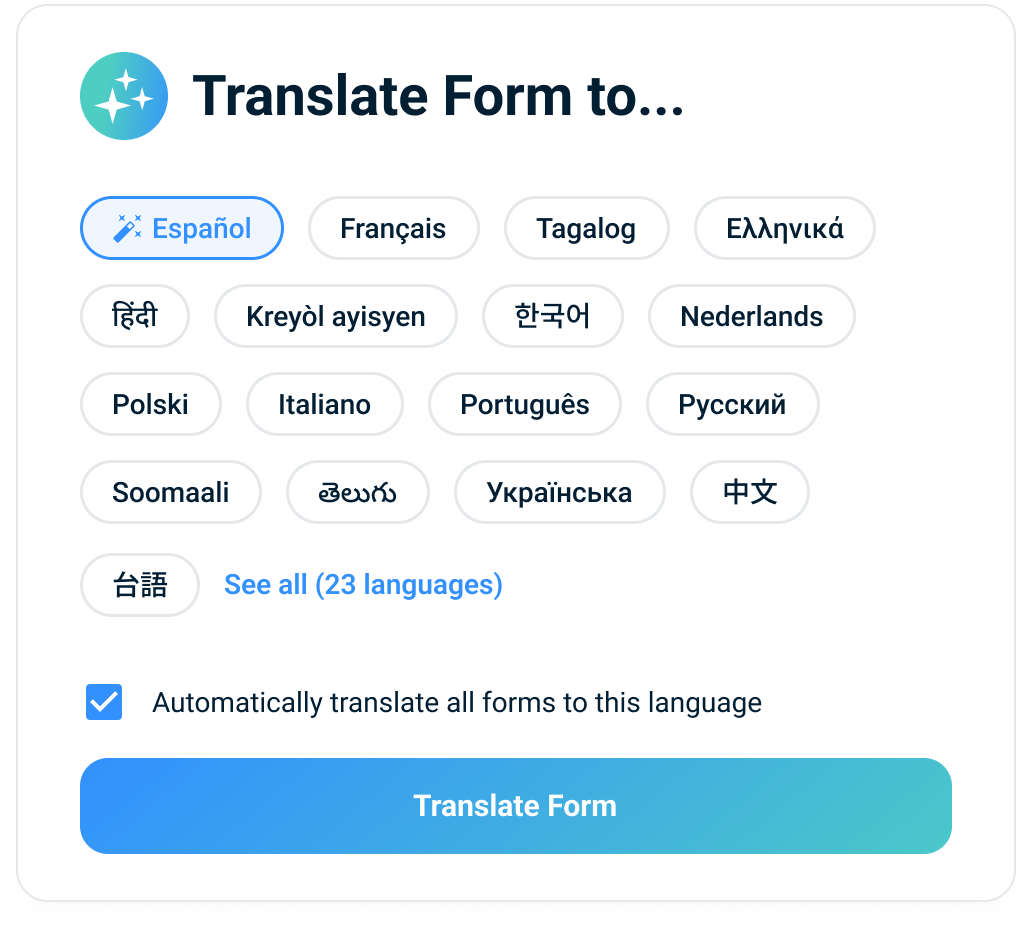
Many Canadian crews work in more than one language — Punjabi, Spanish, Tagalog, and on bilingual sites, French and English both — and the injury statistics track the comprehension gap with brutal precision. Rosie translates both ways: workers complete orientations, forms, and training in their own language; the office reads every submission in English — including the hazard text a worker actually types, not just the menus. Micro-training lands at the point of work, in the worker's language, at the moment it's needed.
The posting asked for ten people.
It's still one of you — with backup.
SALUS never replaces the safety professional. It absorbs the clerk-work the title quietly included, and gives the judgment room to operate.
What's left is the job you actually took.
Walk the site the rotation kept skipping. Mentor the new foreman before the near-miss, not after. Catch the hazard no form has a field for. Sit in the exec room with answers instead of homework. The hundreds of hours a year safety directors lose to admin — that was never the job. It was what kept you from doing it.
Field leadership
Your presence, where the program actually lives — backed by data on where it's needed most.
Judgment
Every Rosie draft lands for your review and sign-off. The trail records both the sources and the human approval.
Standing
You walk into the executive room as the person whose field data wins disputes and passes audits — not the cost center.

One loop, running on every site you can't be on.
AI without field data is autocomplete. Rosie runs on the 250-forms-a-day reality your crews create in SALUS — which is why her drafts survive a COR auditor, a GC, and a deposition.
Crews capture
One QR scan, a voice note, a photo — forms that work offline and take minutes. No logins, no friction, no excuses.
SALUS connects
Every fact links to a worker, a cert, a training record, a machine, a site — one record, not nine apps.
Rosie delivers
Programs, packets, answers, and risk calls drafted from that record — evidence-backed because the data is traceable.
Crew-level facts in. Review-ready answers out.
The tools behind the department of one.
Digital Forms
Conditional FLHAs and SWPs scoped to today's task — the eight questions that matter, not the forty they've signed 200 times. That's what breaks pencil-whipping.
Certificate Management
Every worker's credentials tracked against the task and renewed weeks before expiry — across a dozen sites and every GC's requirements.
Corrective Actions
Named owners, photo closure, automatic escalation — nothing dies in a folder, and the crew sees the loop actually close.
Reporting
The provincial OHS incident record, the COR audit package, the insurance packet — pulled in 30 seconds from the field record instead of rebuilt over a week.
Trust Portal
Live compliance proof for every GC and owner — the prequal binder, retired.
Training
Micro-training and refreshers that meet each worker in their language — delivered at the point of work, not in a classroom.
Departments of one, holding the line at scale.

COR documentation review
$180K/year of admin moved into the platform, with a 5% WCB rebate guaranteed.

insurance saved, zero findings
Zero findings across 37 WorkSafeBC inspections — proof that travels to every GC.

COR audits, one platform
BC and Yukon COR audits run from one dashboard — a full-time paper role eliminated.

adoption, zero training
From Arctic well pads to global sites — crews adopted it on their own.
Trusted across 400K users, 150K sites, and 14K companies.
Three pages worth your next ten minutes.
Meet Rosie properly
Go deeper · admin cleared by Rosie
Watch one safety director's Monday backlog — five admin requests — cleared in under an hour.
For your foremen
Go deeper · field capture and crew proof
10-minute FLHAs, one capture that serves every GC, and proof that protects the crew.
For the owner
Go deeper · scale and margin protection
Scale standards without scaling overhead — and protect the experience rating that prices every bid.
Asked by safety directors, answered straight.
I work under nine different GCs with nine different requirements. Can one platform handle that?
How does SALUS handle COR audits, WCB rebates, and Québec's CNESST regime?
My crews range from apprentices on smartphones to veterans on flip phones. Will they use it?
My workers move between GC sites constantly. Do their records move with them?
How long does implementation actually take?
Is AI-drafted safety content traceable enough for an auditor or GC?
We work in basements, riser shafts, and remote northern sites. What happens without signal?
Is this a way for my company to replace me?
The job was always too big for one person. Keep it anyway.
Bring us your most impossible week — the new GC's program, the COR audit, the cert chase across twelve sites — and watch SALUS cover it in a 15-minute demo.
Crews capture · SALUS prevents · Rosie drafts · You lead