

Construction toolbox talk software built around today’s work.
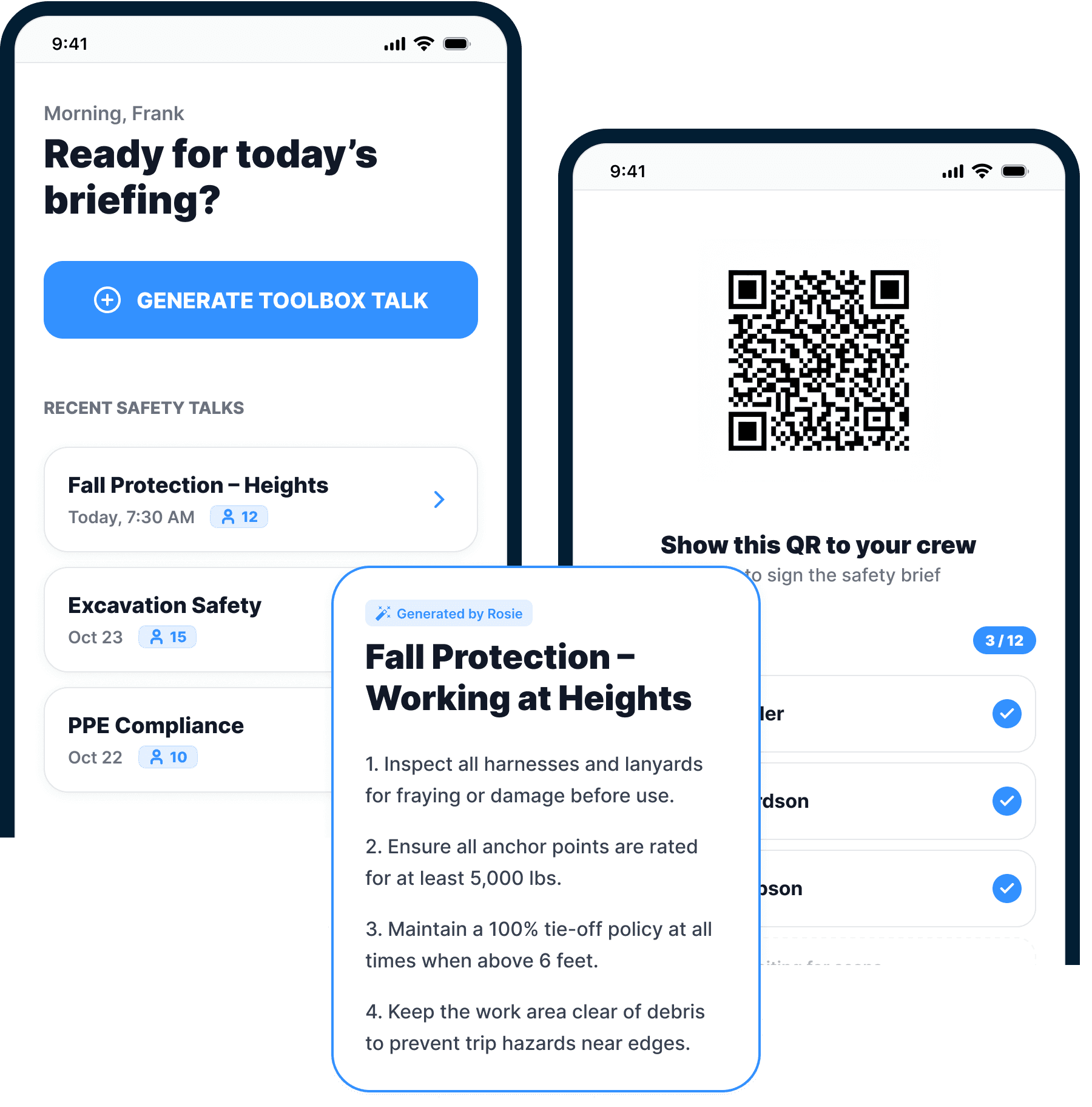
US construction crews need clear safety instruction under their OSHA program, with briefings that reflect the hazards of today’s work. SALUS connects the toolbox talk, attendance, questions, and follow-up in one record. Rosie can draft a briefing from site findings and your own safety documents for the supervisor to review. Workers sign in by QR code, and concerns raised during the discussion can become assigned actions. The safety team can then see which crews received the talk and what needs attention, while the supervisor remains responsible for explaining the controls and checking that the crew understands.
- ~2 min · From request to signable talkStructured, signable, built from your own program — not a generic library.
Within a month or so of us starting to use SALUS, some of the comments were that if we were to take it away and go back to paper, that they would quit.


Stop recycling toolbox talks the crew has tuned out.
Rosie builds the toolbox talk from today's site context.
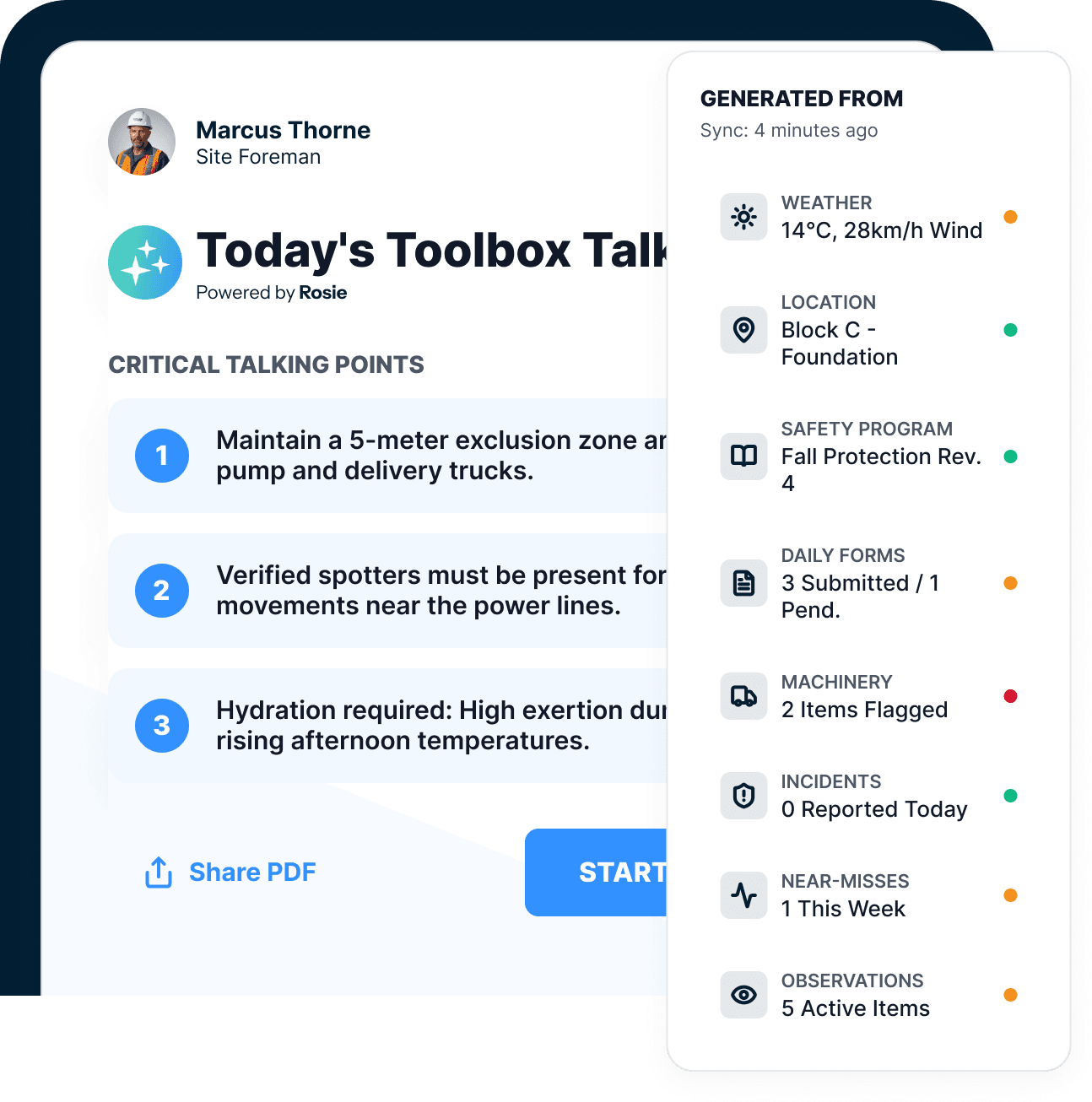
Topic libraries hand every site the same talk. Rosie writes this morning's talk from what your site actually recorded: yesterday's findings, open corrective actions, the weather moving in, the high-risk tasks on the schedule. The crew listens to this one, because it's about the work they're about to do.
Read
Yesterday's findings, open actions, weather, incidents, near-miss trends.
Write
Critical talking points for this crew, this block, this morning.
Deliver
The foreman opens the phone and runs the talk.
Toolbox talks are easier and quicker.
 Dustin B.Project Manager
The topic comes from the job, not a stale binder.
Name the topic. Rosie has already read everything.
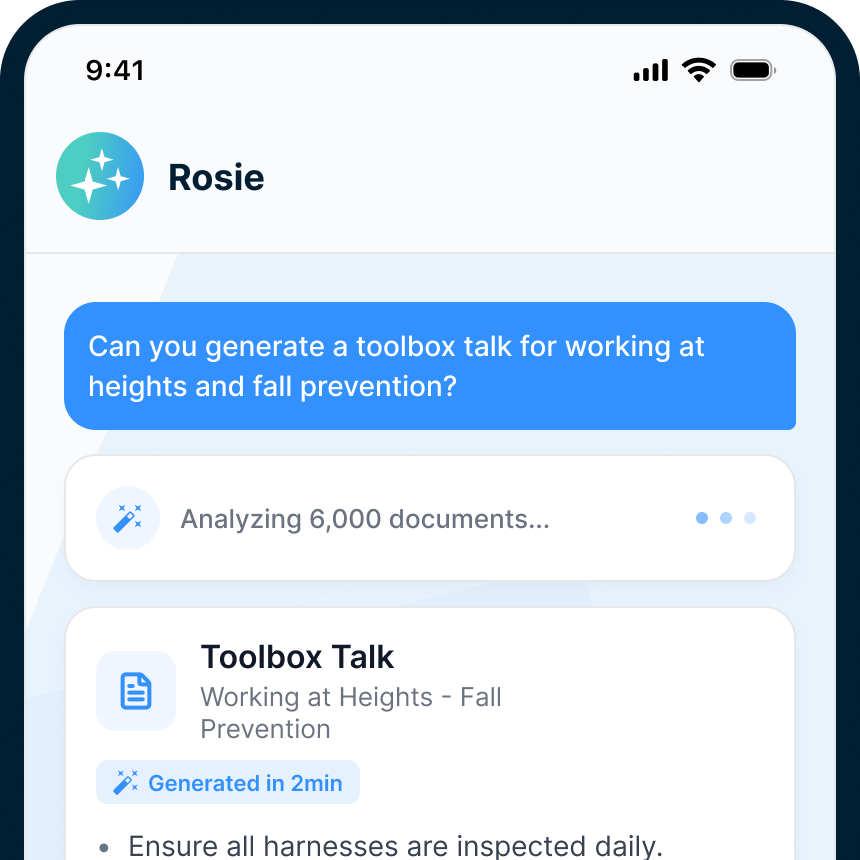
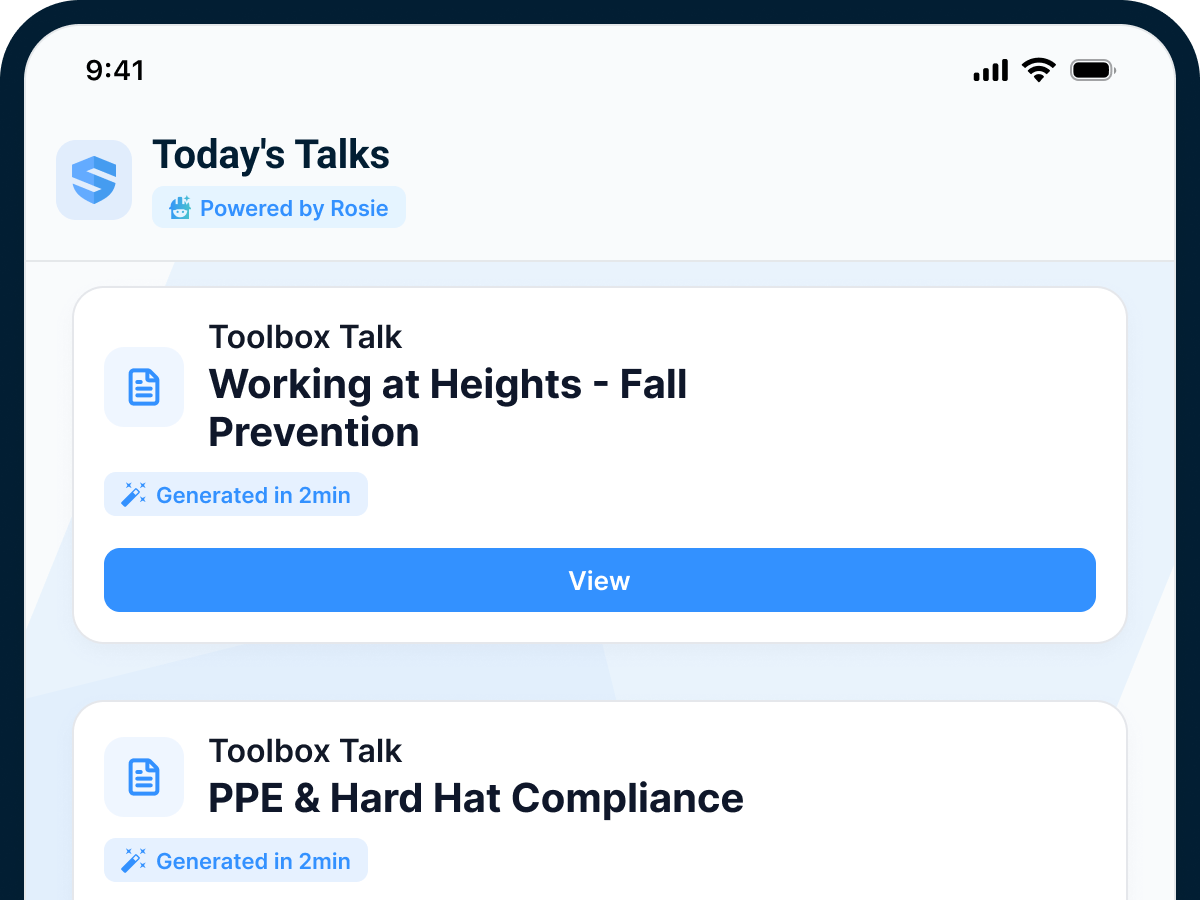
Need a talk on working at heights? Building one used to mean digging through binders, PDFs, and a safety program nobody can search. Now the foreman asks in plain language, Rosie reads the company's entire document base — six thousand documents, if that's what it takes — and a structured, signable talk comes back in about two minutes, built from your own standards, not a generic internet handout.
Six thousand documents read. Zero documents browsed.
One request
Ask in plain language — no menus, no template hunting.
Whole library
Rosie reads the documents nobody has time to.
Your standards
Every point traces back to your own program.
You do the talk. Rosie makes it signable.
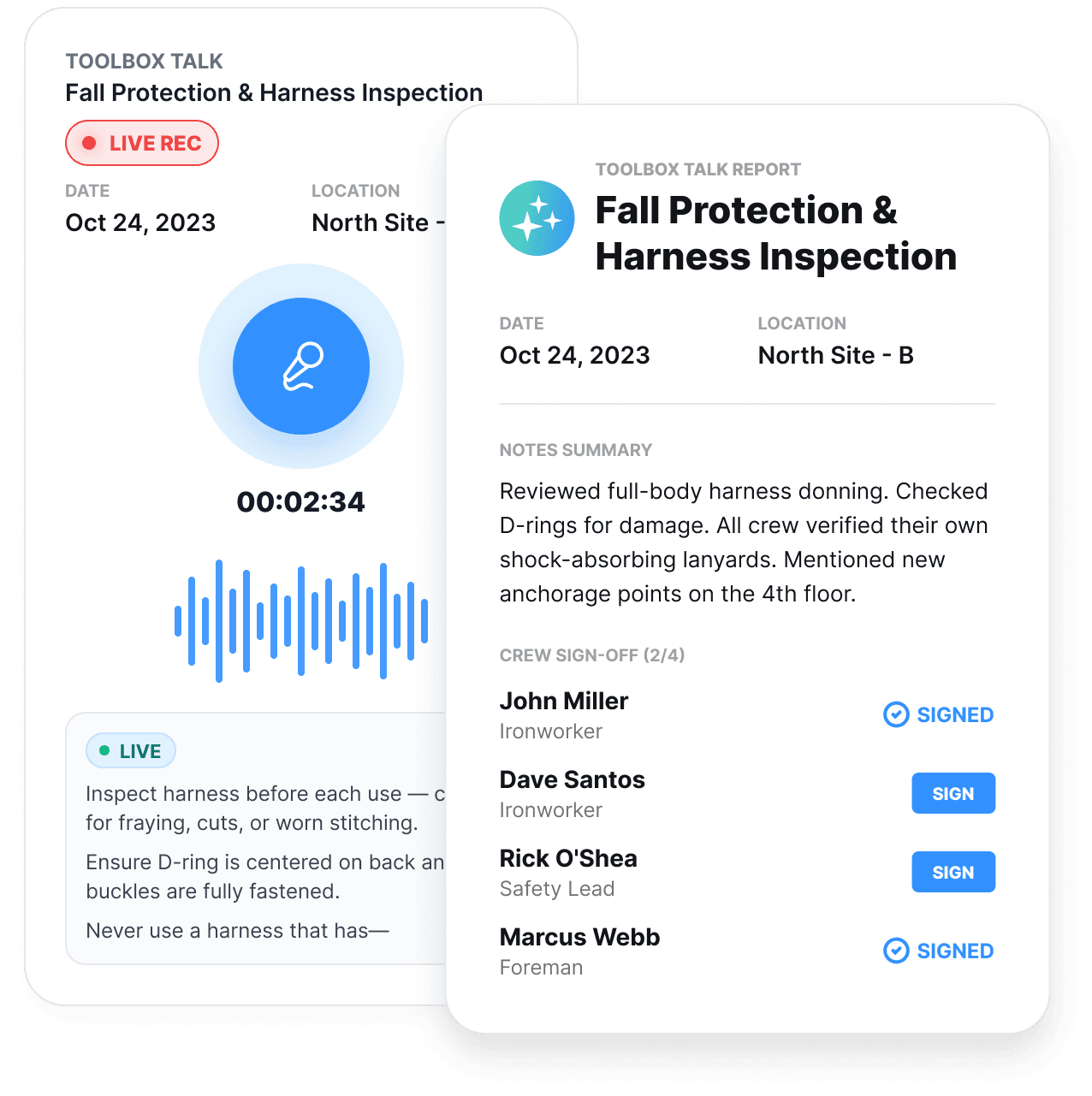
Some talks happen at the rack, not at a desk — a live walkthrough of harness inspection before the crew goes up. Hit record. Rosie turns the recording into a toolbox talk form: a notes summary of what was covered and a crew sign-off list, ready for signatures. The talk that actually happened becomes a record that actually holds.
The foreman never types. The record never slips.
A five-minute talk becomes a permanent record.
Attendance should be verified, not scribbled.
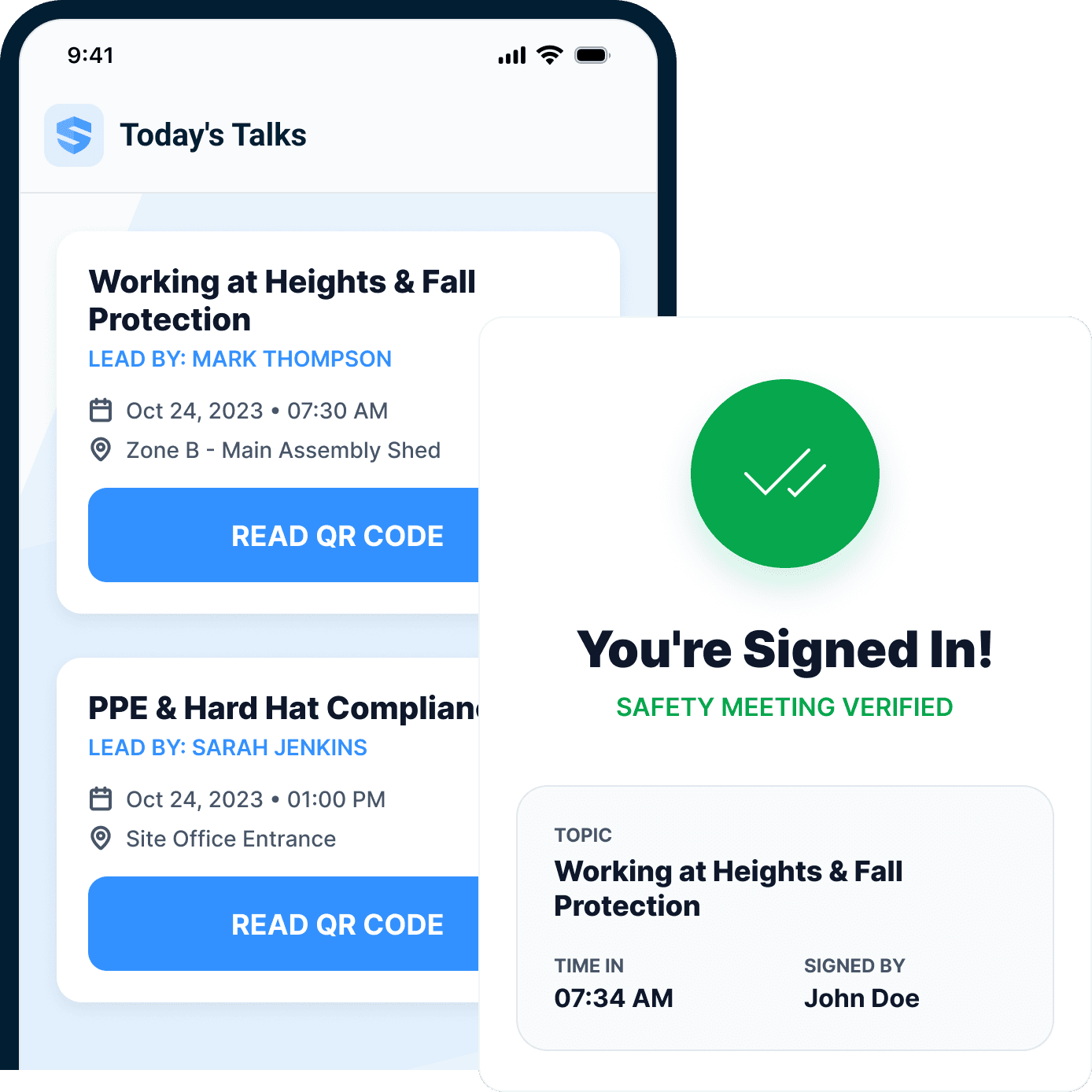
The clipboard is where attendance goes to die: passed hand to hand, signed illegibly, easy to sign for an absent buddy. In SALUS the foreman shows the QR code, the crew scans, and every worker gets an individual timestamped receipt — which topic, what time, whose verified name — checked against the site list at the scan.
Scan. Signed. Working.
- Topic. Time. Name. Verified.
A concern raised in the meeting leaves with an owner.
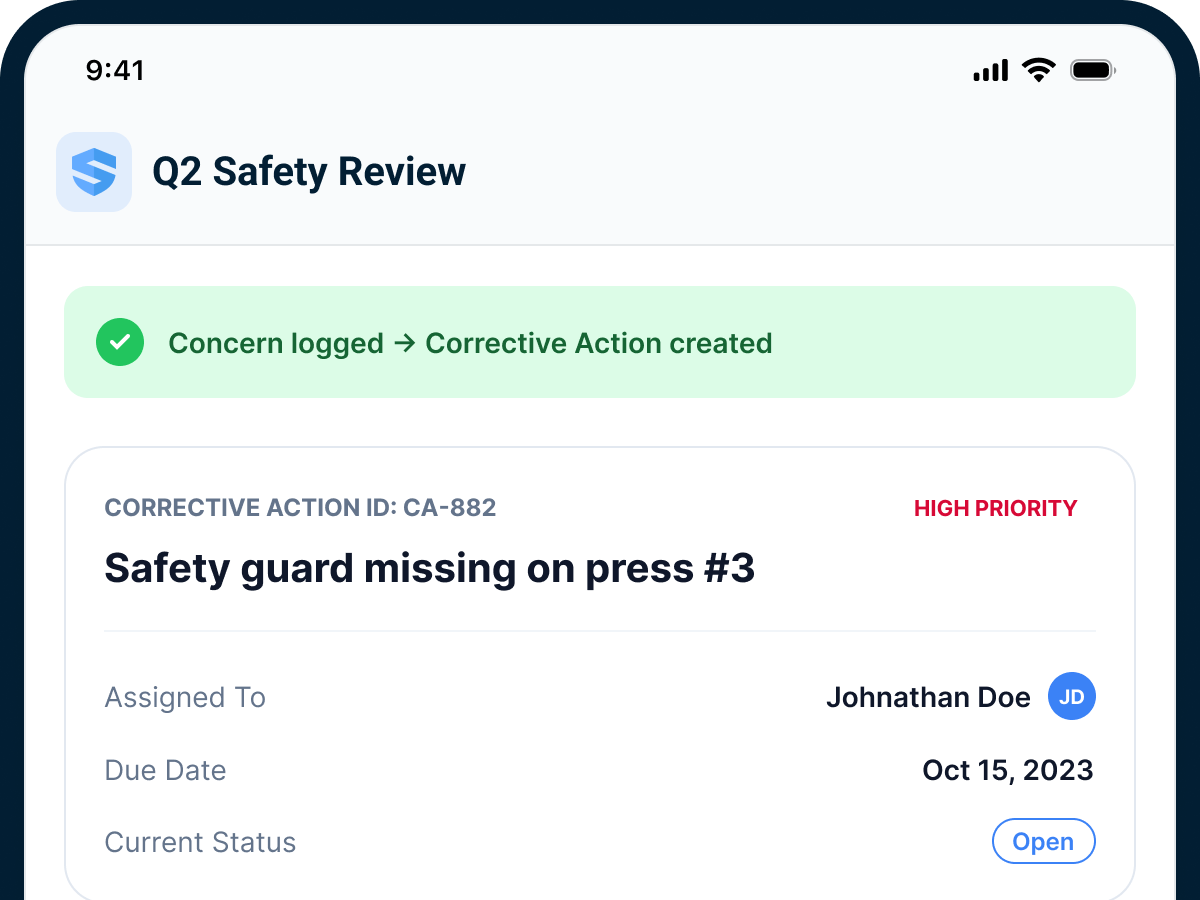
A worker flags a missing safety guard on press #3 — the kind of comment that usually evaporates when the room empties. Not here: the concern becomes corrective action CA-882 before the meeting breaks — named owner, high priority, due date. The crew watches the status move from raised to closed, and nothing builds reporting culture like watching your concern get fixed. The wider story lives on Crew Communication.
Raised
A hand goes up. The concern is logged with the meeting, not a notebook.
Assigned
A named owner, a priority, and a due date — before the huddle breaks.
Tracked
A status the whole crew can watch move — nothing disappears.
Closed
The fix lands in the same record as the concern. One chain.
Heard isn't handled. Owned, tracked, and closed is.
Prove coverage — verified attendance, crew by crew.
Hyper-relevant at every site. Provable at every audit.
Attendance is verified at sign-in, and follow-up actions are tied to an owner. The safety director sees coverage across the portfolio, crew by crew — and hands an auditor the proof without prepping a binder.
Relevance at one site is a win. Coverage across thirty is a program.
Every crew gets its own talk — in the language it works in.
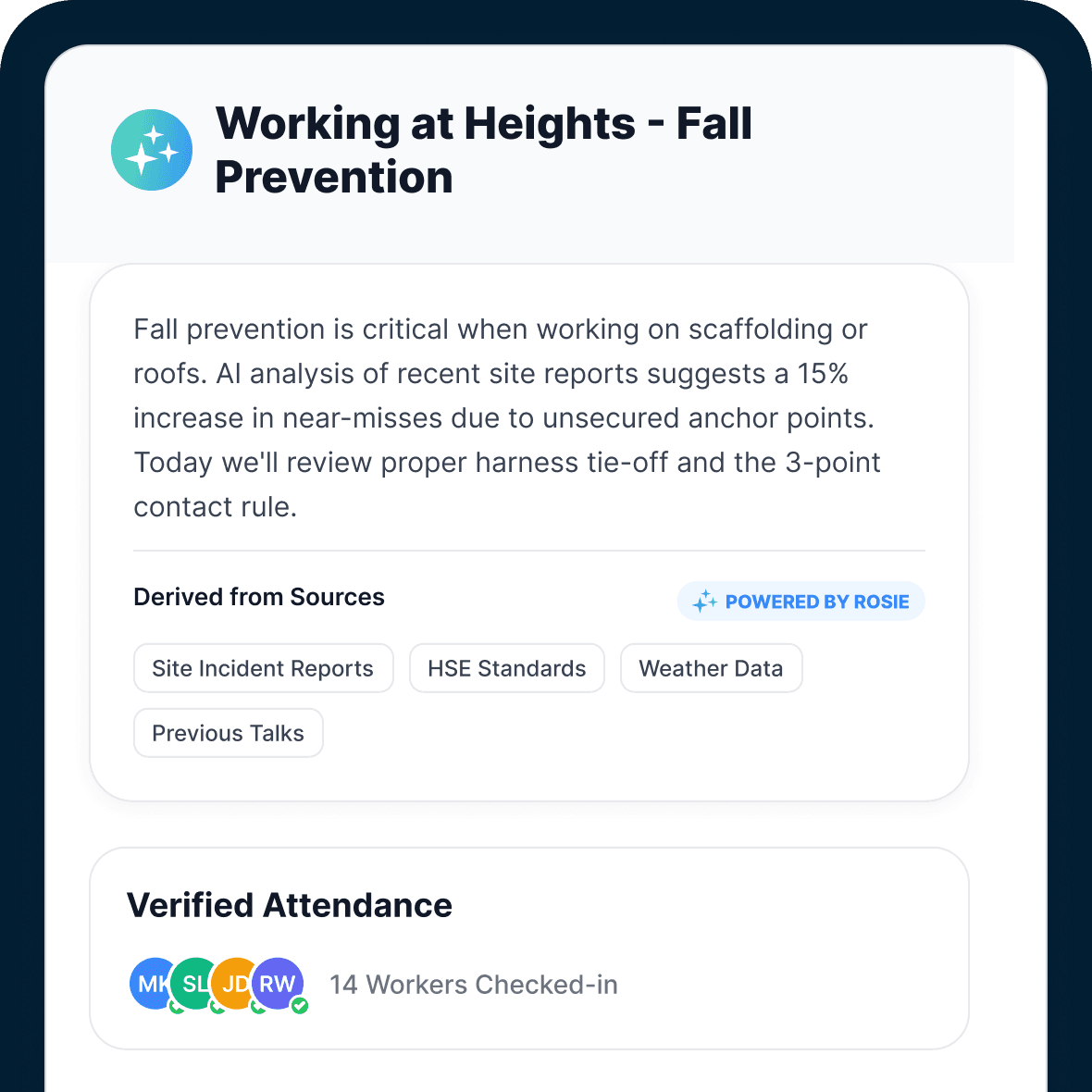
Relevance used to trade off against scale — one safety manager can't write thirty crew-specific talks a night, let alone in two languages. Rosie can: heights for the crew on the scaffold, PPE for the gate, each generated in about two minutes, in the language the crew actually works in. AI Spanish translation is how one customer's most resistant foreman became the app's biggest advocate.
The office stops choosing between relevant and feasible.
Use the briefing to support OSHA safety instruction
OSHA 1926.21(b)(2) requires instruction in recognizing and avoiding unsafe conditions and in the regulations applicable to the work environment. A toolbox talk can support that communication when its content fits the tasks and the people on site. A familiar title and a signature sheet alone do not show that the relevant hazards were explained.
Start with the work planned for the shift and the conditions reported by the crew. Review Rosie’s draft against the site’s procedures, explain the controls, and leave room for questions. Where language or literacy affects understanding, adapt the delivery so the discussion reaches the workers doing the task. The supervisor should check comprehension instead of treating attendance as the whole outcome.
Keep the topic, participants, date, and concerns together in SALUS. Assign follow-up where the conversation identifies a problem and review the result before repeating the same briefing. Activity-specific training and state requirements may add obligations beyond a daily talk. The connected meeting record supports your program; it does not replace required training, qualifications, or supervision.
Daily cadence without the overhead
Rosie writes from live site data and QR sign-in removes the clipboard lap, so the morning talk can happen without the prep chase.
Communication provable
Timestamped, verified sign-ins show who heard what, when, and where.
Turn concerns into closure
Raised issues become assigned corrective actions with owners, due dates, status, and closure proof.
The parts of a safety meeting that usually go missing.
Rosie-generated talks
Written from yesterday's findings, today's weather, open actions, and your own safety program.
QR code sign-in
Show the code, the crew scans, signed in — no clipboard, no waiting.
Verified attendance
Every sign-in checked against the site list, timestamped to the minute.
Multilingual support
The talk lands in the language each crew actually works in.
Concern-to-action flow
A concern raised in the meeting becomes an owned corrective action, same flow.
Coverage dashboards
Which crews met, on what topic, with what attendance — across the portfolio.
Safety meetings connected to action.
Go deeper from topic to proof.
A good toolbox talk needs a relevant topic and a provable record.
Need a topic? Never again.
Start with a vetted construction talk, a printable topic pack, or the requirements behind the meeting. Then use SALUS to deliver it, verify attendance, and close the loop.
Toolbox talks and meetings: questions from US construction teams
Does a signed toolbox talk replace task-specific OSHA training?
How can a supervisor check that a Spanish-speaking crew understood the briefing?
How does Rosie generate toolbox talks from live site data?
Can SALUS create a toolbox talk from our own safety documents?
Can workers sign into a toolbox talk with a QR code?
What is verified attendance for a toolbox talk?
Does OSHA require toolbox talks?
Can toolbox talks be delivered in Spanish or another language?
Can a concern raised during a toolbox talk become a corrective action?
Can safety teams see toolbox talk coverage across projects?
What should we bring to a toolbox talk demo?
Bring last week's toolbox talk.
Rosie will make today's version.
Generate a site-specific talk, verify attendance, and turn one raised concern into an action.
Bring the current workflow. We will map the live version from field action to proof.