

Rosie: Technical White Paper & Benchmark Report
A construction-safety AI methodology and benchmark report covering Rosie’s hybrid retrieval architecture, the 1,023-question SALUS-SafetyQA benchmark, comparative evaluation, failure modes, and publication boundaries.
- Authors
- Alex Jacobs; Dany Ayvazov
- Reviewed by
- Alex Jacobs; Dany AyvazovReviewed
- Released
- Publication
- SALUS technical report
95.01%
SALUS-SafetyQA · n=1,023
8.0–20.9
percentage-point reported advantage
p < 0.001
all reported McNemar comparisons
Paper v2.0.0; dataset v1.0
This release updates the paper, comparison models, figures, and reported results. It does not rename or version-bump the published 1,023-question dataset.
A multiple-choice benchmark
Accuracy is measured on four-option questions. The paper explicitly notes that this can overestimate performance relative to open-ended extraction.
Reported results, stated limitations
The proprietary source corpus and raw files are not published. This edition also does not specify model IDs, run dates, decoding parameters, or a full validation protocol.
Publication note: this is a company-authored technical report and benchmark disclosure, not a regulatory standard. Safety decisions still require qualified human review. Explore how Rosie works inside SALUS.
Abstract
Construction safety documentation is critical but underserved by general-purpose AI systems, which frequently hallucinate plausible but incorrect safety information in high-stakes scenarios. We present Rosie, a production domain-specific AI system for construction safety that achieves 95.01% accuracy through hybrid retrieval combining dense vectors, BM25 keyword search, and learned reranking with safety-optimized prompting to deliver 100% document-grounded responses.
Our contributions include: (1) SALUS-SafetyQA benchmark—the first comprehensive evaluation benchmark for construction safety AI, containing 1,023 expert-validated multiple-choice questions across 11 question types and 10 document source types, (2) comprehensive comparative evaluation demonstrating 8.0-20.9 percentage point improvements of domain-specific AI (Rosie) over frontier LLMs—GPT-5.6 Sol (87.00%), Gemini 3.5 Flash (86.31%), Claude Opus 4.8 (78.49%), and Claude Sonnet 5 (74.10%)—with rigorous statistical analysis (all p < 0.001, McNemar's test), and (3) systematic failure mode analysis identifying where and why general-purpose LLMs fail on safety-critical questions, including hallucination of specifications and poor performance on equipment manuals.
Keywords: retrieval-augmented generation, construction safety, domain adaptation, benchmark evaluation, failure mode analysis
1. Introduction
1.1 Motivation
Construction safety documentation presents unique challenges for information retrieval systems:
- Heterogeneous formats: SDS, equipment manuals, regulations, and policies follow distinct structures requiring specialized parsing
- High-stakes accuracy: Incorrect safety information can result in injuries, fatalities, and significant legal liability
- Temporal sensitivity: Regulations and standards update frequently, requiring version-aware retrieval
- Multi-jurisdictional complexity: State and federal regulations may conflict or complement each other
- Technical terminology: Domain-specific language that general-purpose models frequently misinterpret
Existing solutions fail to address these challenges adequately:
- General-purpose LLMs (ChatGPT, Gemini, Claude, etc.) hallucinate plausible but incorrect safety information
- Traditional search returns relevant documents but requires manual extraction of specific answers
- Rule-based systems lack flexibility for natural language queries and require constant maintenance
1.2 Contributions
This paper makes the following technical contributions:
- SALUS-SafetyQA benchmark — 1,023 expert-validated multiple-choice questions across 11 question types and 10 document source types
- Comprehensive comparative evaluation of domain-specific RAG (Rosie) versus frontier LLMs (GPT-5.6, Claude Opus 4.8 / Sonnet 5, Gemini 3.5 Flash) with rigorous statistical analysis demonstrating 8-21 percentage point improvements
- Analysis of domain adaptation gaps — systematic failure modes in general-purpose LLMs including hallucination of specifications and poor performance on equipment manuals
2. Related Work
2.1 Retrieval-Augmented Generation
Retrieval-Augmented Generation (RAG) systems enhance large language models with external knowledge retrieval [1, 2]. Recent advances include:
- Dense retrieval: DPR [3] and ColBERT [4]
- Hybrid approaches: combining dense and sparse signals [5, 6]
- Reranking: cross-encoders and learned rankers [7]
Rosie builds on these foundations with safety-specific adaptations for construction contexts.
2.2 Domain-Specific AI Systems
- Medical: Med-PaLM 2 achieved expert-level medical question answering [8]
- Legal: Reasoning-Focused Legal Retrieval Benchmark [9]
2.3 Safety AI Benchmarks
- Accident cause classification using Word2Vec and deep learning [10]
- Incident report analysis with machine learning [11]
- PPE detection in images [12]
2.4 Benchmark Generation
Our benchmark generation methodology adapts the automated MCQA framework introduced by Gokdemir et al. [13]. To our knowledge, SALUS-SafetyQA is the first comprehensive QA benchmark designed specifically for construction safety.
3. System Overview
3.1 Architecture
Rosie uses a layered retrieval and reasoning pipeline:
- Hybrid search: dense and sparse vector search with native metadata filtering for robust coverage
- Hybrid reranking: multi-signal rerank combining semantic similarity, keyword match, and learned rankers
- Query expansion/extraction: model-based decomposition of user queries into canonical search terms
- Validation layer: checks retrieved spans for alignment with the query
- Answer synthesis: custom safety assistant prompt that enforces grounding, compliance, and conciseness
3.2 Retrieval Performance
- Search latency: <2 seconds (p95)
- Accuracy: 95.01% on safety questions
- Scalable to millions of indexed safety documents
4. Dataset & Benchmark Design
4.1 Corpus
The Rosie corpus contains safety-critical documentation across the following types:
- SDS: Chemical hazards and PPE requirements (297 questions, 29.0%)
- REGULATION: State and federal safety regulations (211 questions, 20.6%)
- STANDARD: ANSI/OSHA standards (218 questions, 21.3%)
- MANUAL: Equipment operation and maintenance (139 questions, 13.6%)
- POLICY: Contractor and GC safety policies (10 questions, 1.0%)
- FORM_CHECKLIST: Structured inspection requirements (10 questions, 1.0%)
- TRAINING_MATERIAL: Instructional content (77 questions, 7.5%)
- SAFETY_ALERT: Incident and hazard bulletins (27 questions, 2.6%)
- REPORT: Investigation and compliance findings (24 questions, 2.3%)
- OTHER: Miscellaneous safety-related documents (10 questions, 1.0%)
4.2 Question Generation
We developed a custom LLM-based generation pipeline based on Gokdemir et al. [13], adapting their approach for safety-specific requirements. Each example includes:
- Natural-language question
- Expected short answer
- Multiple-choice version with four realistic options
- Question type classification (11 categories)
- Source type and jurisdictional metadata
4.3 Dataset Statistics
Total Questions: 1,023
4.3.1 Distribution by Question Type
| Question Type | Count | Percentage |
|---|---|---|
| Specification | 324 | 31.7% |
| Compliance | 230 | 22.5% |
| What Hazards | 160 | 15.6% |
| How To | 95 | 9.3% |
| When Required | 58 | 5.7% |
| Definition | 53 | 5.2% |
| Emergency | 31 | 3.0% |
| What PPE | 28 | 2.7% |
| Who Responsible | 23 | 2.2% |
| Inspection | 15 | 1.5% |
| Incident | 6 | 0.6% |
4.3.2 Example Question
{
  "mc_question": "In Michigan, what is the required service interval and periodic test voltage for a fiberglass live-line tool used for primary employee protection?",
  "mc_options": [
    {"label": "a", "text": "Every year, tested at 50,000 volts per foot for 1 minute.", "is_correct": false},
    {"label": "b", "text": "Every 2 years, tested at 100,000 volts per foot for 5 minutes.", "is_correct": false},
    {"label": "c", "text": "Every year, tested at 100,000 volts per foot for 5 minutes.", "is_correct": false},
    {"label": "d", "text": "Every 2 years, tested at 75,000 volts per foot for 1 minute.", "is_correct": true}
  ],
  "mc_correct_answer": "d"
}
5. Evaluation Methodology
5.1 Benchmark Harness
Evaluation is performed with a dedicated script that:
- Loads questions from JSON
- Calls the Rosie benchmark endpoint or model provider endpoint
- Records selected answer, correctness, reasoning, retrieval stats
- Computes metrics: accuracy and retrieval usage
5.2 Comparative Baselines
We evaluate:
- Rosie (domain expert LLM system)
- GPT-5.6 Sol (OpenAI)
- Gemini 3.5 Flash (Google DeepMind)
- Claude Opus 4.8 (Anthropic)
- Claude Sonnet 5 (Anthropic)
All baselines receive identical multiple-choice prompts.
5.3 Metrics
- Accuracy: Percentage of correct answers
- Retrieval statistics: Average docs retrieved, percentage using context
- Statistical significance: Bootstrap confidence intervals and McNemar's test (alpha=0.05)
6. Results
6.1 Overall Performance
| System | Accuracy | 95% CI | Notes |
|---|---|---|---|
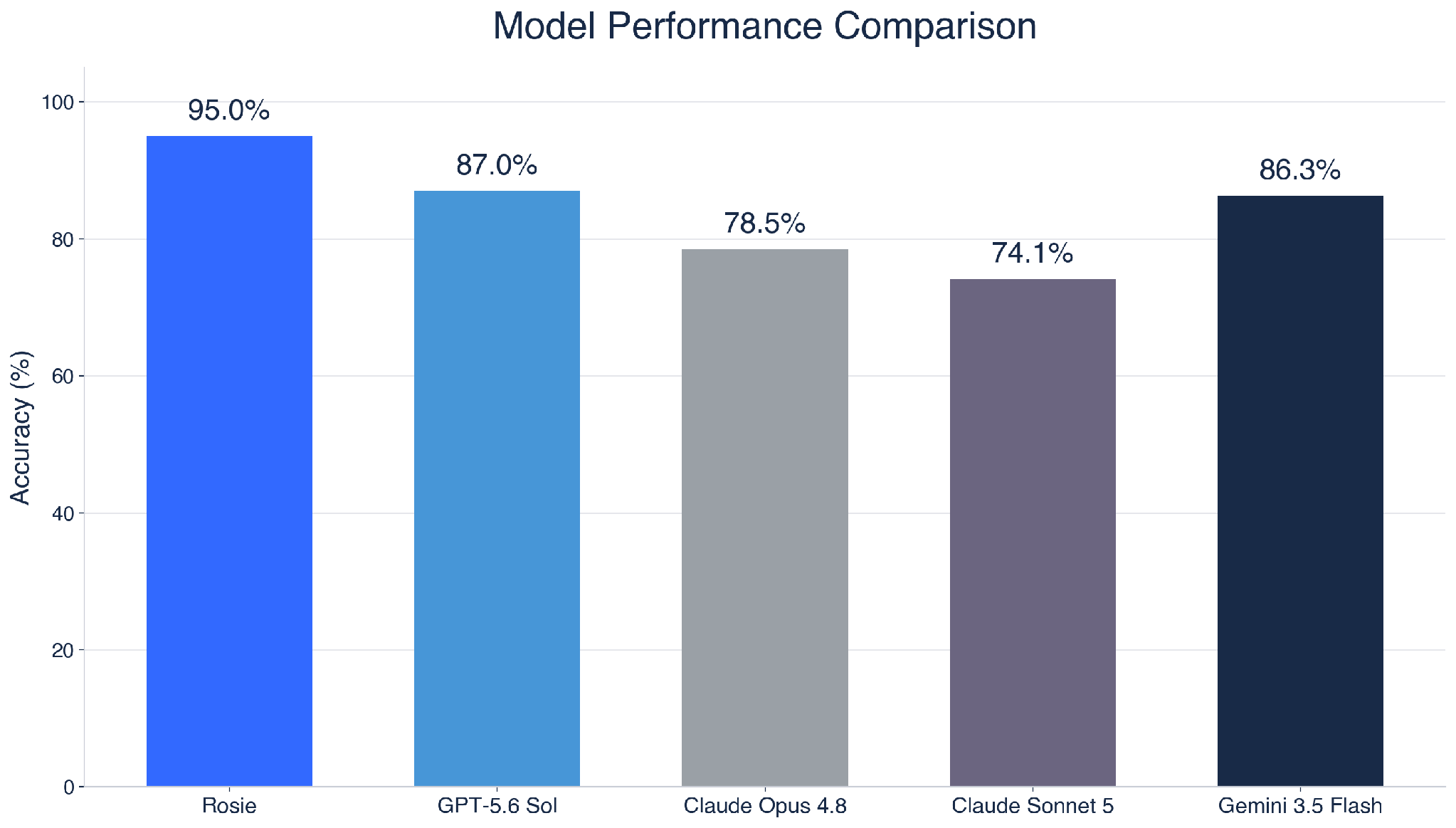
| Rosie | 95.0% | [93.65%, 96.29%] | Hybrid RAG |
| GPT-5.6 Sol | 87.0% | [84.95%, 89.05%] | Zero-shot |
| Gemini 3.5 Flash | 86.3% | [84.26%, 88.37%] | Zero-shot |
| Claude Opus 4.8 | 78.5% | [75.95%, 80.94%] | Zero-shot |
| Claude Sonnet 5 | 74.1% | [71.46%, 76.74%] | Zero-shot |
Table 1: Overall benchmark results on SALUS-SafetyQA (n=1,023). Rosie shows 8.0 pp improvement over GPT-5.6 Sol, 8.7 pp over Gemini 3.5 Flash, 16.5 pp over Claude Opus 4.8, and 20.9 pp over Claude Sonnet 5. All comparisons statistically significant (p < 0.001, McNemar's test).
6.2 Performance Visualizations
6.3 Statistical Significance
All pairwise comparisons between Rosie and baseline models show highly significant differences (McNemar's test, p < 0.001):
| Comparison | Rosie Wins | Baseline Wins | Net Advantage | p-value |
|---|---|---|---|---|
| vs GPT-5.6 Sol | 119 | 37 | +82 | p < 0.001 |
| vs Gemini 3.5 Flash | 129 | 40 | +89 | p < 0.001 |
| vs Claude Opus 4.8 | 207 | 38 | +169 | p < 0.001 |
| vs Claude Sonnet 5 | 245 | 31 | +214 | p < 0.001 |
Table 2: McNemar's test pairwise comparisons. On questions where models disagreed, Rosie answered correctly in 76.3%-88.8% of cases (mean: 81.5%).
7. Analysis
7.1 Domain Adaptation Impact
Rosie's hybrid RAG architecture demonstrates substantial improvements over frontier LLMs:
- +8.0 pp over GPT-5.6 Sol (95.01% vs 87.00%)
- +8.7 pp over Gemini 3.5 Flash (95.01% vs 86.31%)
- +16.5 pp over Claude Opus 4.8 (95.01% vs 78.49%)
- +20.9 pp over Claude Sonnet 5 (95.01% vs 74.10%)
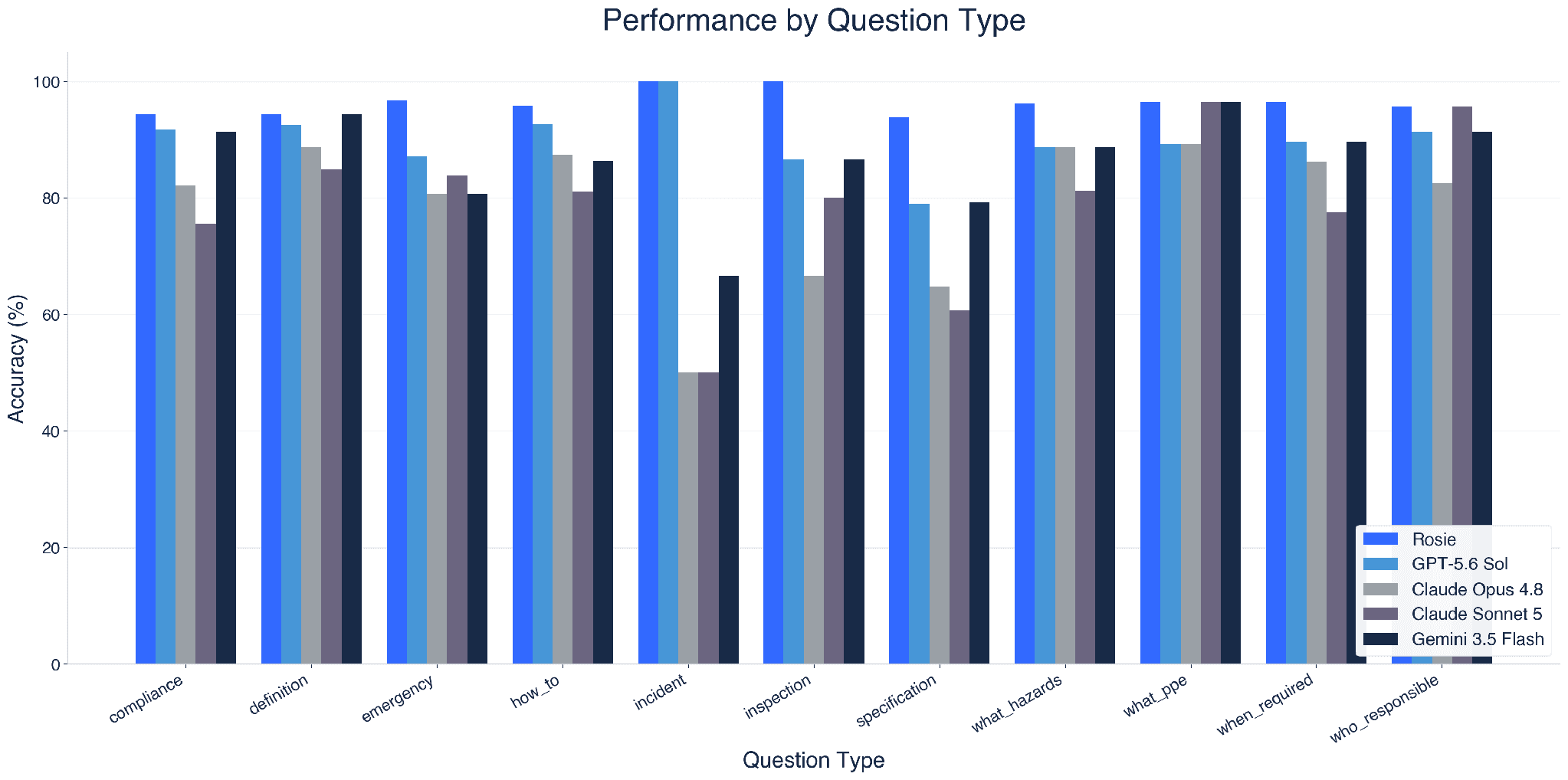
These improvements are consistent across question types, with Rosie achieving 90%+ accuracy on every category (lowest: specification at 93.8%).
7.2 Category-Specific Performance
7.2.1 Specification Questions (31.7% of benchmark)
Rosie excels at questions requiring precise technical values (93.8% accuracy), while baseline models struggle significantly:
- GPT-5.6 Sol: 79.0% (-14.8 pp)
- Gemini 3.5 Flash: 79.3% (-14.5 pp)
- Claude Opus 4.8: 64.8% (-29.0 pp)
- Claude Sonnet 5: 60.8% (-33.0 pp)
This category is the highest failure mode for general-purpose LLMs, which often hallucinate plausible but incorrect numerical values.
7.2.2 Manual-Based Questions
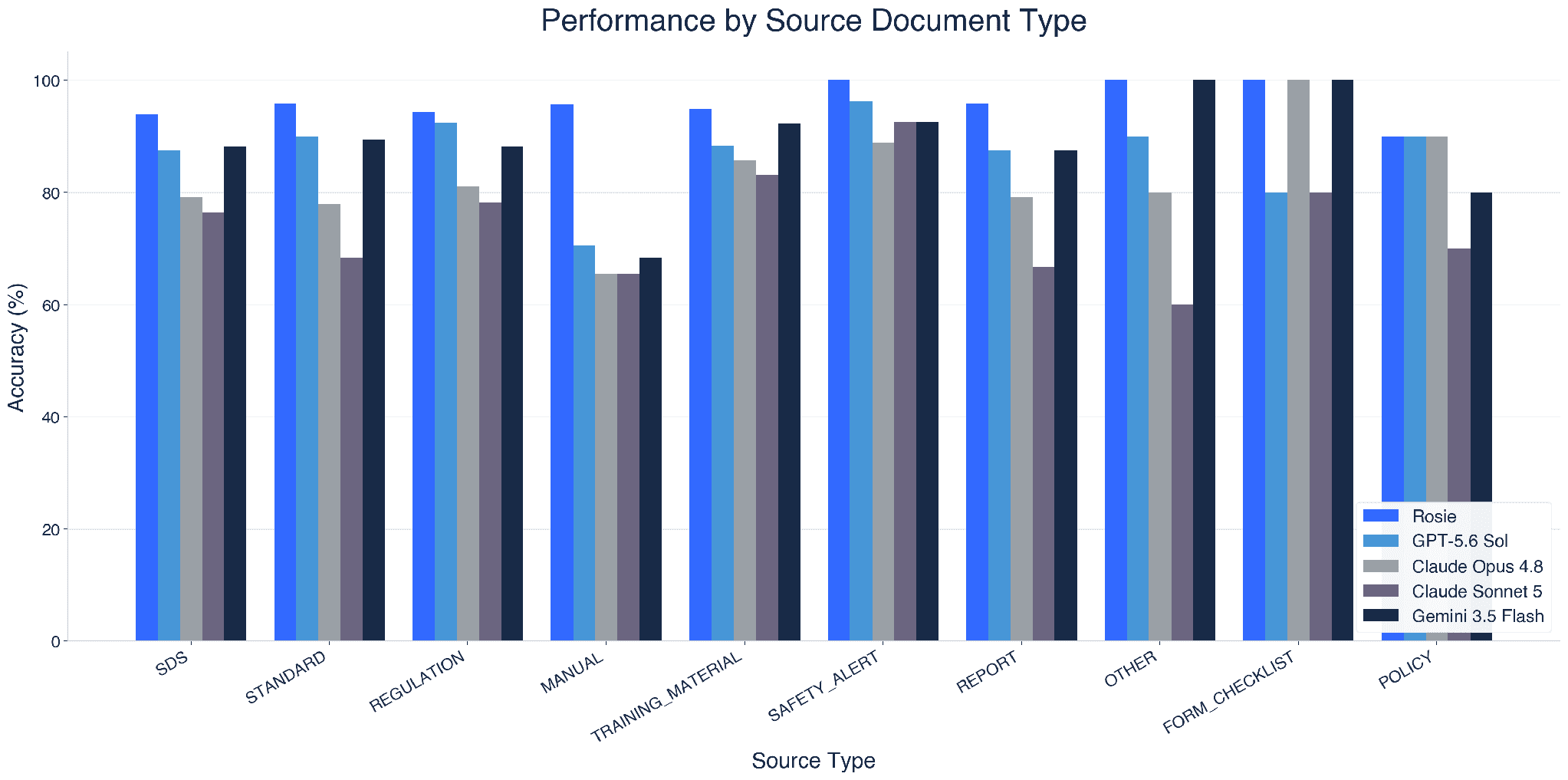
Documents requiring procedural knowledge show the largest gaps:
- Rosie: 95.7%
- GPT-5.6 Sol: 70.5% (-25.2 pp)
- Gemini 3.5 Flash: 68.4% (-27.3 pp)
- Claude Opus 4.8: 65.5% (-30.2 pp)
- Claude Sonnet 5: 65.5% (-30.2 pp)
7.3 Error Analysis
Rosie's residual errors (approximately 5% of questions) cluster around genuinely ambiguous specifications with multiple plausible interpretations and edge cases involving conflicting jurisdictional requirements.
Baseline LLM errors predominantly involve hallucinated values—inventing plausible but incorrect specifications—and general-knowledge substitution, where models rely on common industry practice instead of the document-specific requirement being asked about.
8. Transparency & Data Availability
8.1 What We Publish
- Full benchmark dataset (1,023 questions) with question text, options, correct answers, and metadata
- Complete evaluation harness (evaluate_benchmark.py) and configuration files
- Statistical analysis code with bootstrap confidence intervals and McNemar's tests
8.2 What We Do Not Publish
- Source document content or page snippets (proprietary corpus)
- Document titles and internal database identifiers
- Raw document files or training data
Note: Questions are designed to be answerable with publicly available safety documentation (SDS, OSHA regulations, equipment manuals) to enable independent evaluation.
8.3 Data Availability
The SALUS-SafetyQA benchmark is released under CC-BY-4.0:
- Dataset & Code: https://github.com/SALUS-Technologies/SALUS-SafetyQA
- License: Creative Commons Attribution 4.0 International
8.4 Limitations
- English-heavy corpus: Incomplete coverage for non-US regulations
- Domain shift risk: New standards and equipment revisions may not be represented
- Multiple-choice format: May overestimate performance relative to open-ended extraction
- Temporal constraints: Safety regulations and standards change over time
9. Conclusion
We present Rosie, a domain-specialized construction safety AI system, and introduce the SALUS-SafetyQA Benchmark containing 1,023 expert-validated questions. Results show that tailored RAG pipelines significantly outperform general-purpose LLMs in high-stakes safety domains, with 8-21 percentage point improvements and 100% document grounding.
The benchmark reveals systematic failure modes in frontier LLMs: hallucination of plausible but incorrect specifications and poor performance on equipment manuals. These findings demonstrate the critical need for domain-specific systems in safety-critical applications.
Future work includes expanding jurisdictional coverage, incorporating multimodal inputs (drawings, diagrams), and developing open-ended evaluation protocols.
A canonical paper with a versioned record.
This HTML page and its PDF use the same version identifier. Release artifacts are checksum-verifiable, while the benchmark dataset remains separately versioned.
BibTeX
@techreport{salus2026rosie,
  title={Rosie: Technical White Paper & Benchmark Report},
  author={Jacobs, Alex and Ayvazov, Dany},
  institution={SALUS Safety},
  year={2026},
  month={July},
  note={Version 2.0.0}
}Common questions.
What does SALUS-SafetyQA evaluate?
What accuracy does the paper report for Rosie?
Is the benchmark dataset public?
Is this an externally peer-reviewed paper?
What changed from the 2025 report?
Does the benchmark remove the need for qualified human review?
References
- [1]Lewis, P., et al. Retrieval-Augmented Generation for Knowledge-Intensive NLP Tasks. NeurIPS, 2020.
- [2]Guu, K., et al. REALM: Retrieval-Augmented Language Model Pre-Training. ICML, 2020.
- [3]Karpukhin, V., et al. Dense Passage Retrieval for Open-Domain Question Answering. EMNLP, 2020.
- [4]Khattab, O., and Zaharia, M. ColBERT: Efficient and Effective Passage Search via Contextualized Late Interaction over BERT. SIGIR, 2020.
- [5]Ma, X., et al. Query Rewriting for Retrieval-Augmented Large Language Models. arXiv:2305.14283, 2023.
- [6]Ma, X., et al. Fine-Tuning LLaMA for Multi-Stage Text Retrieval. arXiv:2310.08319, 2023.
- [7]Nogueira, R., and Cho, K. Passage Re-ranking with BERT. arXiv:1901.04085, 2019.
- [8]Singhal, K., et al. Towards Expert-Level Medical Question Answering with Large Language Models. arXiv:2305.09617, 2023.
- [9]Zheng, C., et al. A Reasoning-Focused Legal Retrieval Benchmark. arXiv:2505.03970, 2025.
- [10]Zhang, F., et al. A hybrid structured deep neural network with Word2Vec for construction accident causes classification. International Journal of Construction Management, 2019.
- [11]Tixier, A. J.-P., et al. Application of Machine Learning to Construction Injury Prediction. Automation in Construction, 2016.
- [12]Fang, Q., et al. Detecting non-hardhat-use by a deep learning method from far-field surveillance videos. Automation in Construction, 2018.
- [13]Gokdemir, O., et al. Automated MCQA Benchmarking at Scale: Evaluating Reasoning Traces as Retrieval Sources for Domain Adaptation of Small Language Models. SC Workshops ’25, 2025.