

What is operational safety in construction?
Safety for production, not against it.
A practical operating model for contractors who want safety to help field crews and safety pros get work done — not slow them down.
Email me the printable scorecard
We’ll email you the printable version and give you immediate access here.
It’s on its way—check your inbox.
Download nowConstruction has spent years adding safety: more forms, more programs, more training, more audits, more software. Some of it helped. But too often, safety became heavier than it needs to be — more paperwork, more chasing, more disconnected systems, and more frustration for the crews expected to use them.
Operational safety is safety built into the way work gets done. It helps crews start work faster, control risk, capture proof, close the loop, and keep projects moving.
It is not safety against production — it is safety for production.
Operational safety is a different operating model — not a new checklist.
Operational safety in construction is the practice of embedding safety, risk controls, field communication, documentation, and corrective action into the daily flow of work. Instead of treating safety as separate paperwork, it helps crews get the right information, capture field events, close feedback loops, and make better decisions while the work is happening.
It is not about doing more safety — and it is not a knock on the people who run safety today. It is about making the right safety faster and easier for everyone, from the worker at the task to the safety director at the desk.
Safety for production, not against it.
- ?Can the worker find the right procedure before the task starts?
- ?Can the foreman capture a hazard or near miss without stopping production?
- ?Can the safety team see what happened without chasing paper, photos, and texts?
- ?Can a corrective action actually get assigned, tracked, and closed?
- ?Can leaders spot risk patterns before they show up as incidents?
The problem isn't production. Or safety. It's safety clutter.
Everybody wants to be safe. As the industry became safer, the clutter grew: paperwork, digital or not, slow, repetitive, disconnected work that frustrates the field and the safety team alike.
Operational safety removes the clutter and enhances the relevance and the safety. Focus on value and outcomes over form count, cut the busywork, put the right streamlined procedure in each worker's hands at the right time, make field capture and stakeholder collaboration easy, give crews instant answers to keep the job moving, and turn thousands of data points into trends that continuously improve SWPs and toolbox talks.
Forms without value
Captured because the process says so — not because they make a real difference.
Access to information
The right procedure, equipment manual, SDS, permit approval, or cert confirmation is never where the work is.
Broken communication
Safe Work Procedures and JHAs get pushed down but not adopted. Hazards, near misses, and corrective actions get reported up — and nothing flows back down.
Admin eats time in the field
Foremen, supers, and safety pros all bogged down in the admin of safety instead of making a difference in the field.
Daily logs from memory
The log gets rebuilt at the end of the day from texts, photos, and whatever people can recall.
Proof is slow
When an owner, GC, or insurer asks, evidence of compliance and performance takes days to pull together.
The field and the safety team both get time back.
Operational safety changes the question.
Compliance still matters — and good safety teams already know it isn't the finish line. Operational safety doesn't replace compliance; it makes compliance a byproduct of better work. When safety is captured at the source, routed properly, and tied to follow-through, the records get better because the operation gets better.
The five principles of operational safety.
A simple operating model for making safety help production. Tap each principle to see what it asks — and what it looks like in SALUS.
 Operational safety
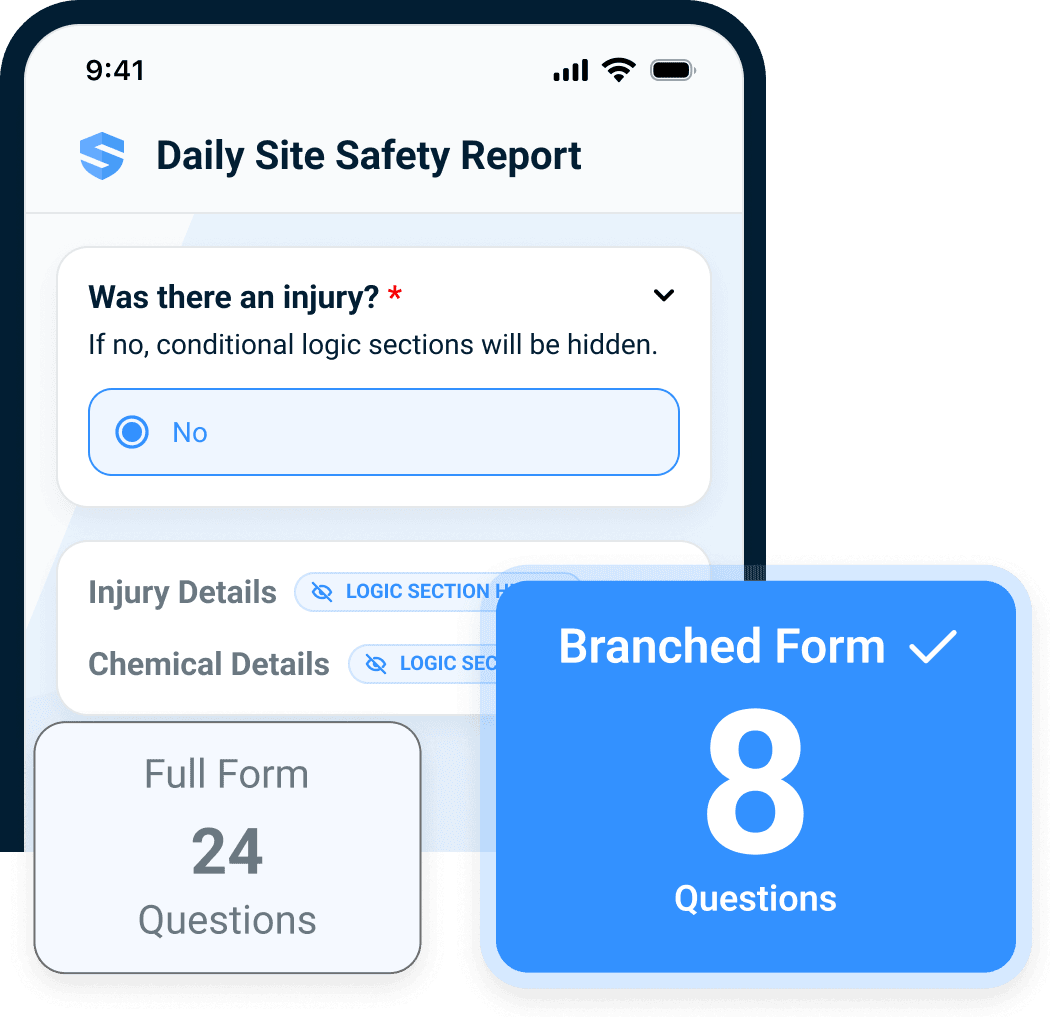
Value over volume
Safety has to deliver value, not just volume.
- The question isn't “How many forms did we collect?”
- It's “Did the safety activity help control a risk, prove the work, or close the loop?”
- A contractor can complete thousands of forms and still miss the signal that matters.
The right information at the right moment
The right procedure, in the right worker's hands, at the moment of risk.
- Not three days later. Not buried in a binder. Not locked in the office.
- AI shouldn't replace safety judgment — it should cut the time to find and apply the right information.
- SDS, permits, training records, and risk controls surface where the task is.

At 40 ft of reach, the rated capacity is 2,500 lb with the load centered and the boom at or below 45°. Confirm the load weight before lifting.
- Rated capacity
- 2,500 lb
- Configuration
- 40 ft reach · centered load · boom ≤ 45°
- At 50 ft
- Capacity drops to 1,200 lb
The operator still verifies the actual load, attachment, and machine configuration before the lift.
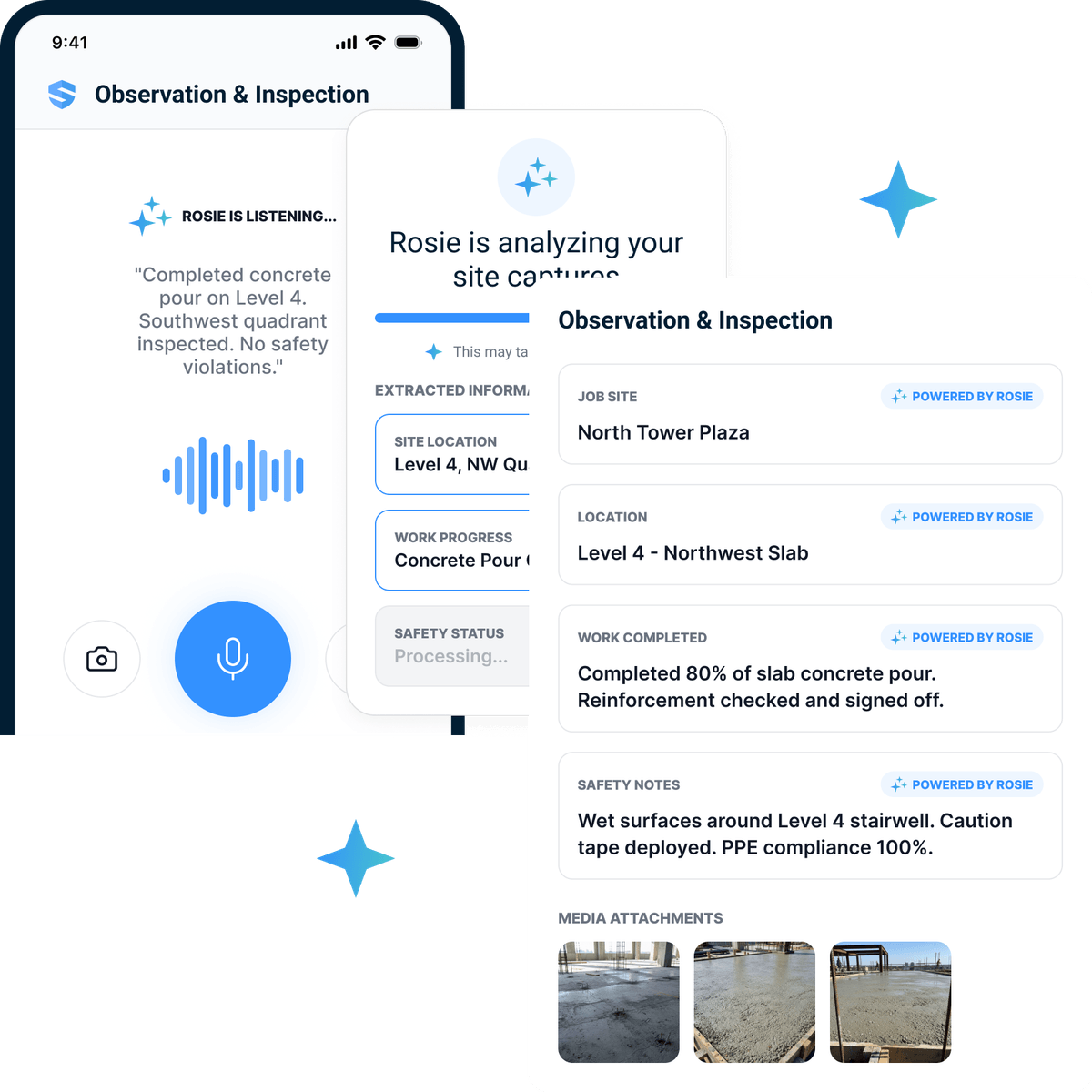
Capture in the flow of work
Capture what happened while the work is still fresh.
- Who was on site, what task was underway, what risk discussion happened.
- A photo, a voice note, a near miss — tied to the site, crew, task, time, and workflow.
- Work continues; the structured record already exists.
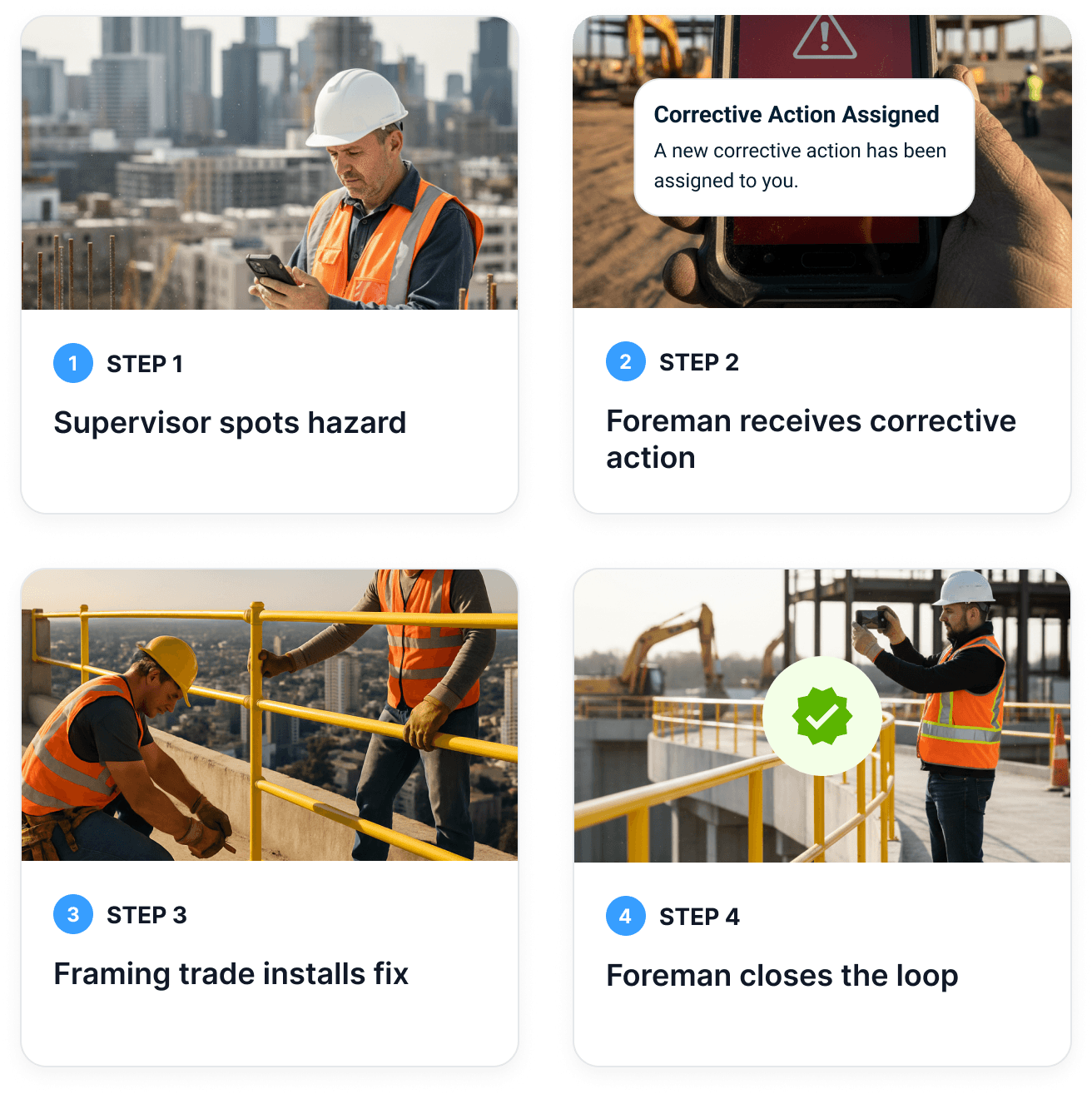
Closed-loop follow-through
A hazard report nobody acts on is not operational safety.
- Capture the event, route it, assign ownership, track the action.
- Confirm closeout, share the learning, watch for repeat patterns.
- This is the clearest line between safety paperwork and safety operations.
Field data becomes risk intelligence
Turn everyday field activity into patterns teams can act on.
- Which crews see repeat hazards? Which phases create the most corrective actions?
- Which subcontractors need support before incidents happen?
- Which forms produce real signal — and which are just noise?
Three projects need attention. Northgate Tower is the most exposed because of 436 unassigned corrective actions, one serious open incident, and a slipping schedule.
- Northgate Tower
- High safety · behind schedule · margin at risk
- SeaTac Terminal
- Medium safety · tight schedule · margin eroding
- Broadway Towers
- Medium safety · on track · healthy margin
This is a decision-support ranking; leaders review the linked evidence before acting.
What operational safety actually looks like, hour by hour.
The same field truth, captured once, becomes readiness in the morning, proof during the shift, a closed loop after an event, and the daily report at the end of the day.
- 0106:30Morning start
Crews open the day with the plan already loaded.
Pre-task plan, hazard assessment, permits, and required credentials surface for today's work — the right procedure available without hunting.
RosieMobilization readinessThe first site mobilizes Monday with a new bilingual crew. Get them ready.Drafted the site-specific safety planPlan draftedBuilt the orientation and field formsPackage builtPrepared the crew-language documentsEN + ES readyThe site is ready to mobilize Monday with the plan, orientation, field forms, and hazard controls prepared for the crew.
Monday mobilization — readiness record- Site controls
- Site-specific plan + deployed hazard controls
- Crew package
- Orientation + required field forms
- Languages
- English + Spanish
Sources: Site profile · company standards · crew rosterThe site lead confirms the final scope, crew, and local requirements before mobilization.
- 0210:14During the work
A worker spots a hazard and captures it in seconds.
Voice, photo, or note from the field — tied to the site, crew, task, time, and the right workflow. No retyping, no chase.
- 0311:02After the event
The loop closes — not the spreadsheet.
The right stakeholder is notified, a corrective action is assigned, and the field sees the issue didn't disappear into a folder.
- 0417:45End of day
The daily log assembles itself.
The day's safety record, daily report, and risk dashboard become outputs of the same field truth — captured as the work happened, not rebuilt from memory.
RosieDaily site summarySummarize what happened at Broadway Towers yesterday from the forms, photos, and notes.Pulled yesterday’s field submissions12 formsReviewed the attached site evidence8 photosParsed the supervisor record3 notesThe daily record is assembled. Two crews are missing hazard assessments, one near miss is documented, and one corrective action remains open from last week.
Broadway Towers — daily summary- Site activity
- 23 workers · 12 form submissions
- Safety record
- 0 incidents · 1 near miss
- Follow-through
- 3 new actions · 1 carried open
Sources: 12 forms · 8 photos · 3 supervisor notesReview daily reportThe foreman reviews the assembled report before it becomes the final daily record.
AI doesn't make safety operational. Grounding does.
AI becomes useful when it's grounded in your procedures, field records, forms, and workflows. It should reduce the distance between a field question and a useful answer — not invent more forms to fill out.
- Get workers specific answers to specific questions
- Generate site-specific safety materials faster
- Summarize captured field events into usable reports
- Surface repeat hazards and risk patterns
- Show managers and safety leads what needs follow-up
- Cut the admin load between field capture and office reporting
- Act as an autonomous safety authority
- Answer from the open internet instead of your approved content
- Replace human judgment on complex hazards
- Hide its sources or skip the citation
- Collect worker-level data without governance
The future isn't more forms with AI on top. It's less waste, faster answers, cleaner capture, and better risk intelligence from the safety work crews already do.
Operational safety metrics worth tracking.
Lagging indicators like TRIR and DART matter — but they arrive late. These metrics tell you whether the operating model is working before harm happens.
Time spent creating, chasing, and rebuilding safety reports
Active crew usage by workflow — not just user logins
Pre-task / JHA / FLRA completion before work starts
Systems where the same field data is retyped
Time from hazard capture to assigned action
Corrective-action closure rate and average days to close
Repeat hazards by crew, trade, task, location, or phase
Time from field question to usable answer
Time to generate daily, weekly, executive, or audit reports
Percentage of reports usable without cleanup
The 6-step operational safety audit.
You don't operationalize safety with a rip-and-replace. You do it one high-friction workflow at a time.
- 01Step 1 of 6
Pick one high-friction workflow
Start with something crews already touch daily or weekly: pre-task plans, FLRAs/JHAs, toolbox talks, permits, hazard reports, near misses, inspections, corrective actions, or daily logs.
Start where crews already work — not with a new program - 02Step 2 of 6
Map the current friction
Where does the field lose time? Where does information get retyped? Where does safety data go missing? Where does the office have to chase? Where does a hazard report fail to become action? Where does the daily report depend on memory?
- 03Step 3 of 6
Remove the low-value steps
Don't digitize clutter. Remove it. Operational safety is not paperless bureaucracy — it's simpler safety with better signal.
Don't digitize clutter — remove it - 04Step 4 of 6
Capture field facts at the source
Make capture fast, mobile, contextual, and tied to the real jobsite entities: worker, crew, trade, task, location, asset, permit, form, time, hazard, incident, and action.
- 05Step 5 of 6
Close the feedback loop
Every hazard, near miss, question, or corrective action should have an owner, a status, and a resolution path — visible to the field that raised it.
- 06Step 6 of 6
Turn the data into decisions
Use dashboards, AI summaries, reports, and risk insights to help teams act sooner — not just report later.
The Operational Safety Scorecard.
Score each dimension from 1 (pure paperwork) to 5 (fully operational). Watch your total move between compliance clutter and operational safety — then take the full version to your team.
Some workflows are digital, but the system is still form-first.
1 = pure paperwork · 5 = fully operational. Move the dials to see where safety helps production — and where it drags.
Email me the printable scorecard
We’ll email you the printable version and give you immediate access here.
It’s on its way—check your inbox.
Download nowRun the scorecard with your team — find the friction.
Get the full Operational Safety Scorecard as a printable worksheet, plus the diagnostic prompts behind each dimension. It's a practical way to find where safety is helping production — and where it's creating drag for crews and safety teams alike.
Email me the printable scorecard
We’ll email you the printable version and give you immediate access here.
It’s on its way—check your inbox.
Download now- 8 dimensions, scored 1–5, with diagnostic prompts
- Four maturity tiers from compliance clutter to operational safety
- A short-list of the highest-ROI workflows to fix first
- See how SALUS closes each gap — capture, loop, and intelligence
Common questions.
What is operational safety in construction?
Is operational safety the same as compliance?
Does this replace the safety team?
What role does AI play in operational safety?
How is operational safety different from safety software?
Sources and context
Each source is listed for the specific context it supports; none independently validates SALUS product claims.
- Recommended Practices for Safety and Health Programs in Construction
U.S. Occupational Safety and Health Administration
Primary regulatory-program context for worker participation, hazard identification, prevention, training, and program improvement.
- Safety Management — Worker Participation
U.S. Occupational Safety and Health Administration
Primary guidance for accessible hazard and near-miss reporting, prompt follow-up, worker input, and removal of language or process barriers.
Stop adding safety. Start operationalizing it.
Bring your most cluttered safety workflow to a 15-minute demo and we'll show you how SALUS turns it into operational safety: faster capture, cleaner data, closed-loop follow-through, and risk intelligence from the work crews already do.
Value over volume · Capture in the flow · Close the loop · Field data becomes intelligence