

Every worker on the same page — in their own language.
Poor communication is the number one reason crews get blocked: unclear instructions, information silos, language barriers, missing details. And in an industry short 439,000+ workers, every blocked crew and every walk-off hurts twice. SALUS puts the whole site on one channel — instructions delivered understood, alerts acknowledged by name, and a crew whose reports come back as visible fixes.
Workers stay where tools respect their time and their voice produces change.
Live board
The morning message · Crew 7B
Poor communication — the #1 crew blocker
Instructions on every phone, in 21+ languages
Stand-downs acknowledged & tracked by name
Reports become visible fixes — the loop that retains
Built for a 439,000-worker shortage
The #1 reason crews get blocked is poor communication. And you can't hire your way around it.
When communication breaks down, workers are left without the clear instructions they need to do their jobs right — and in a structural labor shortage, every blocked hour and every resignation costs more than it ever has.
Unclear. siloed. untranslated. Unheard.
The message leaves the office. It rarely reaches the crew.
- Unclear instructions — workers don't know which task comes first
- Information silos — photos, plans, and updates stuck on one phone
- Language barriers — confusion, mistakes, and signatures without understanding
- Missing details — crews arrive but can't start without the day's specifics
- The relay chain — PM to super to foreman to, maybe, the crew
- The feedback void — reported once, never heard about again
Blocked crews today. Empty positions tomorrow.
- Blocked crews — in a market where you can't hire replacements
- Slow starts — onboarding drags when half the crew can't read the packet
- Participation capped at the English speakers — a third of the workforce excluded
- Near-misses unreported — the risk you can't see grows quietly
- ~68% industry turnover — ~73% in the skilled trades — and ½–2× salary to replace a journeyman (The Resource Company 2025; Gallup)
- Your best people leaving for outfits whose tools respect them
One channel, both directions, every language.
Down the channel: tasks, talks, alerts, and procedures published once — arriving on every worker's phone, in their language, with delivery confirmed by name. Up the channel: questions, near-misses, photos, and ideas — readable in English the moment they're sent, routed to an owner, and answered where the worker can see it. Rosie carries both directions: translating, targeting, confirming, routing.
What the office sends
- Today's tasks, in orderper crew
- Custom toolbox talks21+ languages
- Wind stand-down — 35 mphacknowledged
- Revised SWP, v12versioned
- Corrective actions, messages, formsone inbox, live status
Translates · targets · confirms · routes — both directions.
What the crew sends back
- “¿Este arnés sirve?” — answeredin Spanish
- Near-miss, Level P3routed → fixed
- Photo: pour area blockedtimestamped
- “The talk should cover wind”next talk
Published once. Understood by each. Answered in return.
The relay chain loses the message. The channel confirms it.
Watch one revised work sequence travel from the PM to a 44-person site, both ways. The relay chain is a telephone game played with safety-critical information; the channel is the same message, delivered whole, in eight languages, with receipts.
Four hops, half a day, no receipts.
6:00 AM · The PM writes the change
6:40 AM · The super relays it at the gate
7:15 AM · The foreman repeats it from memory
9:30 AM · A bilingual worker translates, informally
The night crew — never told
Who heard what? Nobody can say — until the rework proves it
One publish, 44 confirmed receipts.
6:05 AM · Published once — pushed to every phone
6:05 AM · Rendered in each worker's language (8 on this site)
6:07–6:19 AM · 42 of 44 acknowledged, by name
6:20 AM · The 2 who haven't — flagged to their foremen
Night crew · same message waiting at clock-in, versioned
Who heard what? Timestamped, per worker — provable
Fidelity decays at every hop. The channel has no hops.
Recognize the relay chain? Replace it with a channel that confirms.
See the channel reach your crewSay it once. Reach everyone.
The crew starts knowing exactly what comes first.
Unclear instructions and missing details are how mornings die. With SALUS, the day's tasks, the briefing, the procedures, and the urgent alert all land directly on the worker's device — in order, in their language, with receipt tracked. The information silo (one phone holding what the whole crew needs) stops existing.


The toolbox talk is drafted around the event the crew just experienced: treat wet floors as immediate hazards, own housekeeping, and barricade before work resumes.
- Event
- Slip on wet floor · Level 2 · Dec. 29
- Crew controls
- Identify · barricade · clean · verify
- Delivery
- Site-specific talk · ready in 4 minutes
The supervisor reviews the draft and leads the crew discussion before collecting acknowledgement.
The briefing, generated and signed
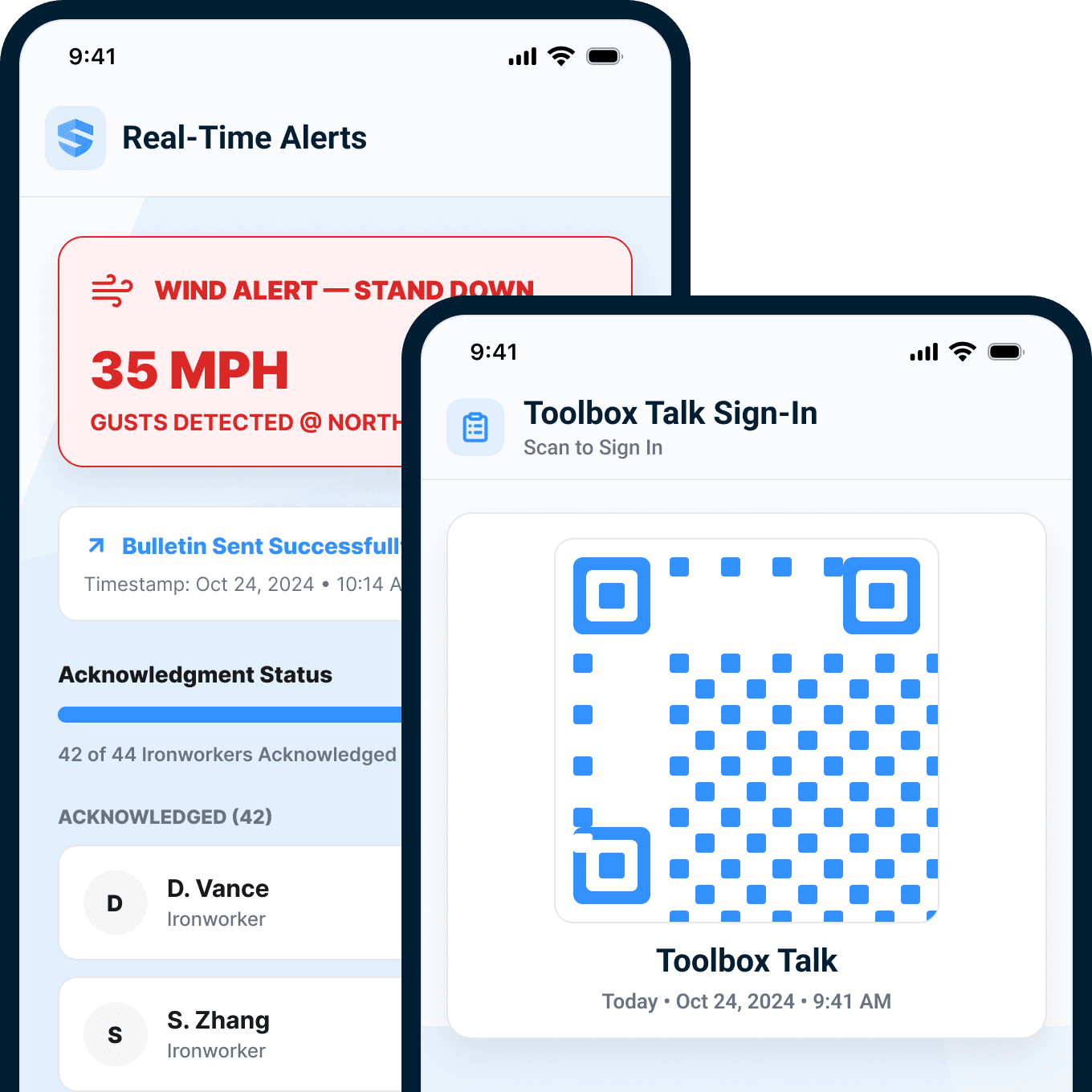
Rosie drafts the morning talk from the site's own near-misses and scope, and the crew signs in by QR — no clipboard, no 'who missed it?'. The day opens with everyone on the same plan.
The toolbox talk is drafted around the event the crew just experienced: treat wet floors as immediate hazards, own housekeeping, and barricade before work resumes.
- Event
- Slip on wet floor · Level 2 · Dec. 29
- Crew controls
- Identify · barricade · clean · verify
- Delivery
- Site-specific talk · ready in 4 minutes
The supervisor reviews the draft and leads the crew discussion before collecting acknowledgement.
The alert that proves it arrived
Wind hits 35 mph and the stand-down goes straight to every ironworker's phone — 42 of 44 acknowledged in minutes, the last two flagged by name to their foremen. Word-of-mouth becomes a receipt.
Nothing missing on day one
Crews that arrive without the day's specifics can't start. The mobilization package — site plan, orientation, forms, translated key docs — is on their phones before the gate opens.
The site is ready to mobilize Monday with the plan, orientation, field forms, and hazard controls prepared for the crew.
- Site controls
- Site-specific plan + deployed hazard controls
- Crew package
- Orientation + required field forms
- Languages
- English + Spanish
The site lead confirms the final scope, crew, and local requirements before mobilization.
One inbox for everything they owe
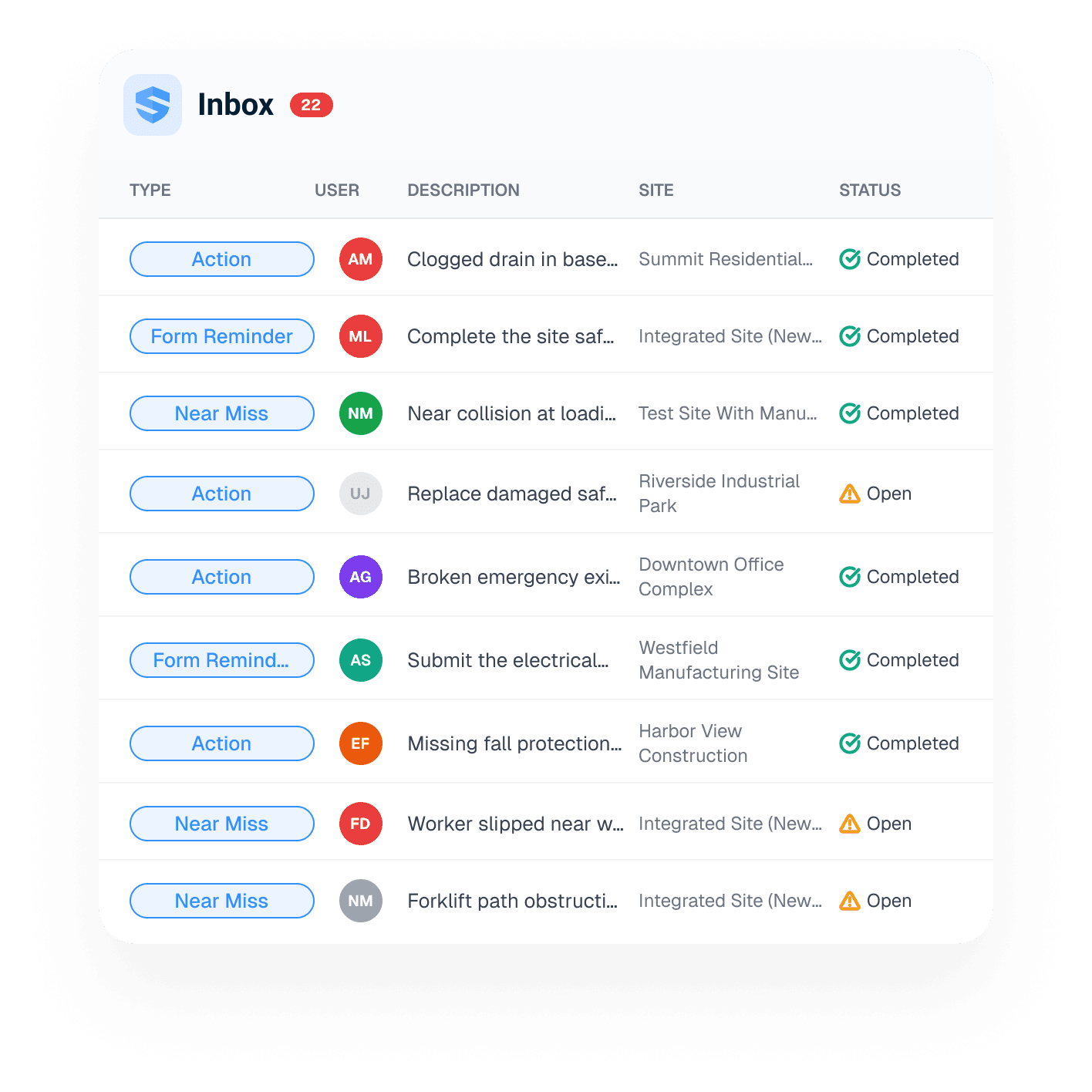
Corrective actions, messages, form reminders, near-miss follow-ups — scattered across texts, emails, and trailer conversations, they slip. SALUS centralizes every To-do in one inbox on the worker's phone, each with a live status the office sees too — and the office reviews and resolves from the same list the field updates. Nothing waits on memory. Everything shows its status.
A crew can't follow a plan it can't read.
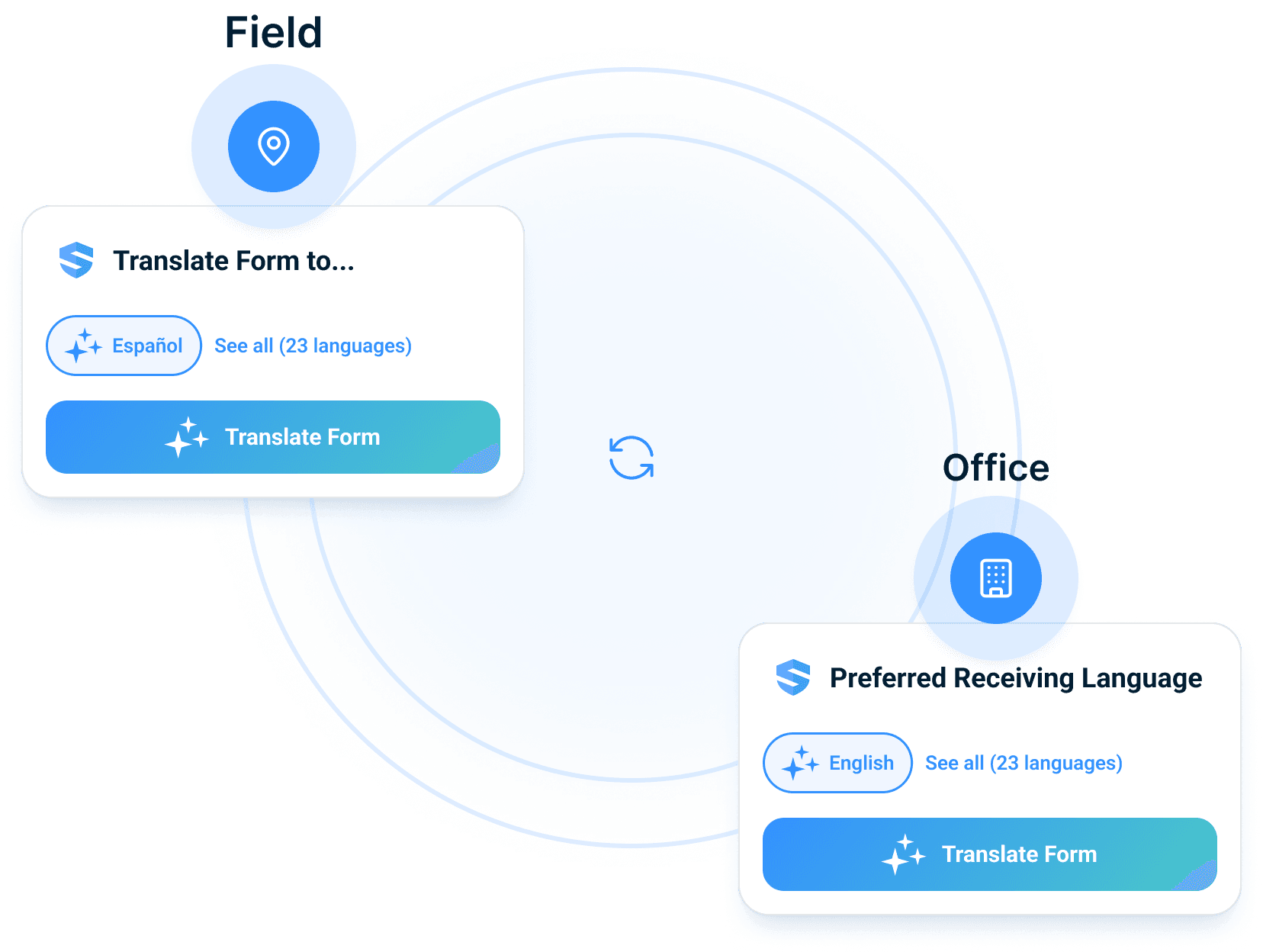
A third of the US construction workforce is Hispanic, and English-only paperwork caps participation at the English speakers — signatures without understanding, observations that never surface. Rosie translates the actual content, both ways: what goes to the worker arrives in their language, and what they send back lands readable in English.
Two directions, one record
The crew works in Español; the office reads everything in English. Not interface labels — the submissions themselves. A hazard typed in Spanish is actionable by the English-speaking super the moment it's sent.
Every form, in their language
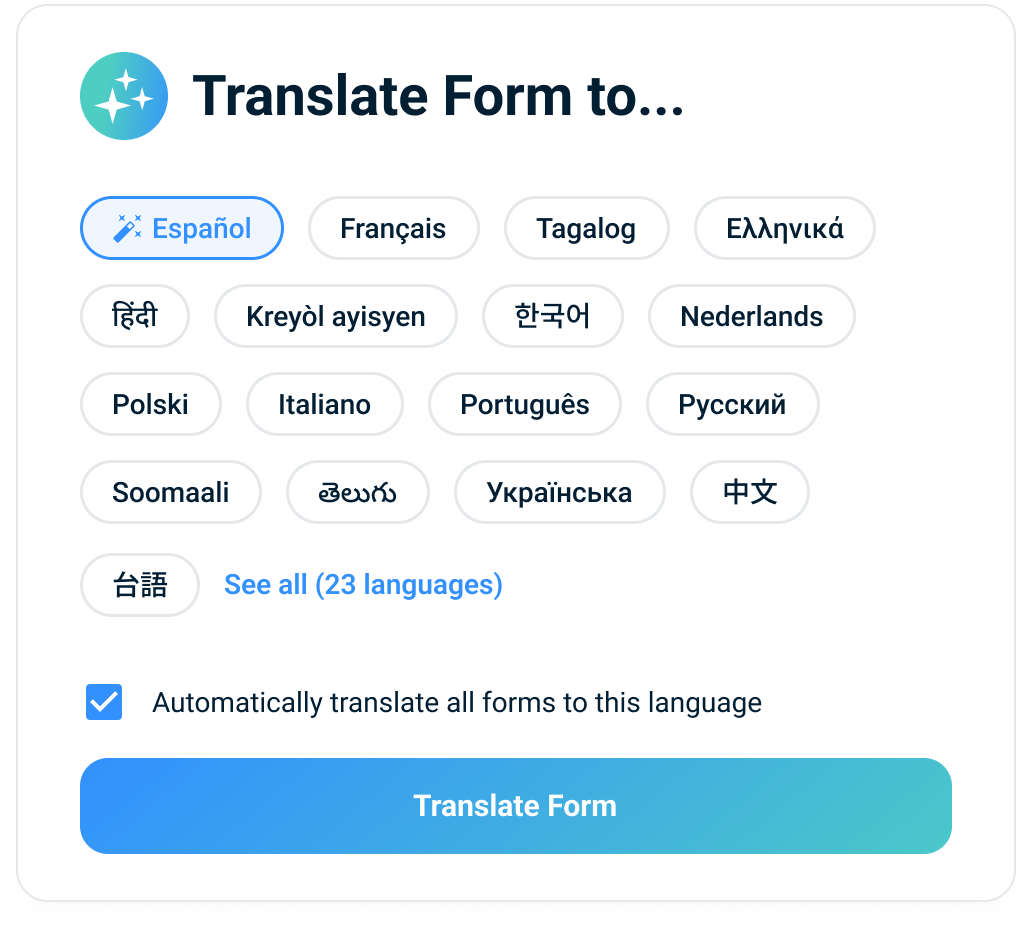
Twenty-three languages and counting — orientations, JHAs, talks, and training rendered per worker, automatically. The signature starts meaning what it's supposed to mean: understood.
Questions answered in plain language
Ask about the chemical, the procedure, or the machine in whatever words come naturally — Rosie returns the specific answer with the source cited, in the language of the asker.
Clear the area, get trained spill-response support, and use the PPE specified in the SDS. Contain the spill with compatible absorbent material; do not add water unless the approved procedure explicitly directs it.
- Immediate action
- Isolate area · notify supervisor · assess exposure
- Controls
- Chemical-resistant PPE · compatible absorbent
- Disposal
- Collect as regulated waste under the site procedure
Follow the product SDS and site emergency plan. Untrained workers should not attempt spill cleanup.
Everything about the worker arrives with the worker.
The biggest communication break isn't on the site — it's between sites. Every transfer used to reset the conversation to zero: re-orientation, re-collected certs, training records lost in a binder two projects back. In SALUS the profile travels — orientation history, certificates, training, language preference, signatures — so the next jobsite already knows who's walking through the gate. Nothing has to be re-said, re-signed, or re-proven.
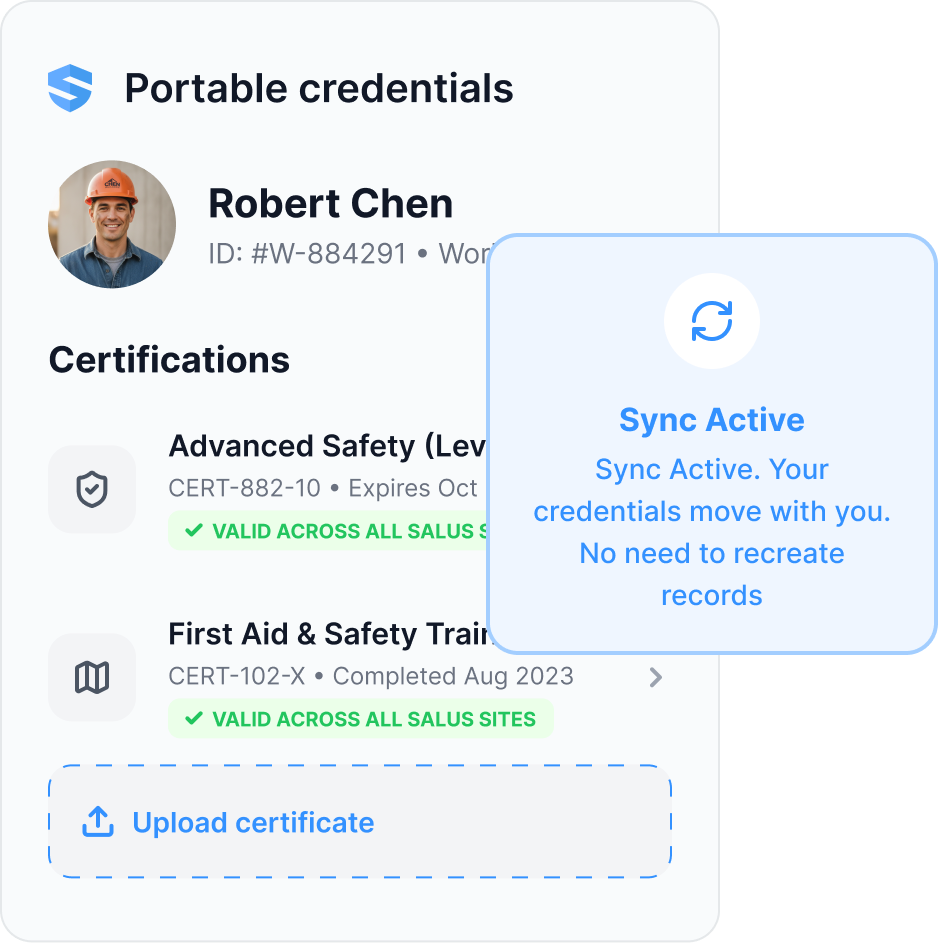
They build it themselves — once
No IT department, no front-office data entry: the worker creates their own profile like any modern app and uploads their certs straight from the phone. Verified once, then valid across every SALUS site — their credentials move with them.
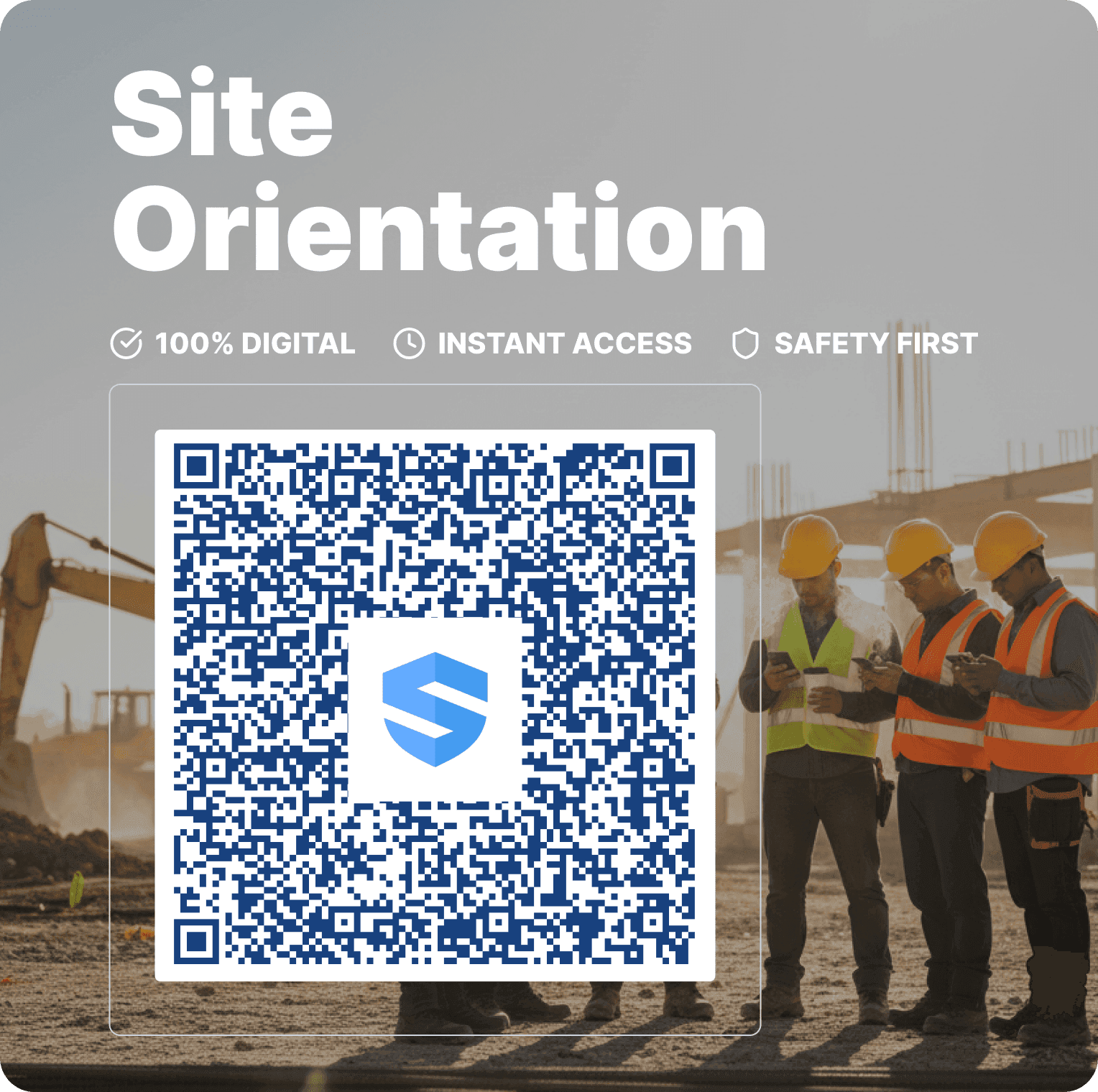
The next gate already knows them
Arrive, scan the orientation QR, and the site already knows the company orientation is done — only the site-specific delta remains, in the worker's language. Two idle hours become thirty productive minutes.
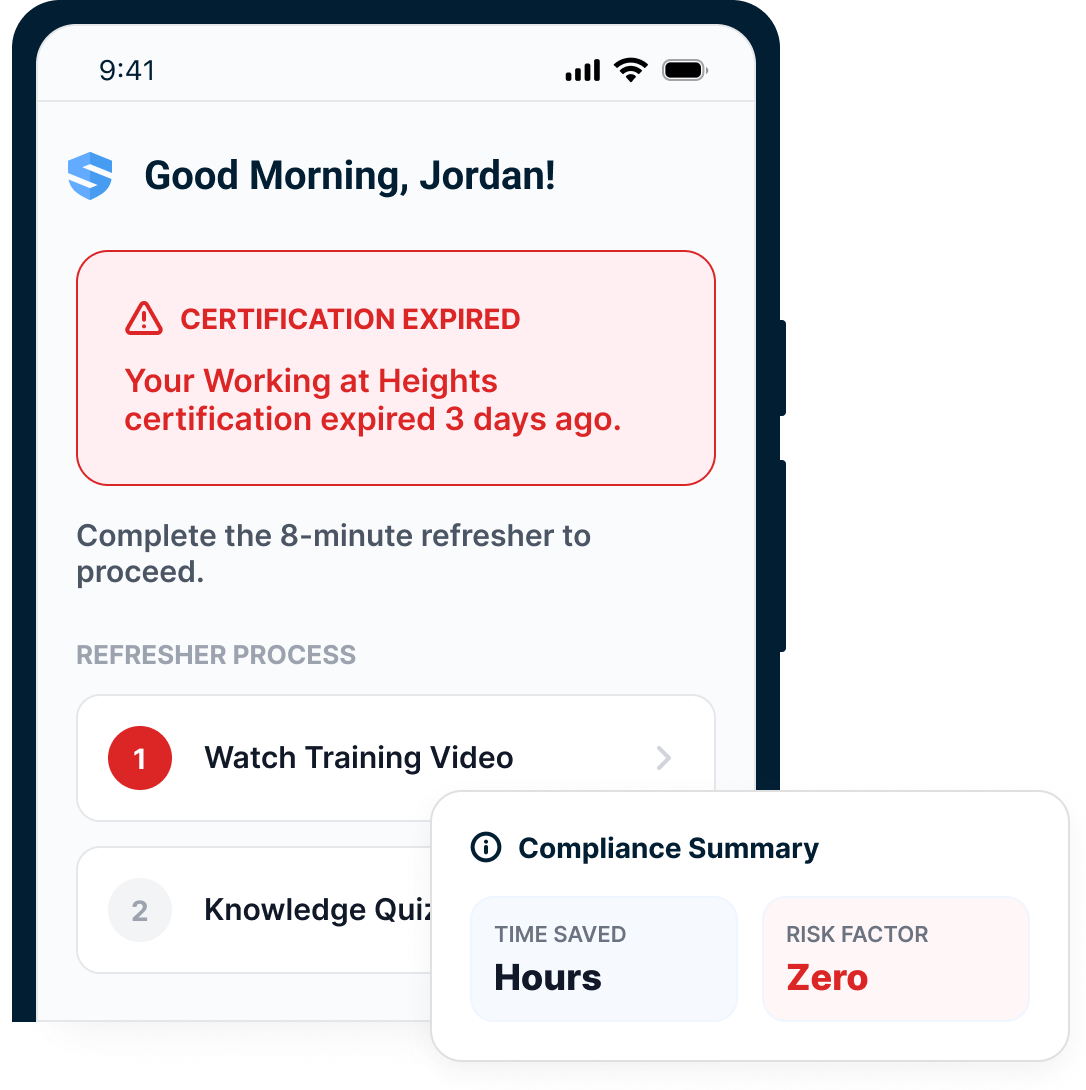
Certs and training, current wherever they go
The Working at Heights cert that expired three days ago prompts its own 8-minute refresher on the worker's phone — and the renewal lands back on the traveling profile, visible to this site and the next one.
Workers stay where their voice produces change.
The feedback loop is broken on most sites: workers report hazards and nothing visible happens, so they stop reporting — and eventually, they stop staying. SALUS closes the loop in front of them: the report routes to a named person, the fix comes back with a photo, and the reporter watches it happen. In a market bleeding talent, that loop is a retention strategy.
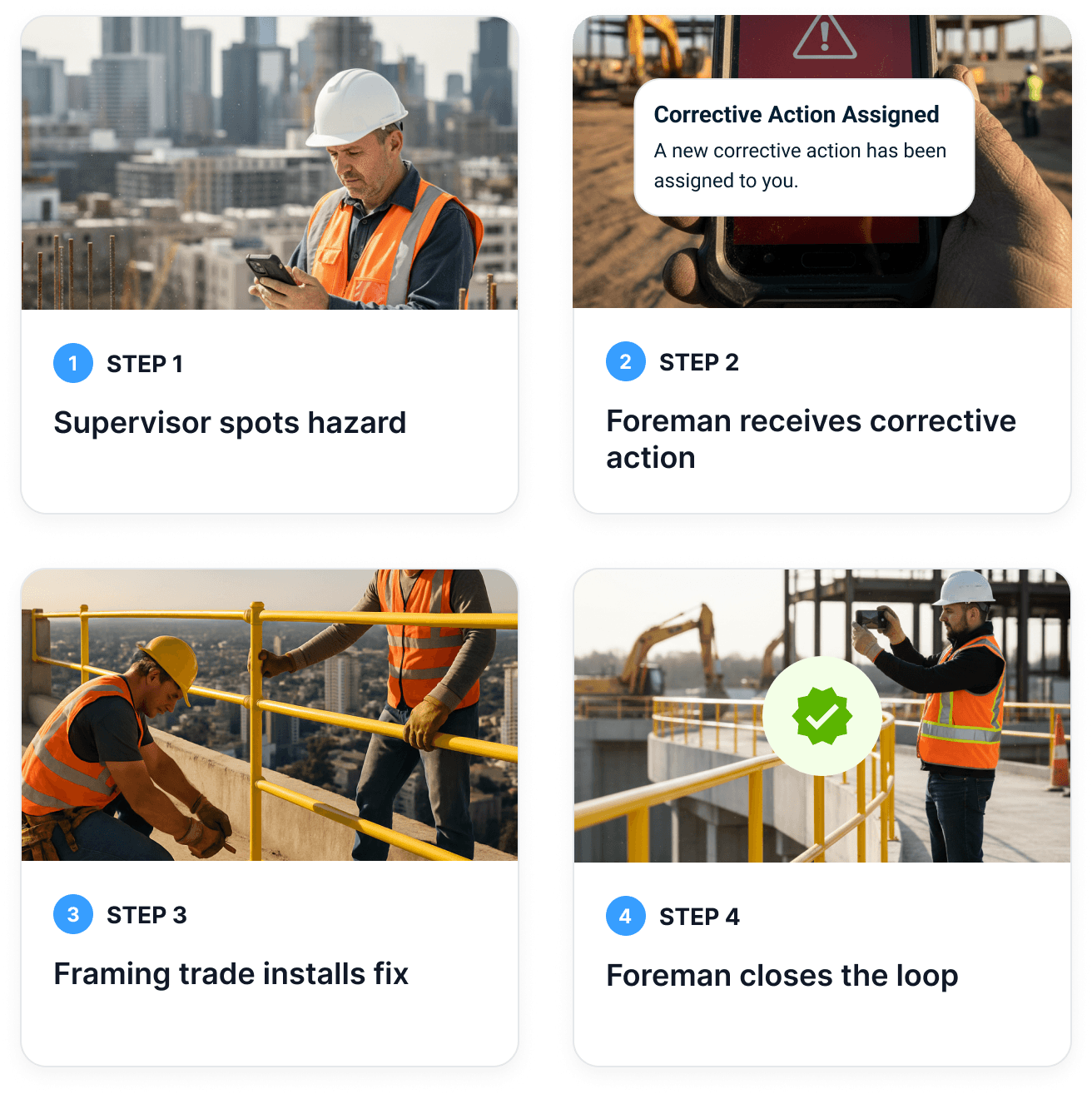
The report that visibly lands
Spot it, report it in 90 seconds, watch it route to a named owner and come back fixed — with the photo. The 7-day paper average becomes hours, and the worker who spoke up sees the proof.
Closed by a name they know
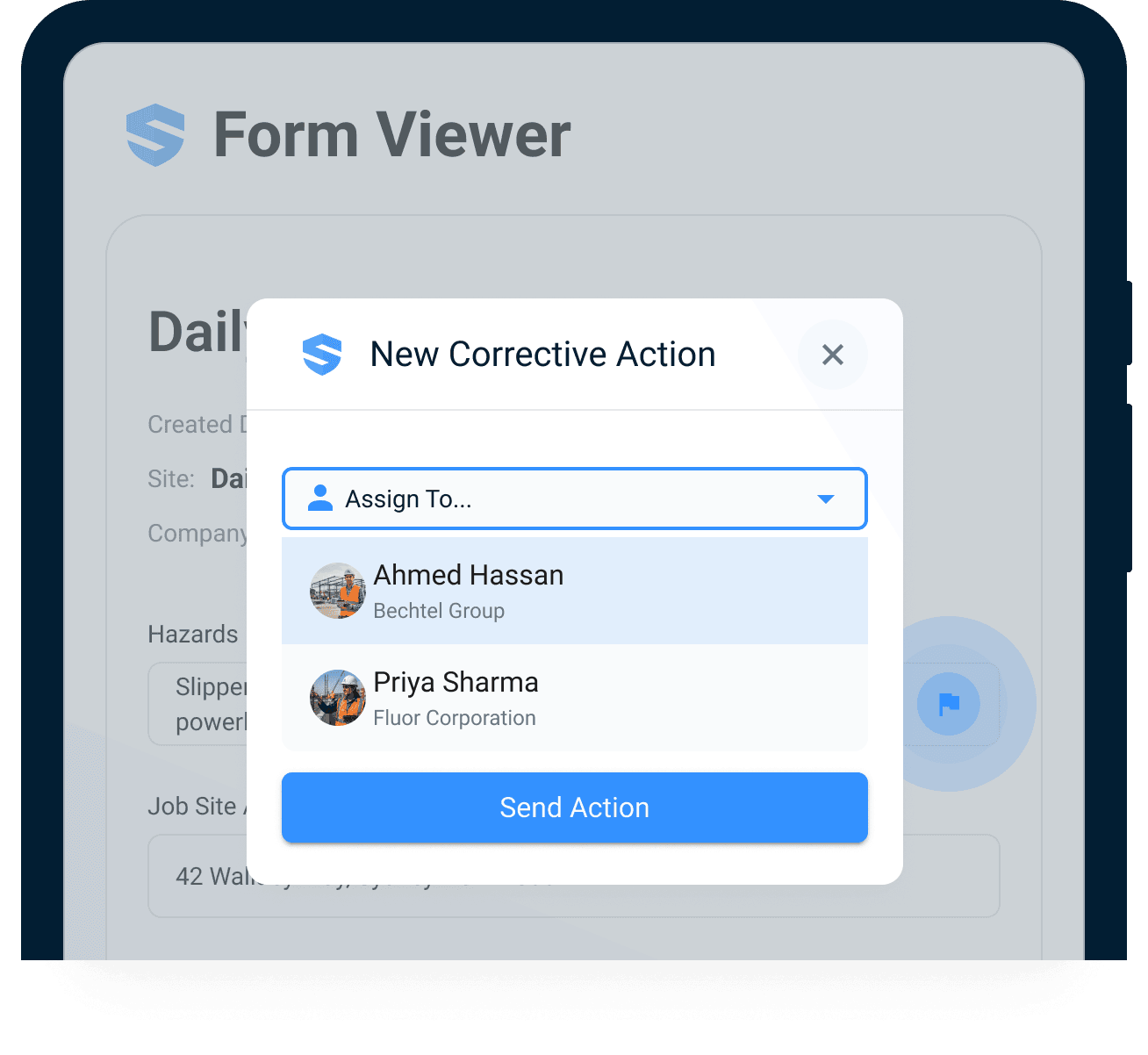
The hazard flagged in the morning's assessment becomes a corrective action without leaving the form — assigned to Ahmed Hassan by name, with a due date, before the walk is over. Accountability the crew can watch builds the trust that surveys can't.
Closed concerns create the next raised hand
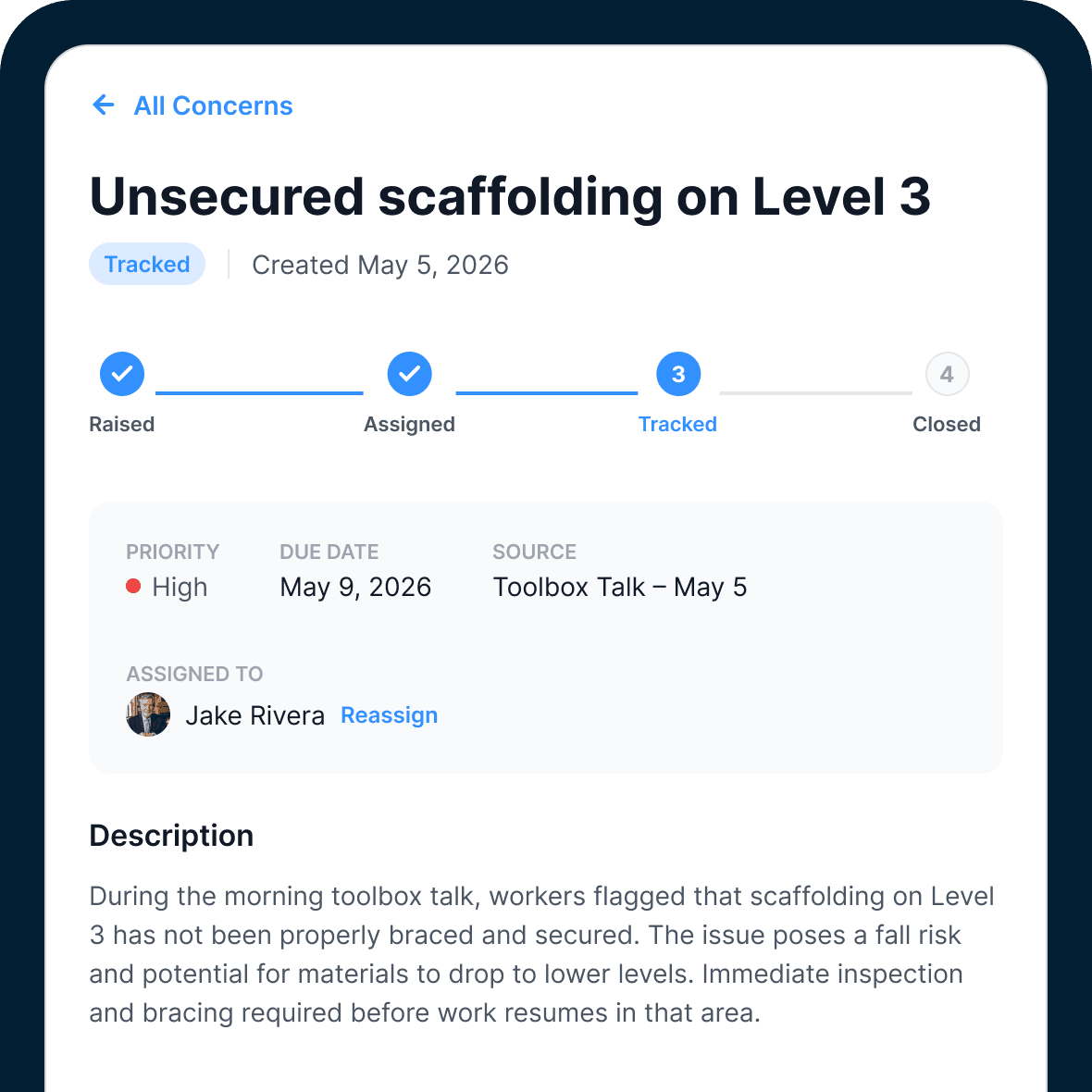
Workers stop raising concerns the first time one disappears into a notebook. SALUS makes the opposite visible: a concern from the May 5 talk — unsecured scaffolding on Level 3 — carries a status the whole crew can watch move from Raised to Assigned to Tracked to Closed, with a named owner and a due date.
When the message gets through, the people stay.
Workers
Gets back · A voice that works
Instructions they can read, questions answered in their language, and reports that come back as visible fixes — participation that feels like belonging.
Foremen & supers
Gets back · A crew that knows what's first
No relay chain, no repeating the brief three times, no being the human translation layer — the morning starts with everyone already aligned.
Safety & ops leaders
Gets back · Culture they can measure
Near-misses from every worker, not just the fluent ones. Standards that reach every phone. Acknowledgments you can audit instead of assume. When speaking up visibly works, workers speak up more — the leading indicators a program is supposed to run on.
Executives
Gets back · Retention as a strategy
In a 439,000-worker shortage with turnover near 68% — ~73% in the skilled trades (The Resource Company, 2025) — tools workers refuse to give up are a competitive moat. Replacing one journeyman runs one-half to two times annual salary (Gallup): on an $80K journeyman, $40K–$160K.
What gets through — and who stays because it does.
Communication and retention are the same problem wearing two hats: the crew that's informed works, and the crew that's heard stays.
What gets through
- Today's tasks, in order, on every phone
- Alerts acknowledged and tracked by name
- Specs and SWPs versioned to the crew, instantly
- Talks understood in 21+ languages — and signed
- Day-one readiness instead of day-one confusion
Who stays
- Participation from the whole workforce, not a fraction
- Near-misses surfacing because reporting visibly works
- Trust built by named, photo-proven follow-through
- Journeyman replacements avoided, at ½–2× salary each
- A program the next generation of workers expects
Crews that got the channel — and kept it.

Crew adoption via AI translation
Their most tech-resistant foreman became the company's first SALUS Award winner — “what got him turned around was the AI Spanish feature.” The crew, in their words: “They feel heard and see it in real time.”

Recovered foreman productivity
100 non-English speakers adopted instantly through AI translation — crews call the experience “Nintendo Wii-level simplicity.” Adoption isn't a training problem when the tool speaks the crew's language.
Reached. Understood. Heard. Retained.
The connected workflows that carry the message.
Every move above runs on a workflow your crews already use. Go deeper on any of them.
Bulletins & Notifications
Pushed to every targeted device — received, opened, acknowledged, timestamped per worker.
Toolbox Talks & Meetings
Drafted by Rosie from the day's data, signed by QR — relevant content, provable attendance.
AI Translation
21+ languages, both directions — submissions translated, not just menu labels.
QR Codes
One scan is the whole interface — no passwords, no downloads, no barriers to participation.
Digital Forms
Task-branched, multilingual, voice-friendly — forms the whole crew can actually complete.
Corrective Actions
Named accountability and visible closure — the loop that builds trust with the field.
Site Orientations
Day one in the worker's language, 30 minutes — and never repeated at the next site.
Offline Mode
The channel works in basements and dead zones — every keystroke saved, synced later.
Keep exploring the work SALUS gives back.
These pages use the same field-to-proof system from different operating angles.
Cut the clutter, the admin, the overhead. Not the protection.
SALUS and Rosie cut safety admin line by line — daily reports in minutes, site plans the same afternoon, audit packets on demand — with proof intact.
Get crews ready to work faster.
Reduce non-productive field time caused by orientations, missing certificates, permit delays, safety questions, SDS lookup, and paper forms — while keeping OSHA-ready documentation organized. The SALUS Ready-to-Work system.
The whole world asks for proof. Rosie answers them all.
GCs, owners, auditors, insurers, and executives all ask for proof — but the evidence lives in binders, PDFs, photos, and inboxes, when it exists at all. SALUS captures crew-level facts with full context, and Rosie assembles them into packets, dashboards, and live portals in minutes.
Find the risk. Close the loop. Prove it.
Construction risk management software that connects hazard assessments, inspections, incidents, corrective actions, and verified closure across every jobsite.
You can't hire your way out. You can keep the crew you've got.
Bring your most multilingual jobsite to a 15-minute demo — and watch one message reach every worker, in their language, with receipts.
Say it once · Every language · Confirmed · Answered