Skip to content
Rosie · For operations

Rosie keeps crews ready and work moving.

A missing plan, an unanswered field question, or a weak daily record can stop work or leak margin. Rosie creates what is missing, answers from approved sources, captures what happened, and keeps the evidence ready if the job goes sideways.

Site-specific plans from your standardsSourced answers to field questionsVoice, photo, and QR captureEvidence packets built from the record
Friday · 4:48 PM · Mobilization queueRosie on shift
The GCSite-specific plan for Monday2 daysDrafted
The crew12 workers ready to mobilizeA shiftReady
ForemanForklift capacity on this slope?45 minAnswered
The superDaily reports across six sites35 min eachReview
The PMDelay backcharge evidenceA weekPacket
Rosie drafts · Your team reviewsAll blockers cleared · Monday 7:00 AM
  1. Ready the crew

  2. Capture the work

  3. Answer in the field

  4. Defend the record

How Rosie changes the work

Four ways Rosie changes the game.

Ready the crew. Capture what happens in the flow of work. Answer the crew's questions. Defend the record.

Over the last 15 years, more forms have not made crews safer, and more software has not made crews more productive. It is time for less clutter, less software, and fewer non-productive tasks.

01
Create · Mobilize the crew

A missing document used to stop work. Now, it's a prompt.

New scope, new city, new GC requirement - and suddenly the crew cannot start because a document does not exist. Rosie drafts the ad-hoc procedure or site-specific plan from your company standards, the site profile, and the GC's requirements - and hands it to you for review. The crew starts on schedule.

  • Ad-hoc SWPs for new tasks, drafted before the crew needs them.
  • Site-specific plans aligned to each GC's requirements - section by section, sourced.
  • When requirements change mid-job, update once and push to the field instantly.
Ready to mobilize · Monday 7:00 AM
FRI 4:48 PM
Blocker

The GC's requirement lands

A site-specific plan is required before the crew can start Monday. The task is new for this site.

Step 1
FRI 4:51 PM

Rosie reads the record

Site profile, company standards, GC requirements, applicable hazards - all pulled from SALUS. Nothing invented.

Step 2
FRI 4:53 PM

Draft ready for review

Nine sections, hazard controls mapped to your master program, GC-formatted. Sources cited on every clause.

Step 3
FRI 5:10 PM

Ops approves

Your safety lead reviews, edits two lines, and approves. Approval trail attached.

Step 4
SUN 6:00 PM

Crew package pushed

Plan, bilingual orientation, JHA, and forms reach the crew's device before they leave the yard.

Step 5
MON 7:00 AM
Ready

Readiness record attached

Every worker acknowledged. Site shows ready to mobilize. The record is the proof before the first cut.

Step 6
02
Capture · While the work is happening

Talk while you walk. The record builds behind you.

No one woke up this morning excited to fill out forms. Capturing the field should cost nothing - and with Rosie, it almost does. A foreman speaks to her while walking the slab. Snaps a photo of the blocked pour area. That is the entire act of documentation: no form hunting, no typing with gloves, no laptop at the tailgate.

Assessments, observations, inspections, extra work: Rosie captures it all, and adds context to every voice note, photo, and scan: date, location, worker, equipment, and conditions.

Because the day was captured as it ran, the 4:30 PM reconstruction dies. The daily summary assembles from what the crew actually submitted - workers on site, hazard assessments, near misses, and corrective actions - and the foreman just reviews it. Field admin time drops by up to 75%.

Daily summary · Review only
A foreman speaks to Rosie while walking the slab, and the voice note becomes a structured observation with site, work, safety, and photo context
One capture · many records
Daily report provenance
North Tower Plaza · July 12
Ready for review
Hazard assessment
6:52 AM · signed by 12 workers
Foreman voice memo
2:18 PM · blocked pour area
Site photos
8 images · timestamped and located
Equipment scan
3:06 PM · pump inspection attached
Rosie-drafted daily summary
12
Workers
8
Photos
1
Delay

Work completed: 80% of Level 4 slab pour completed and inspected.

Constraint: Southwest pour area blocked at 2:18 PM. GC notified at 2:24 PM.

Every statement links to its source record
03
Answer · Instant field answers

The answer comes back before the crew goes idle.

Every unanswered question in the field is a crew slowing down - and a foreman pulled off the work to chase it. Rosie answers from the documents that govern the job: your SWPs, the GC's project requirements, the equipment manuals, the SDS library, and the regulations.

  • Grounded in your programs, the project's own requirements, and the regulations - not the public internet.
  • Each source cited, not guessed, so anyone can verify it.
  • Workers ask in their own language and get the answer in it.
Answered · Sources attached
Rosie
Field answer
What is the rated capacity on the GTH-1056 telehandler at 40 ft of reach?
Matched the GTH-1056 equipment manualManual matched
Located the rated load chartPage 147
Verified reach, boom angle, and load centerLimits checked

At 40 ft of reach, the rated capacity is 2,500 lb with the load centered and the boom at or below 45°. Confirm the load weight before lifting.

GTH-1056 — rated-capacity evidence
Rated capacity
2,500 lb
Configuration
40 ft reach · centered load · boom ≤ 45°
At 50 ft
Capacity drops to 1,200 lb
Sources: GTH-1056 Operator’s Manual · load chart · p. 147 of 312

The operator still verifies the actual load, attachment, and machine configuration before the lift.

04
Defend · The record is already there

When the claim lands, the record already exists.

Disputes are not won by memory. They are won by daily reports, timestamped photos, signed forms, and inspection records - the evidence usually scattered across inboxes, text threads, and truck cabs when you need it most. Because crews capture everything in SALUS as a byproduct of working, Rosie assembles the defense in minutes: who was where, what was done, what was blocked, and who was notified - in order, with timestamps.

  • Every record timestamped, GPS-tagged, and tied to a verified signature.
  • Notice trails included: when conditions changed, who was told, and when.
Evidence packet · Ready for review
Rosie
Delay defense
The GC says our crews caused the delay. Show what the field record proves.
Collected the signed daily reports5 of 5 reports
Ordered photos and notices by timestampChronology built
Matched blocked work to redirected tasksCause tested

The documented sequence shows the pour area was not released and the crew was redirected after written notice. The evidence does not support crew-caused delay.

Northgate Tower — delay chronology
Oct. 14 · 7:02
Photo: pour area occupied by predecessor trade
Oct. 14 · 7:15
Notice sent · GC acknowledgement at 7:41
Oct. 15–17
Redirected work + labor hours documented
Sources: 5 daily reports · 12 photos · notices · signed field recordsReview delay packet

The project team and counsel review the chronology and contract position before it is issued.

Defend the business

Proof is strongest when it was captured at the source by the crew. Rosie helps you surface it.

Safety was the first app to focus on crew-level data: hazard assessments, inspections, corrective actions, and the conditions around the work. As a result, SALUS already generates some of the most valuable operational data for contractors.

With Rosie, crews can capture everything that happens in the field with almost no friction: delays, damage, extra work, and more. When a backcharge lands and the GC says the pour delay is on your crew, the evidence is not reconstructed from memory. Rosie pulls the daily reports, photos, notices, and signatures that show what the crew actually did - and who was told. The packet is reviewed and sent the same day.

A professional-grade report is built by aggregating the best contemporaneous evidence from forms, voice memos, and pictures.

Charges that used to be paid start getting withdrawn.

01 · Project status

See whether progress, staffing, and constraints are moving together.

Rosie turns daily reports, crew counts, disruptions, and documented work into a current project-health view, so operations can spot drift before the forecast or owner meeting.

02 · Delay claim

Prove which constraint moved the work.

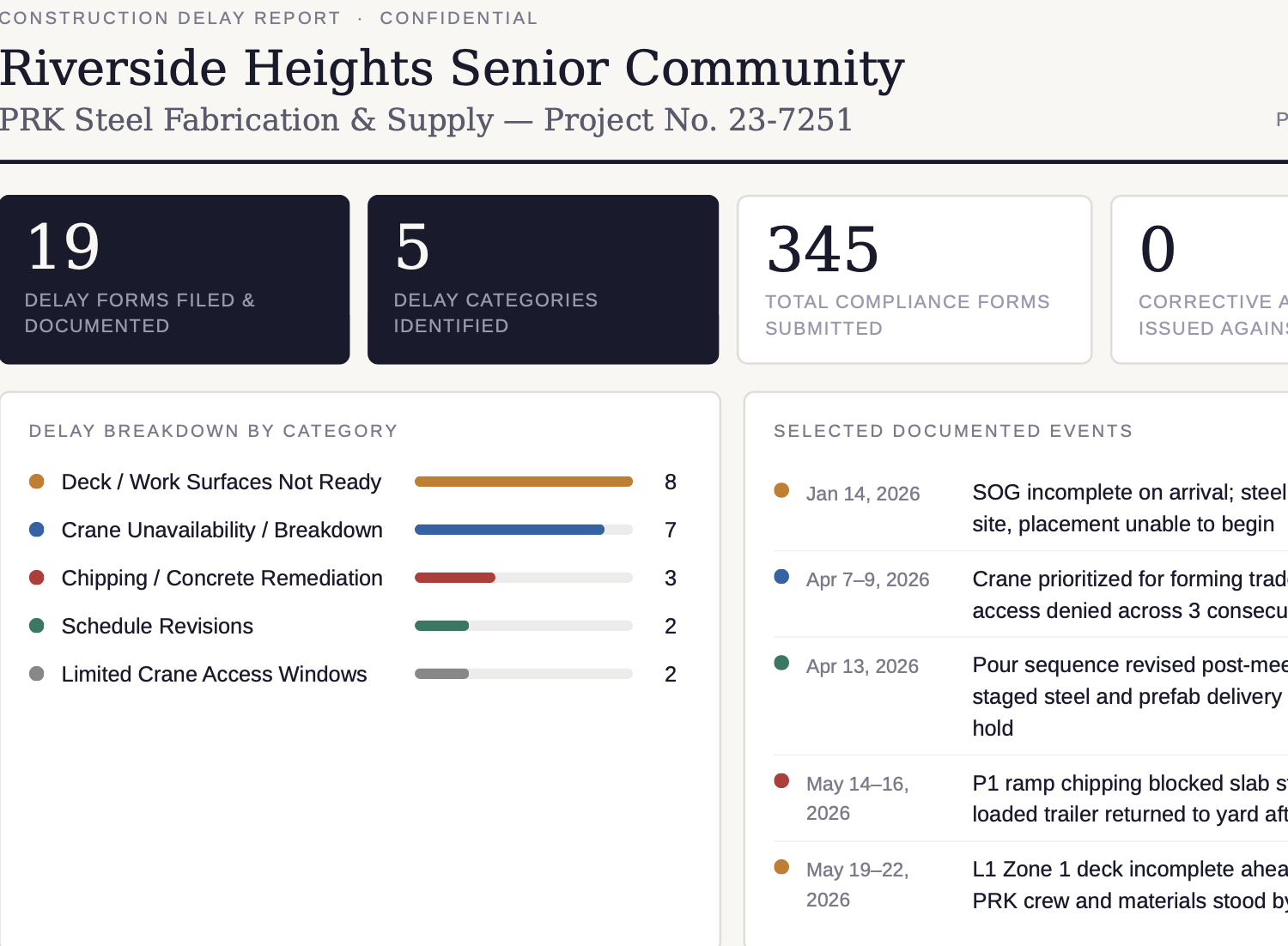
When access, crane availability, or changed sequencing stops the crew, Rosie assembles dates, notices, photos, and signed records into a chronology that shows what drove the delay.

Damage claim defense · Draft
Level 3 glazing · $38,600 backcharge
Evidence
17 records
Notice lag
3 min
7:12 AM
Pre-task photos
East corridor glazing intact before your crew entered.
10:06 AM
Delivery record
GC logistics crew moved carts through the corridor.
10:31 AM
Damage observed
Foreman voice note and three timestamped photos attached.
10:34 AM
Notice sent
GC superintendent acknowledged the condition at 10:42 AM.
Record finding

The field record does not support attribution to your trade. Held for operations and counsel review.

03 · Damage claim

Test attribution against the condition record.

Rosie orders pre-work photos, equipment scans, witness notes, and notice acknowledgements into a defensible chronology, so a damage backcharge is assessed against evidence instead of memory.

The unfair advantage

Rosie only works because SALUS already earned the trust of the crew.

Once executives see safety data for what it actually is - a ground-truth operational record - the use cases open up in ways they have not considered. Protecting a progress draw. Refuting a backcharge. Proving a delay was not yours. These are some of the ways crew-level data starts working harder for the business.

400K
users
150K
sites
1B
field data points
14K
companies
The return

Fewer fire drills. Faster mobilization. Foremen who lead crews.

Readiness standardized across crews, jobs, cities, and GCs — without a layer of admin riding along. The blockers get resolved before they reach the field, and the record that clears them is the same record that defends the schedule.

01
$750/day

recovered foreman productivity

Brice Construction measured it after switching — crews call the experience 'Nintendo Wii-level simplicity.'

02
250+/day

field forms across 170+ sites

LMS Reinforcing Steel's crews capture more because the tool is faster than what it replaced.

03
Real-time

field visibility — was a 2-hour lag

Utilities Unlimited sees field activity as it happens, with AI Spanish unlocking full crew participation.

Standardize readiness. Not the admin.

Proven in the field

Rosie only works because she helps the crew create the data.

Chinook logoRosie proof

I love Rosie. It's just a total game changer. I'm working on something right now - I'll be done in the next half an hour with Rosie. That would have taken me three days probably.

Amy MooreSafety Manager, Chinook
B&B Group logoRosie proof

I have used other AI tools but they were not connected to my company's SMS documentation. By having all of my historical SMS data reviewable, it uses my real-world data to give me insight into what actions will have the greatest positive impact.

Scott CoristineHealth & Safety Manager, B&B Group of Companies
Smith Bros & Wilson logoRosie proof

The biggest differentiator is being able to ask a plain-language question and get a useful answer directly from our own data.

Krista ChisholmHealth & Safety Manager, Smith Bros & Wilson
Why Rosie can do this

Most AI starts with a prompt. Rosie starts with the work your crews already did.

Every operational output above comes from the same connected record - the SALUS record your field teams produce as they work. Nothing is invented, nothing has to be re-typed, and everything is traceable back to who did what, where, and when.

01 · Field facts

Voice, photos, QR scans, signatures, and forms - captured by the crew, timestamped and located.

· Voice· Photos· QR· Forms· Signatures
02 · Connected context

Attached to the worker, site, task, equipment, certificate, SDS, orientation, and program they belong to.

· Worker· Site· Task· Equipment· Cert· SDS
03 · Operational output

Drafts, answers, summaries, and evidence - assembled from that record, held for review, and cited when sent.

· Drafts· Answers· Summaries· Evidence
Rosie is fluent in
Digital forms & JHAsSearchable SDSEquipment & pre-opOrientationsCertificatesCorrective actionsReporting & insights
AI trust model

Not a chatbot. Not autopilot. An assistant that shows its work.

Rosie is grounded in SALUS records. She cites the source behind every answer and holds every draft for a human to approve. Judgment stays with your team.

01

Rosie drafts. Humans approve.

Every toolbox talk, corrective action, and proof packet is reviewed by your safety, operations, or executive team before it leaves SALUS.

02

Every answer is sourced.

Rosie cites the SDS, SWP, form, photo, signature, or field record behind each answer. No unsourced advice.

03

Your data stays yours.

Rosie runs on your SALUS tenant. Your field record is not used to train models for anyone else.

Technical methodology · v2.0.0

Review the architecture, SALUS-SafetyQA benchmark design, comparative results, statistical tests, failure analysis, and publication boundaries behind Rosie.

Read the methodology
FAQ

Common questions.

How does Rosie unblock a crew waiting on a document?
Describe what's needed — an ad-hoc SWP, a site-specific plan, a procedure for a new scope — and Rosie drafts it from your company standards, the site profile, and the GC's requirements. It lands as a draft for your review; nothing reaches the field without sign-off.
What can the field actually ask Rosie?
Anything governed by your documents: procedure steps, equipment limits from the operator's manual, SDS guidance, permit requirements, project-specific rules. Answers come with sources cited, in the worker's language.
How does Rosie help with delay claims and backcharges?
Your crews' daily reports, photos, forms, and notices are timestamped and connected when they're captured. Rosie compiles them into an evidence packet — what happened, when, who was notified — in minutes instead of a week across emails and texts.
Does mobilizing in a new state mean rebuilding our program?
No. Rosie maps the jurisdiction's requirements against your existing program, updates forms and controls per state, and flags extra obligations like state-mandated training. The mobilization package — plan, orientation, forms, translations — assembles in hours.
Will this slow my foremen down?
The opposite — that's the design constraint. Capture is voice, photo, and QR-based, faster than the paper it replaces. Brice Construction measured $750/day in recovered foreman productivity; LMS crews file 250+ forms a day because it costs them less time than not filing.
Rosie · For Operations

Rosie removes blockers before they become delays.

Bring your next mobilization to a 15-minute demo — the new state, the new crew, the GC's requirements — and watch the readiness package assemble.

Readiness · Unblocking · Field answers · Dispute-proof records