

Find the risk. Close the loop. Prove it.
SALUS is construction risk management software that connects risk assessment, hazard identification, incidents, and corrective actions—then tracks every risk to verified closure. Every follow-up stays tied to a named owner, current standard, and field record while Rosie, the AI Admin & Risk Assistant inside SALUS, watches the open loops.
You can't fix the risk you can't see — and you can't claim the fix you can't prove.
Live board
Open loops · 14 active sites
Near-miss reporting climbs when capture costs seconds
Actions owned by a name, not a company
97% closed within 24 hours — provable
Every action traced to its origin
Rosie watches every open loop
Most programs can report. Fewer can follow through — and prove it.
A paper JHA or isolated hazard register captures one moment. The field reports and hears nothing back, the office assigns and can't verify, and every new project makes the risk picture harder to connect across inspections, incidents, actions, and proof.
Open loops. Drifting standards. Risk you can't see.
Reports go in. Nothing visibly comes back.
- Hazards and near-misses reported — then silence
- Findings written up with no owner attached
- The fix happens, but nobody can prove it
- The same six toolbox talks, whatever the work
- SWPs that don't match the new site or scope
- Paper JHAs signed, not read
Growth outruns the standards.
- Corrective actions open for weeks, assigned to companies instead of people
- No link between the action and the inspection, incident, or meeting that created it
- Standards deployed unevenly — every site running its own version
- Near-miss data too thin to mean anything
- Trends by site, trade, or individual — invisible
- “Where is risk lurking?” — unanswerable
Risk and compliance software built for construction safety
SALUS keeps the construction safety loop connected from field signal to assigned control and verified closure. OSHA evidence stays linked to the inspection, incident, or assessment that created it; current standards stay consistent across sites; assigned controls stay tied to named owners; and every verified fix creates audit-ready closure proof. Rosie monitors what remains open and surfaces patterns across the portfolio.
Reports — and keeps reporting
Because capture takes seconds, and the follow-through is visible. Feedback is what keeps the signals coming.
Risk becomes visible
Near-misses, findings, and incidents — captured in seconds, so more of them arrive. One near miss is a report. Ten are a signal.
Watches every open loop. Connects every action to its origin. Surfaces the risk before it surfaces you.
By site · By trade · By sub · By individual
Closed, with proof
Assigned in-flow to a named person with a due date, tracked to photo-proven closure — connected to what created them.
Deployed, customized
SWPs, JHAs, PTPs, and talks — current on every site, sized to the crew, the activity, and the day.
…and the standards loop back to the crew
Signals flow up. Standards flow down. Nothing stays open.
Same sites. Same crews. A different picture of risk.
Risk control isn't a time figure — it's visibility. Here is the same 14-site quarter, twice: once with reporting that costs 20 minutes, and once with capture that costs 90 seconds. And because the modules are connected, the correlations become readable: form completion against incident rates, training completion against near misses, corrective-action closure against repeat hazards.
Risk is invisible until it's an incident.
The safety pyramid — what gets reported
The only layer you see — after the fact
The dashed mass never gets reported — 20 min of paperwork each
The portfolio — where is risk lurking?
13 unknowns · 1 surprise, found at month-end
Open corrective actions — age & ownership
19 days · “the framing sub”
14 days · unassigned
9 days · status unknown
47 open · avg 19 days · proof: take their word
Risk is ranked, owned, and closing.
The safety pyramid — what gets reported
Fewer — because the base finally talks
The signals multiply — capture takes 90 seconds
The portfolio — where is risk lurking?
Every site graded · the D flagged by Rosie — visited tomorrow, not month-end
Open corrective actions — age & ownership
22 min · M. Chen · photo ✓
1 day · R. Alvarez · photo ✓
2 days · D. Okafor · in progress
6 open · 97% closed within 24 hrs · photo-proven
Lagging indicators become leading ones. The ratios are what the field reports.
Recognize the open loops? They close — with names, timestamps, and proof.
See the loop close on your programSee it. Shut it. Learn from it.
Standards that scale — without flattening into boilerplate.
Growth used to force the choice: one generic program everyone ignores, or a tailored one nobody can maintain. Rosie maintains the tailored one — SWPs, JHAs, PTPs, and talks deployed to every site, customized to the crew, the activity, and the day, and kept current as the work changes.


Five gaps need attention: ground-level exclusion-zone enforcement, struck-by PPE, an all-clear protocol, a current review date, and pre-task verification.
- Field controls
- Exclusion zone + struck-by PPE
- Communication
- All-clear protocol
- Governance
- Current review + pre-task verification
The safety lead validates every recommended change before the approved procedure is replaced.
The SWP, current on every site
Rosie cross-references near-misses against the procedure, flags the gaps — including the document nobody has touched in eight years — and regenerates it. Update once; every site runs the same current version.
Five gaps need attention: ground-level exclusion-zone enforcement, struck-by PPE, an all-clear protocol, a current review date, and pre-task verification.
- Field controls
- Exclusion zone + struck-by PPE
- Communication
- All-clear protocol
- Governance
- Current review + pre-task verification
The safety lead validates every recommended change before the approved procedure is replaced.
The JHA, sized to the task
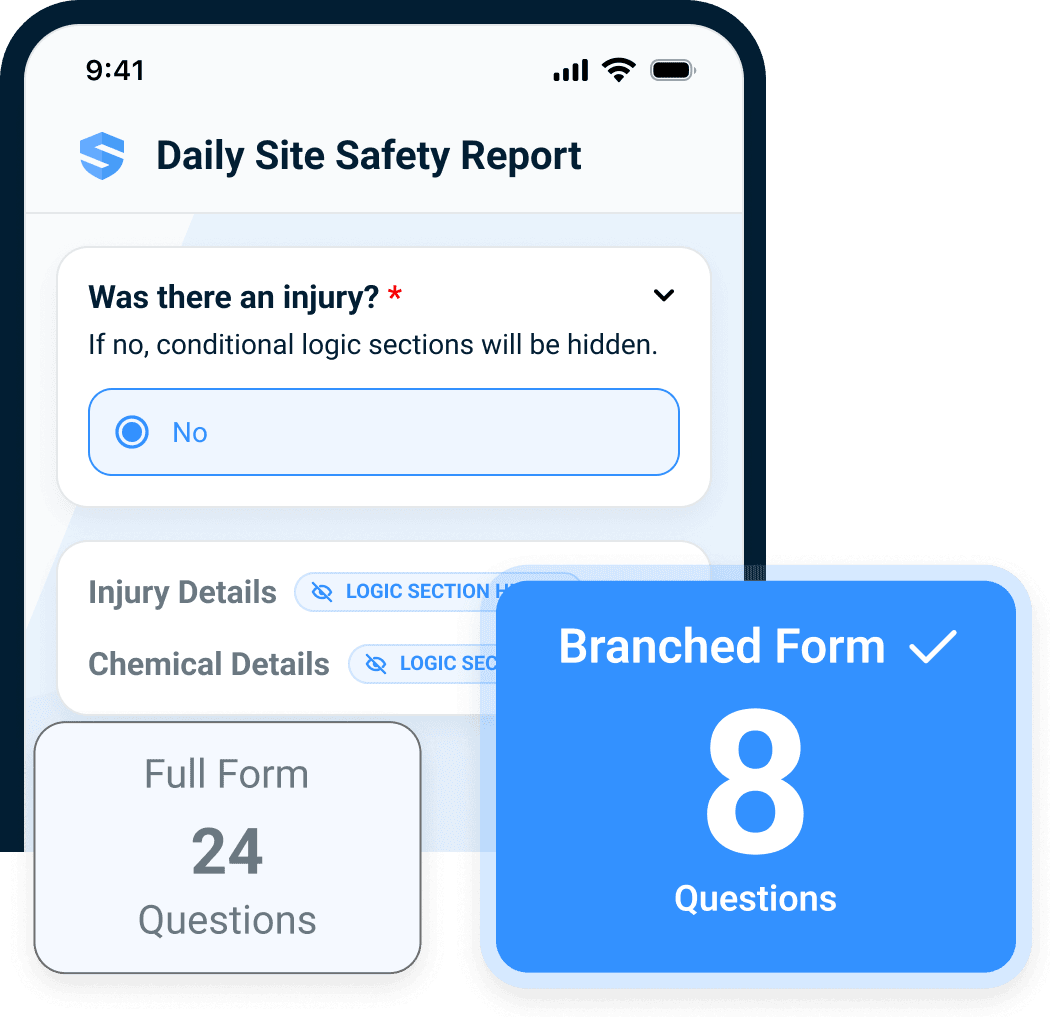
Conditional logic branches the form to today's work — 24 questions become 8 relevant ones. Crews read what they sign, and the hazard data that comes back actually means something.
The talk, written for this crew, today
Rosie drafts each briefing from the site's own near-misses, the scope, and the conditions — hyper-relevant beats recycled, and the QR sign-in makes attendance a record instead of a clipboard.
The toolbox talk is drafted around the event the crew just experienced: treat wet floors as immediate hazards, own housekeeping, and barricade before work resumes.
- Event
- Slip on wet floor · Level 2 · Dec. 29
- Crew controls
- Identify · barricade · clean · verify
- Delivery
- Site-specific talk · ready in 4 minutes
The supervisor reviews the draft and leads the crew discussion before collecting acknowledgement.
You can't fix the risk you can't see.
Near-miss data is thin for one reason: reporting used to cost 15–20 minutes of paperwork. Make capture cost seconds and the field starts talking — observations, inspections, near-misses — the rich intel that risk identification actually requires.
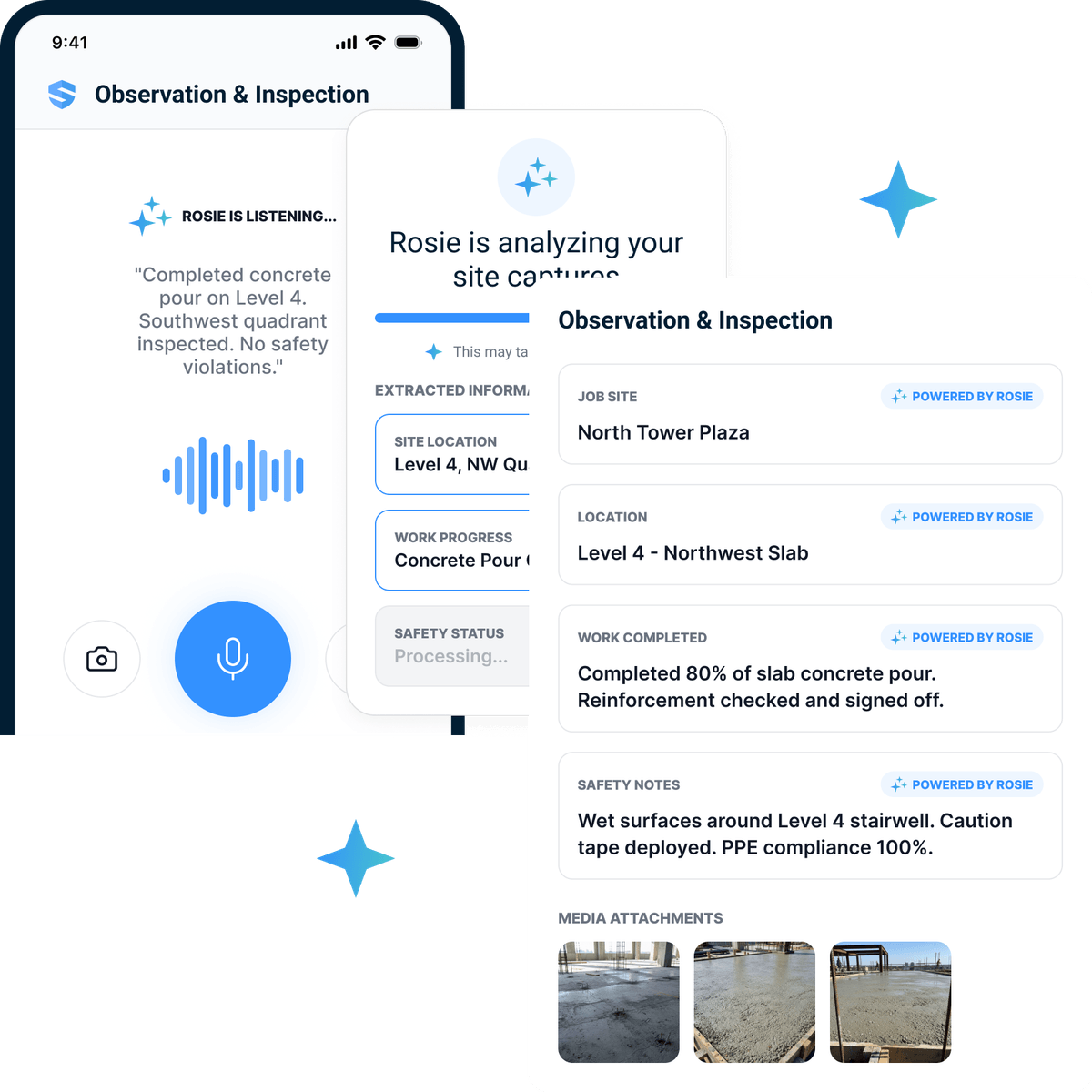
The observation, spoken
A foreman talks while walking the slab; Rosie structures it into a signed observation record with photos attached. Inspecting and documenting become the same act.
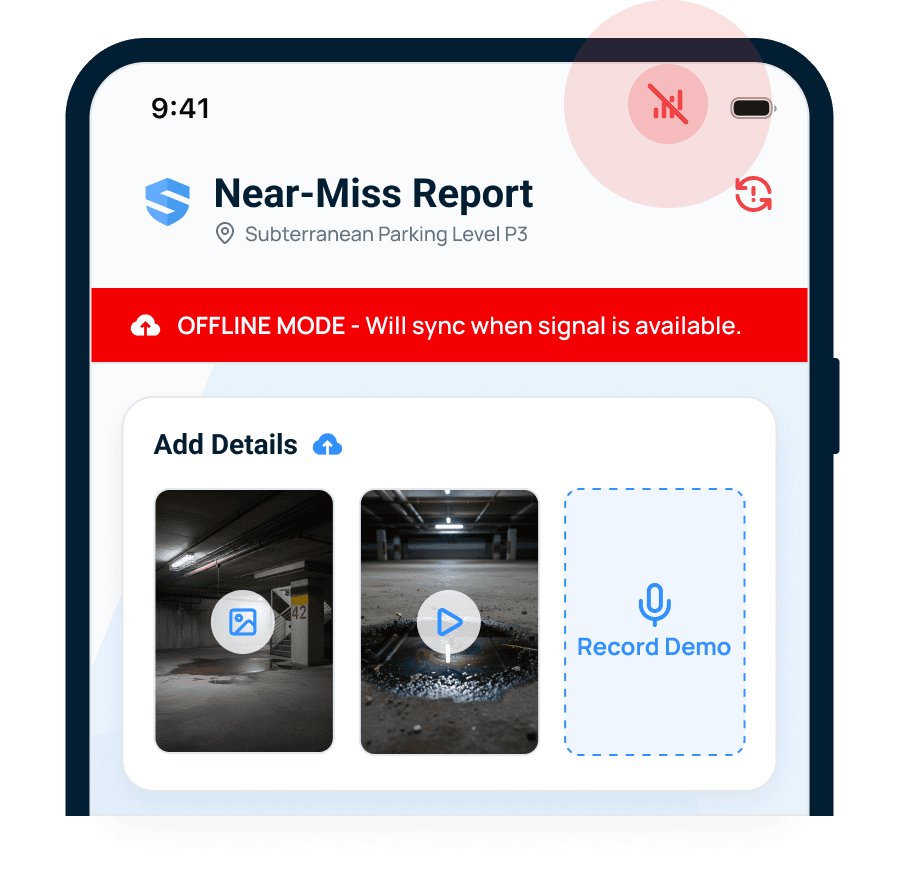
The near-miss, captured where it happens
Three levels underground with zero signal: photos, video, voice — auto-saved offline, synced complete when signal returns. The report that used to take 20 minutes at a desk takes 90 seconds at the scene.
The inspection that acts on the spot
The supervisor spots the hazard, and the corrective action is assigned before the walk ends — same workflow, no separate module, no escalation chain. Seeing and assigning become one motion.
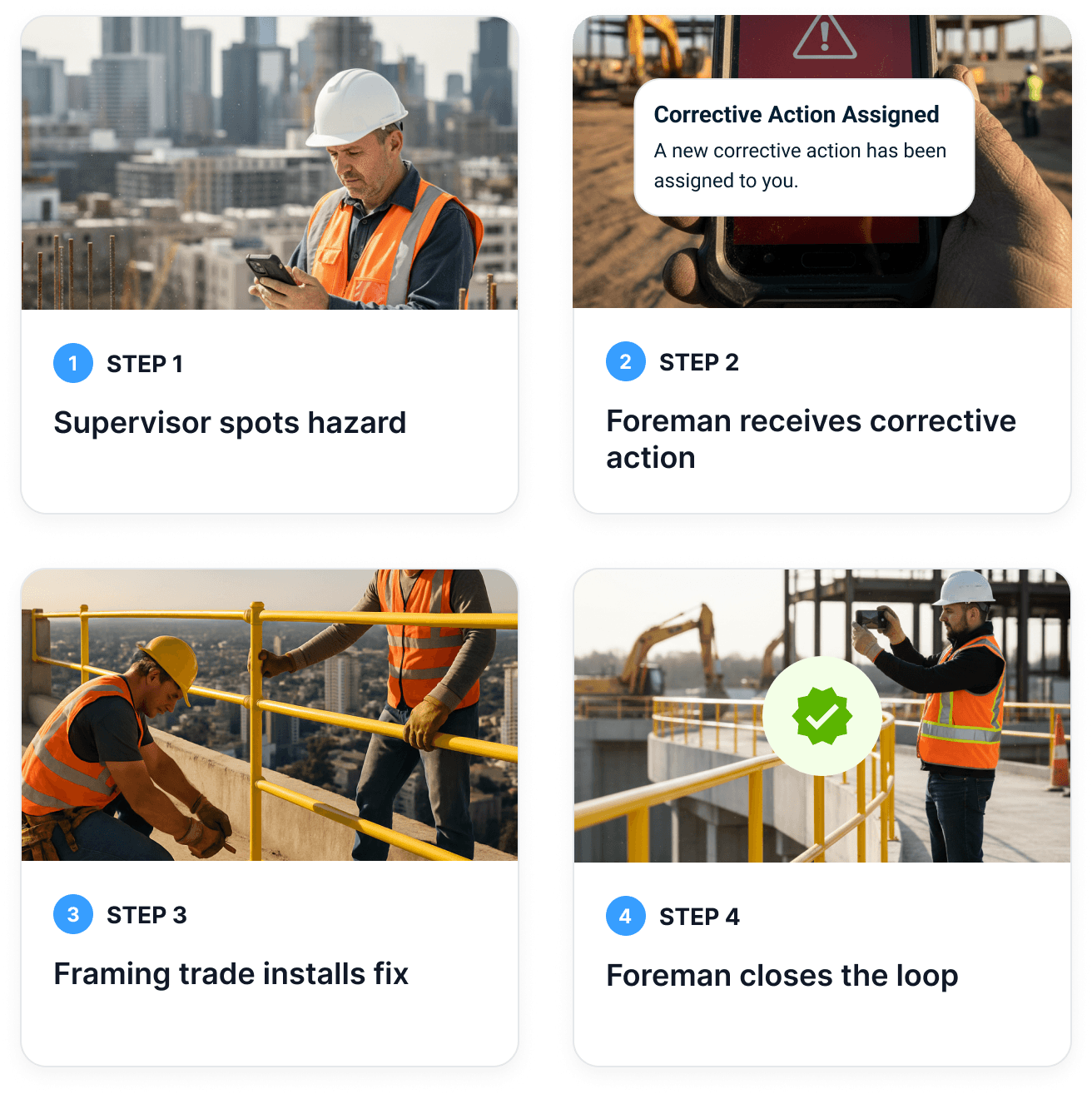
From construction risk assessment to verified corrective action
Actions assigned to "the framing sub" die in an inbox. Actions assigned to Marcus Chen, due 5 PM, with the photo and the location attached, get closed — and the closure carries evidence. Every hour an action stays open is open-risk time; closing faster shrinks it, and strengthens OSHA documentation and insurance-claim support. Every action stays linked to the inspection, incident, form, or meeting that created it, so the loop can be audited end to end.
Five gaps need attention: ground-level exclusion-zone enforcement, struck-by PPE, an all-clear protocol, a current review date, and pre-task verification.
- Field controls
- Exclusion zone + struck-by PPE
- Communication
- All-clear protocol
- Governance
- Current review + pre-task verification
The safety lead validates every recommended change before the approved procedure is replaced.
Owned by a name, closed with a photo
The assignment lands on one person's phone with full context and a due date. The fix is photographed, timestamped, and verified — this one closed in 22 minutes.
Five gaps need attention: ground-level exclusion-zone enforcement, struck-by PPE, an all-clear protocol, a current review date, and pre-task verification.
- Field controls
- Exclusion zone + struck-by PPE
- Communication
- All-clear protocol
- Governance
- Current review + pre-task verification
The safety lead validates every recommended change before the approved procedure is replaced.
Velocity you can manage
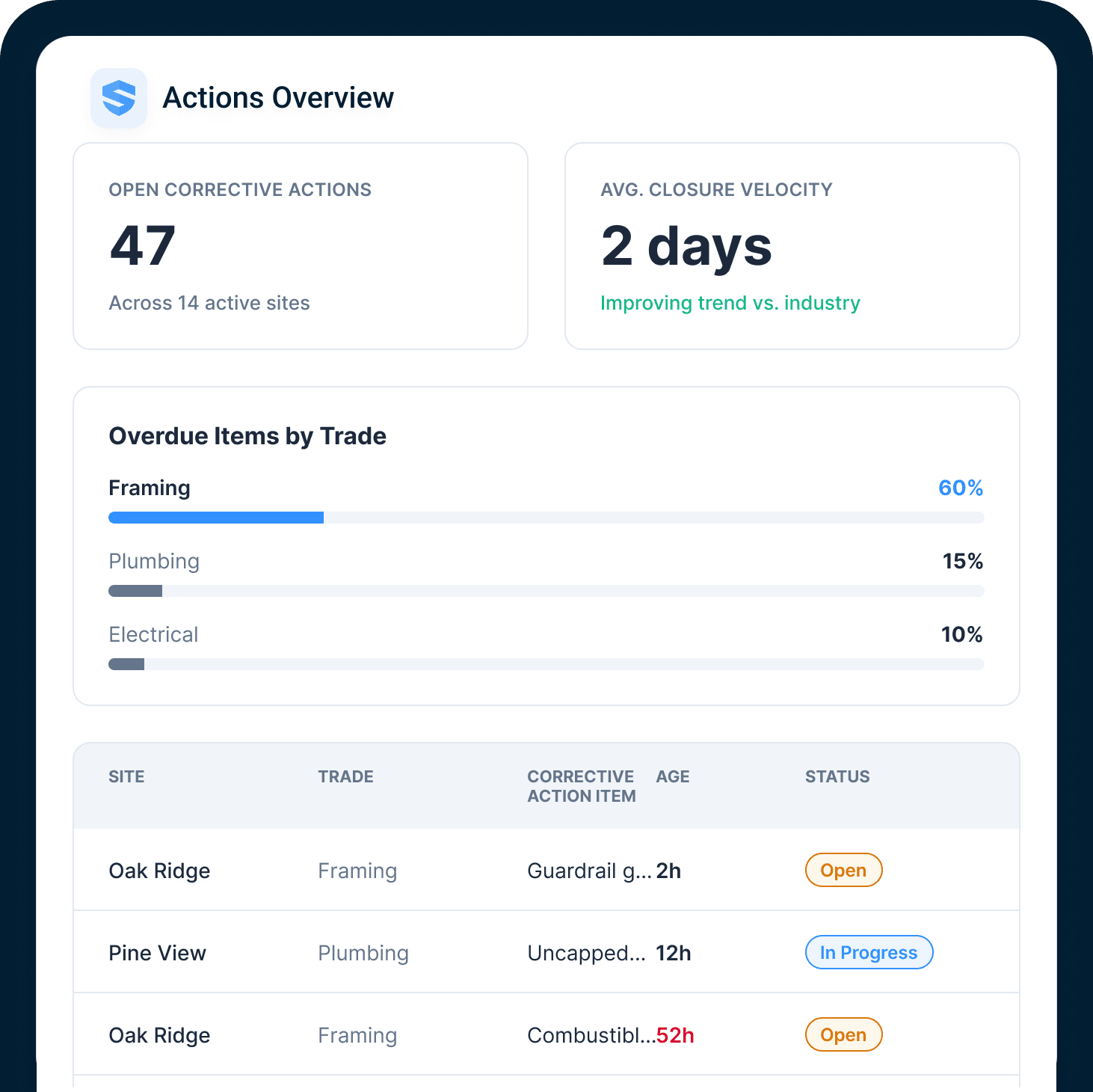
47 open actions across 14 sites, average closure two days and improving — with overdue items ranked by trade, so the conversation with the framing sub is about their 60%, not a feeling.
Traced to its origin
Every action carries its lineage: the inspection that found it, the JHA it relates to, the evidence that closed it, and the toolbox talk it fed afterward. Nothing floats free of its context.
Corrective Action #1284 — full lineage
ClosedNothing floats free of its context
Where is risk lurking? Rosie answers with evidence.
No human reads every form across fourteen sites — Rosie does, continuously. She monitors open actions and trends by site, trade, sub, project, and individual; watches each site's own conditions — wind climbing past 38 mph at the tower, a scaffold inspection due at the harbor; flags the anomalies that precede incidents; and tells you where to spend tomorrow.
Four active sites have no submissions. SeaTac and Surrey are the highest priority because each has 71 workers on site without a hazard assessment on record.
- SeaTac
- 71 workers · no assessment
- Surrey
- 71 workers · no assessment
- Broadway Towers
- 2 locations · 9 workers total
Site leaders confirm work status and complete the missing assessments before affected tasks continue.
The silence, flagged
Four active sites have zero hazard-assessment submissions this week — two of them with 71 workers on site. The most dangerous signal is the one that stopped arriving; Rosie notices the absence.
Four active sites have no submissions. SeaTac and Surrey are the highest priority because each has 71 workers on site without a hazard assessment on record.
- SeaTac
- 71 workers · no assessment
- Surrey
- 71 workers · no assessment
- Broadway Towers
- 2 locations · 9 workers total
Site leaders confirm work status and complete the missing assessments before affected tasks continue.
The drift, caught early
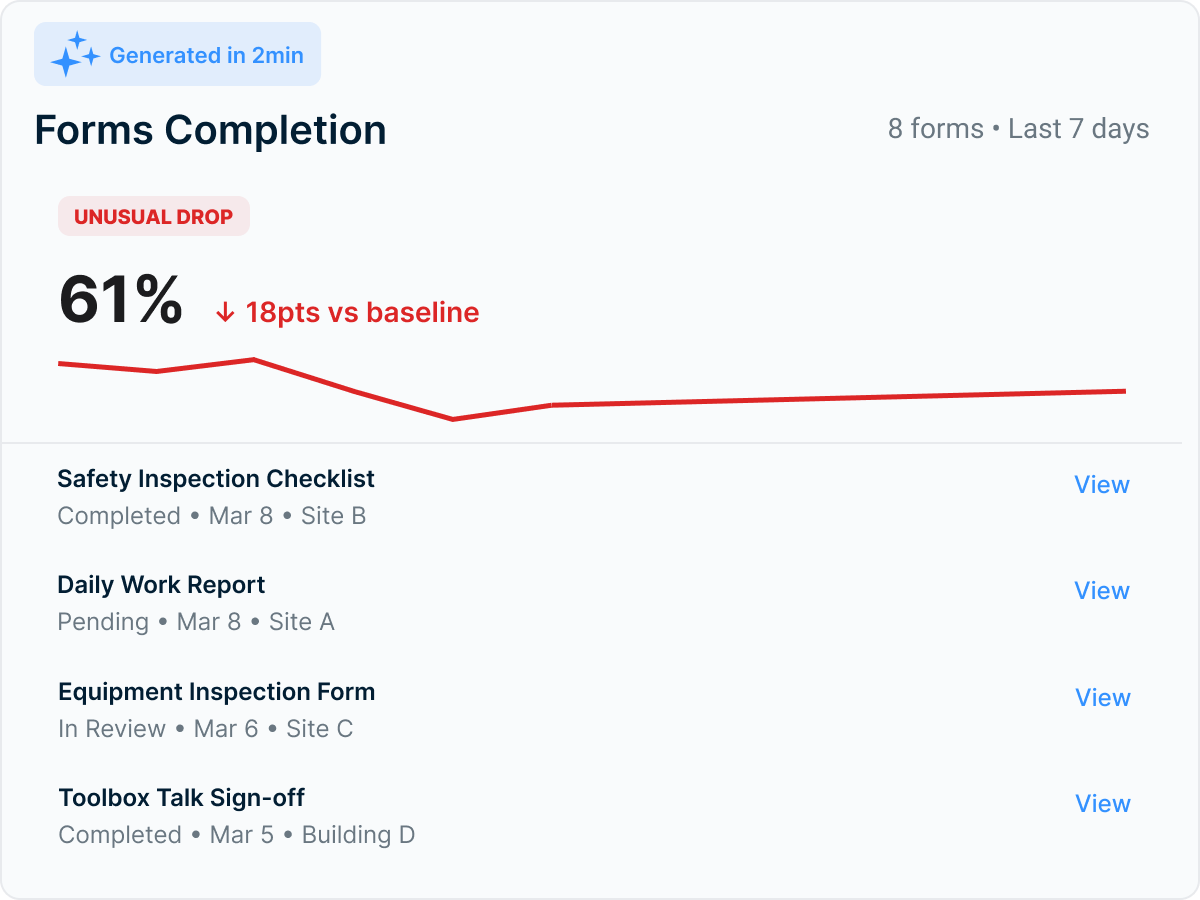
A crew's form completion quietly drops 18 points below baseline after a foreman change. A project's incident volume is rising while its reporting quality is falling. Neither is a dashboard you checked — they're the compound signals Rosie raises before they become recordables.
The response, recommended
Watching closes into acting. When corrective-action closure drifts, Rosie says so — and recommends the fix: a safe work procedure change, a toolbox talk, a conversation. When hand-injury near misses spike across two projects, she routes a three-minute refresher to the affected crews before the next morning's hazard assessment. The trend line moves before the incident report does.
Rosie — recommended response
RoutedFrom calendar event to risk response
Tomorrow, decided by the data
“Which site should I go to tomorrow?” Rosie ranks the portfolio — open incidents, unassigned actions, open high-risk permits, expiring certs — and names the site that needs you, with the risk profile attached.
Northgate Tower Block A is the priority. It has one serious open incident, 436 unassigned corrective actions, and 17 fall-protection certificates expiring within 30 days.
- Incident
- 1 serious open case · 13 total
- Actions
- 436 open · none assigned
- Credentials
- 17 fall-protection certificates expiring
The ranking supports the safety leader’s judgment; it does not replace site-specific review.
Three desks, watching the same loop close.
Safety leaders
Gets back · Risk, ranked
Field intel multiplied, trends by site and trade, and a daily answer to “where do I spend my time?” Field presence goes where the risk is — not where the rotation says.
Operations leaders
Gets back · Standards that hold at scale
Every site on the same current program, customized to the work. Findings become assigned actions before the walk ends — fewer surprises reaching the schedule.
Executives
Gets back · Provable control
Closure velocity as a leading indicator underwriters and owners can verify on a live dashboard, the blindside project caught early, and growth that doesn't dilute the program — the renewal story itself lives in Proof on Demand.
More seen. Nothing left open.
The halves reinforce each other: easy capture multiplies the signals, the signals direct the fixes, and proven fixes teach the program — so the next standard ships smarter than the last incident.
What you see
- Near-misses multiply — capture that costs seconds
- Findings documented during the walk, not after
- Trends by site, trade, project, and individual
- The anomaly flagged before the incident
- The site that needs you tomorrow, named
What you close
- Actions owned by named individuals, due-dated
- Closure in hours, not weeks — photo-proven
- Every loop traced to its origin, auditable end to end
- Standards current and customized on every site
- “Where is risk lurking?” — answered with evidence
Loops closed, on the record.

Field signals across 170+ sites
The volume that makes risk visible: forms, inspections, and near-misses captured because the tool is faster than what it replaced. You can't identify the risk you don't see — LMS sees it 250 times a day.

Of jobsite oversight, no travel
“You create a system where people can bring jobs to life in front of your eyes.” Ninety audit forms covering every field practice — and the patterns across sites visible from one desk.
More signals. Faster closure. Provable control.
The connected workflows that keep it closed.
Every move above runs on a workflow your crews already use. Go deeper on any of them.
Digital Forms
JHAs and PTPs branched to the task — hazard data specific enough to mean something.
Toolbox Talks & Meetings
Drafted by Rosie from the day's data; concerns raised become corrective actions in the same record.
Inspections
Findings spoken during the walk, corrective actions assigned in-flow — no separate workflow.
Digital Permits
Field-level permit checks are not admin; they are risk control — construction logs over 50 fatal and 300 nonfatal electrical injuries annually (CPWR Construction Chart Book, 7th ed.).
Incident & Injury Management
Near-misses and incidents captured at the scene — multi-modal, offline, multi-person.
Corrective Actions
Full lifecycle: named owner, status, photo evidence, closure velocity — traced to origin.
Integrated Training
Refreshers routed by the data — targeted training pushed to the affected crews after near misses, incidents, or repeated observations.
Bulletins & Notifications
The stand-down pushed to every device — received, opened, acknowledged, timestamped.
Reporting & Insights
Trends by site, trade, project, and individual — leading indicators before they become incidents.
Rosie Risk Intelligence
Monitors open loops, flags anomalies and silence, ranks the portfolio, names tomorrow's site.
Keep exploring the work SALUS gives back.
These pages use the same field-to-proof system from different operating angles.
Every worker on the same page — in their own language.
One channel for every crew, in 21+ languages — instructions confirmed by name, hazards answered with visible fixes, and the workers who feel heard stay.
Cut the clutter, the admin, the overhead. Not the protection.
SALUS and Rosie cut safety admin line by line — daily reports in minutes, site plans the same afternoon, audit packets on demand — with proof intact.
Get crews ready to work faster.
Reduce non-productive field time caused by orientations, missing certificates, permit delays, safety questions, SDS lookup, and paper forms — while keeping OSHA-ready documentation organized. The SALUS Ready-to-Work system.
The whole world asks for proof. Rosie answers them all.
GCs, owners, auditors, insurers, and executives all ask for proof — but the evidence lives in binders, PDFs, photos, and inboxes, when it exists at all. SALUS captures crew-level facts with full context, and Rosie assembles them into packets, dashboards, and live portals in minutes.
Risk can't hide in a closed loop.
Bring your open corrective-action list and last month's near-misses to a 15-minute demo — and watch the loop close with names, timestamps, and proof.
Deploy · Capture · Assign · Close · Learn