

Cut the clutter, the admin, the overhead. Not the protection.
Safety programs gain weight: forms that grow and never shrink, binders nobody opens, the same facts typed three times, reports built by hand, admin headcount that scales with every project. SALUS and Rosie cut the busywork line by line — and keep what protects: a connected, timestamped, OSHA-ready record.
Leaner because everything is connected — not because corners get cut.
Live board
The safety stack · Project Northgate
Forms 60–70% shorter
Rosie writes & updates the documents
Capture once — zero re-entry
Overhead flat as you scale
Proof that gets stronger
Most safety teams aren't short on effort — they're buried under non-productive work.
The field sees safety as paperwork. The office sees safety as an administrative backlog. Executives see delayed reporting.
≈ 30–45 min per worker, per day. ≈ $6M/yr fully loaded at a 300-person contractor.
Crews want to do the right thing — the process gets in the way.
- Paper forms that take too long to complete
- Repetitive questions across JHAs, PTPs, inspections, and reports
- Too many apps to find safety info
- Forms that don't work in low-connectivity areas
- Hard to add photos, videos, or voice notes
- Language barriers limit participation
- Unclear training, certificate, or form requirements
Field info arrives incomplete, and paperwork keeps piling up.
- Continuously creating and updating JHAs, PTPs, SWPs
- Constantly having to prove compliance to the GCs
- Chasing workers and foremen for cert, permits, training
- Filing, naming, and organizing records manually
- Rebuilding reports from paper, PDFs, and emails
- Translating multilingual submissions
- Recreating toolbox talks from scratch
- Prepping owner, GC, insurer, OSHA, executive packets
- Cleaning up inconsistent submissions
One loop replaces the paper chase — running both ways.
The record flows clockwise: the crew captures once, the office reads it live. The program flows back: standards maintained once, delivered to each worker customized — the exact procedure, form, and training for this task, this site, this language. One-size-fits-all documents existed because tailoring by hand was impossible. Not anymore.
Captures as it works
Speaks, snaps, scans — offline included. Gets the program served at the point of work.
One clean record
Captured once — structured, timestamped, connected. Reports and packets assemble from it; nobody rebuilds the work later.
Structures every capture into the record. Customizes every document for the worker, the task, the moment.
No re-entry · No one-size-fits-all
Reads live, publishes once
Sees the record as it happens — no chasing, no cleanup. Maintains the program in one place.
Standards, sized to the worker
SWPs, SDS, training, orientations, forms — maintained once, delivered tailored: the right slice, the right language, the right moment.
…and the program loops back to the crew
The admin, task by task: reduced or removed.
Not reorganized — cut. Pick a side of the trailer door and see where the time goes today, and what's left of it with SALUS.
- Morning pre-task plan / JHAWithout SALUS30–40 minWith SALUS10 minConditional logic pre-loads relevant hazards
- Daily reportWithout SALUS35 minWith SALUS6 minAuto-populated from verified platform data
- Toolbox talk sign-inWithout SALUS10–15 minWith SALUS2 minWorkers scan the foreman's phone QR code
- Verify a worker's certWithout SALUS10–15 minWith SALUS3 secTap the name on the live site list
- Look up an SDSWithout SALUS10–15 minWith SALUS8 secAsk Rosie in plain language
- Report a hazardWithout SALUS15–20 minWith SALUS90 secPhoto + voice note + auto-route
- Prove compliance to the GCWithout SALUS30–60 min/dayWith SALUS0 minThe GC sees the data in real time
- Equipment walk-aroundWithout SALUS15 minWith SALUS5 minQR scan loads the form + history
- Create & update formsWithout SALUSDays per formWith SALUSHoursRosie converts paper & PDFs; updates push everywhere
- Chasing missing formsWithout SALUSHours every weekWith SALUS0 minGaps auto-flag on the dashboard daily
- Writing toolbox talksWithout SALUS30–45 min eachWith SALUSSecondsRosie drafts from near-misses and scope
- Cert trackingWithout SALUS1–2 hrs/weekWith SALUSAutomaticAlerts at 30/14/7/1 days; blocks at the scan
- Owner / GC / OSHA / insurer packetsWithout SALUS2–3 daysWith SALUSMinutesCompiled from timestamped records
- TranslationWithout SALUSDays, outsourcedWith SALUSInstant21+ languages, both directions
- Weekly / exec reportsWithout SALUS4–8 hrsWith SALUS30 secLive field data, evidence attached
- Filing & organizing recordsWithout SALUSManual, inconsistentWith SALUSAutomaticEvery capture lands named and connected
Recognize your stack? The weight is removable — and the record only gets stronger.
See the lean version of your programLeaner, not lighter.
The writing work goes to Rosie. You keep the sign-off.
The office's biggest admin line item is documents — creating them, and keeping them current. Rosie drafts each one from your own program and the field's own records, and keeps them updated as the work changes. Your team's job shrinks to the only part that needed a human: review and approval. That's where the drafting weeks go to die.


Yes. The draft contains nine sections and 24 site-specific hazard controls, aligned to Meridian’s requirements and ready for the safety lead’s review.
- Plan structure
- 9 sections · roles · emergencies · sign-off
- Hazard controls
- 24 project-specific controls
- Requirements
- Company standards + OSHA + Meridian
The safety lead reviews and approves the plan before it is issued to Meridian or the crew.
The site-specific plan, drafted
A new GC, a new state, a Friday-afternoon request. Rosie pulls your standards, the site profile, and the GC's requirements and drafts the plan — 4:48 PM to 4:53 PM. What took 2–3 days of research is a review before you leave; the crew mobilizes Monday.
Yes. The draft contains nine sections and 24 site-specific hazard controls, aligned to Meridian’s requirements and ready for the safety lead’s review.
- Plan structure
- 9 sections · roles · emergencies · sign-off
- Hazard controls
- 24 project-specific controls
- Requirements
- Company standards + OSHA + Meridian
The safety lead reviews and approves the plan before it is issued to Meridian or the crew.
The SWP, kept current
Rosie cross-references last week's near-miss against the procedure, flags the gaps — including the document nobody has touched in eight years — and regenerates it. Update once, and every site is current. No addendum archaeology.
Five gaps need attention: ground-level exclusion-zone enforcement, struck-by PPE, an all-clear protocol, a current review date, and pre-task verification.
- Field controls
- Exclusion zone + struck-by PPE
- Communication
- All-clear protocol
- Governance
- Current review + pre-task verification
The safety lead validates every recommended change before the approved procedure is replaced.
The toolbox talk, written from the field
Writing a good talk takes 30–45 minutes nobody has — so the same six get recycled and crews tune out. Rosie drafts each week's talk from the site's own near-misses and scope in seconds, and collects the sign-ins by QR.
The toolbox talk is drafted around the event the crew just experienced: treat wet floors as immediate hazards, own housekeeping, and barricade before work resumes.
- Event
- Slip on wet floor · Level 2 · Dec. 29
- Crew controls
- Identify · barricade · clean · verify
- Delivery
- Site-specific talk · ready in 4 minutes
The supervisor reviews the draft and leads the crew discussion before collecting acknowledgement.
The executive report, sourced
The 4–8 hour spreadsheet merge becomes a question Rosie answers in minutes: every project graded on pure safety signals — hazard-assessment coverage, open corrective actions, incidents — board-ready, with the evidence attached.
Ten of 14 sites are at A or B+ standard. Four sites need corrective-action plans before the portfolio scales, with Northgate Tower requiring the first review.
- On standard
- 10 of 14 sites · A or B+
- Needs action
- 4 sites below the portfolio baseline
- First priority
- Northgate Tower · open actions + incident
Rosie can draft the site action plans; accountable leaders approve priorities and changes.
Say it, snap it, scan it — captured, in seconds.
Capturing the field should cost nothing, and now it nearly does — offline included. Rosie structures every capture into the final record on the spot: named, connected, synced. The first touch is the last; the retyping, filing, chasing, and cleanup that used to follow every field event stop existing.
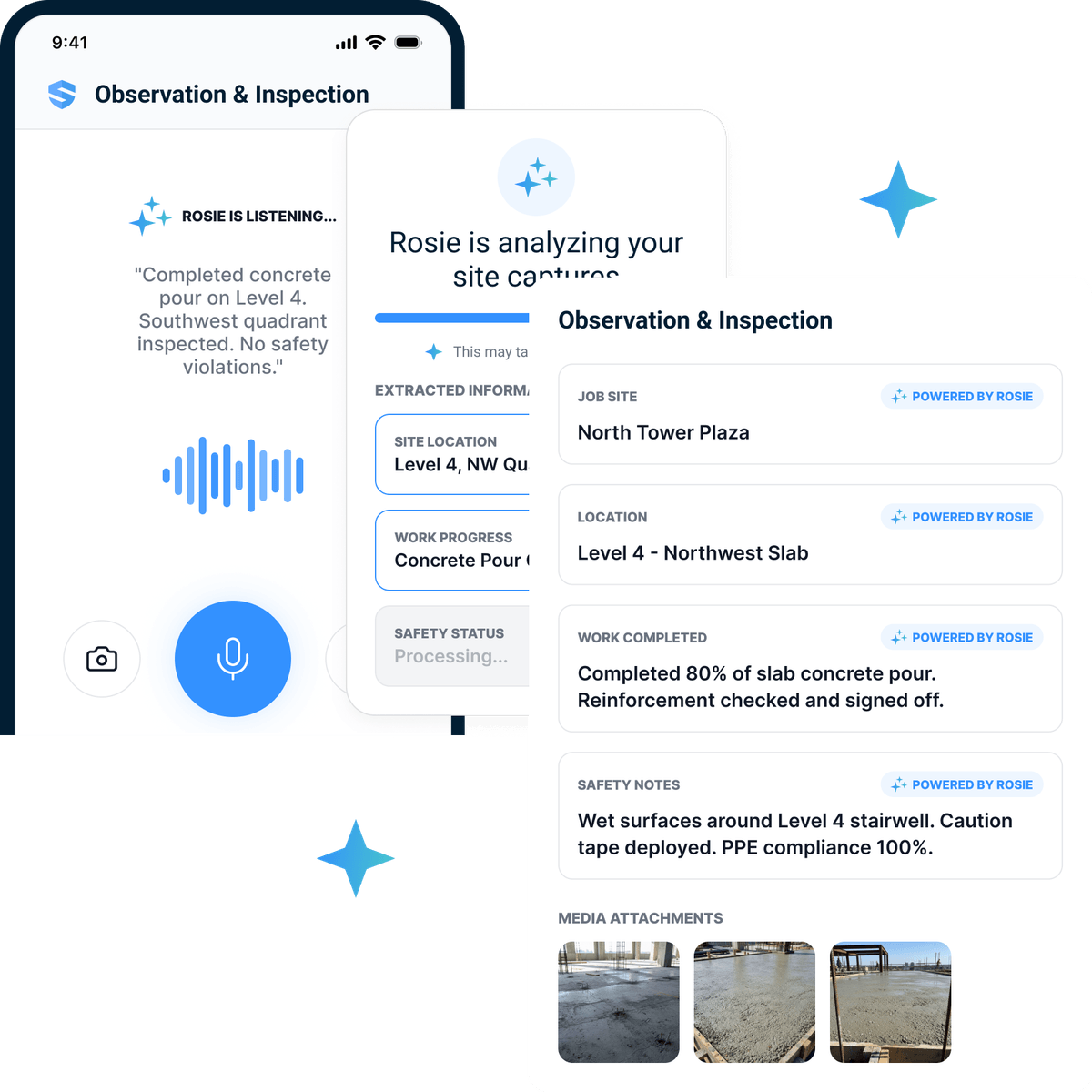
Say it — it's a record
A foreman speaks while walking the slab. Rosie turns the voice note into a structured, signed observation with the photos attached — and the daily report that used to take 35 minutes of memory work becomes a 6-minute review.
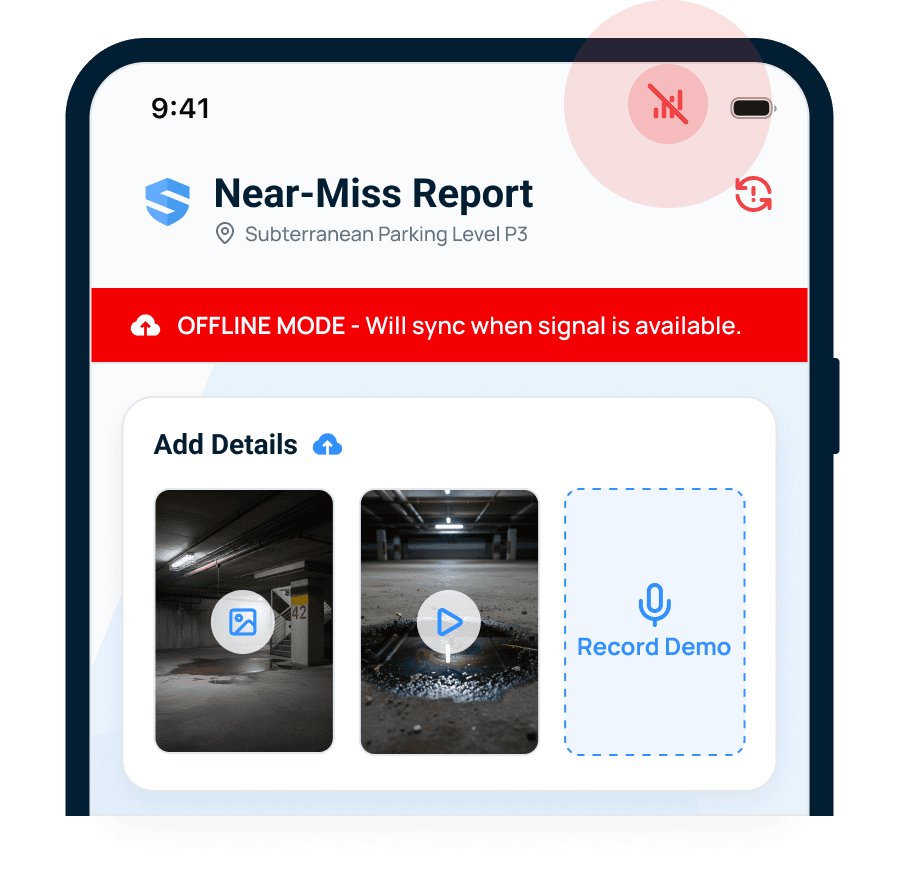
Snap it — even with zero signal
A near-miss three levels underground: photos, video, voice — captured offline, auto-saved keystroke by keystroke, synced complete when signal returns. Documented at the scene in minutes, not reconstructed at a desk.
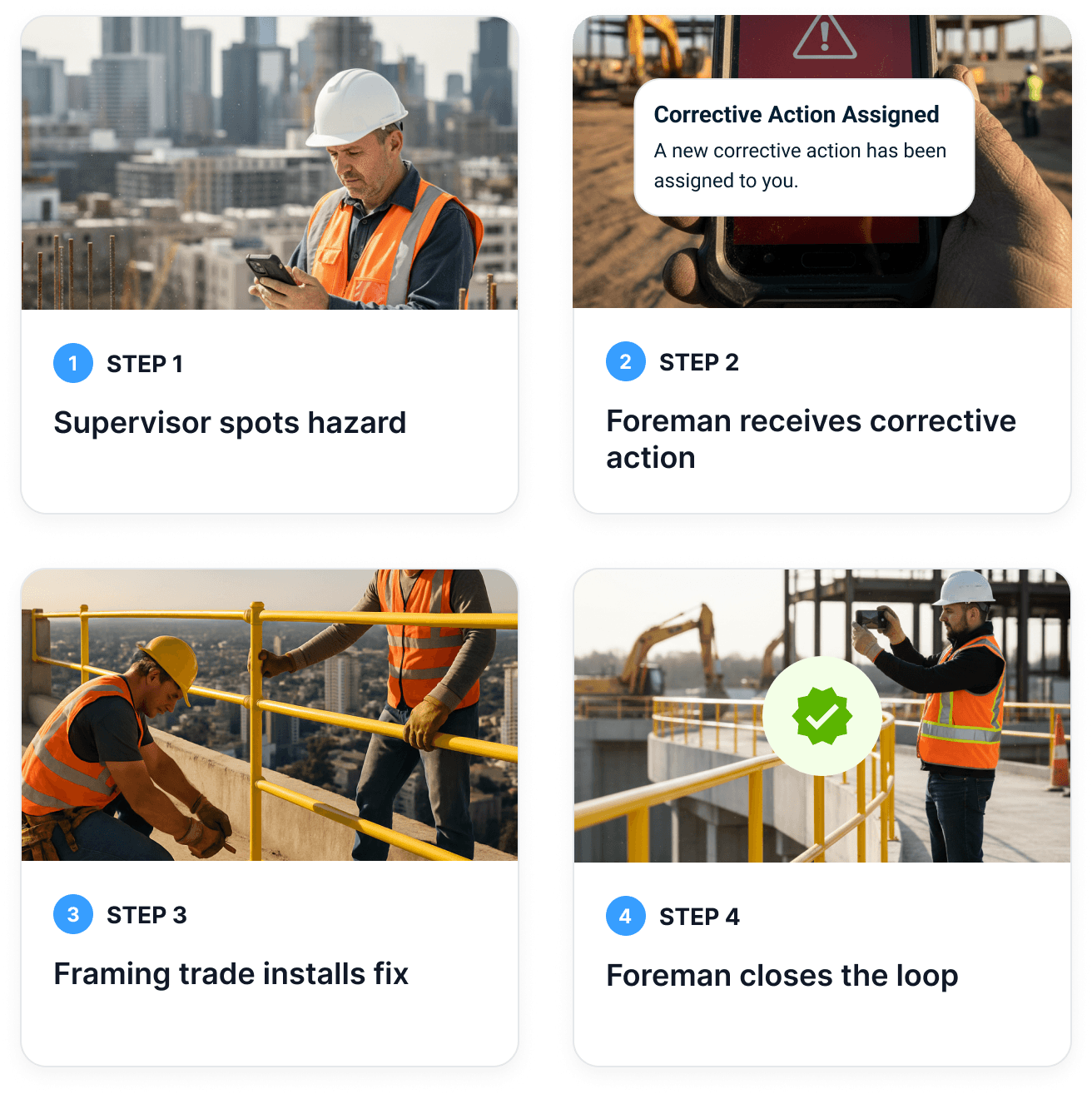
Scan it — and the loop closes itself
A hazard spotted becomes a corrective action auto-routed to the right person, fixed, photographed, and closed — 15–20 minutes of paperwork compressed to 90 seconds, with gaps flagging themselves instead of being chased.
Forty questions for everyone, or eight for this task.
One-size-fits-all was never a safety decision — it was a distribution constraint. When tailoring by hand is impossible, everyone gets everything, and the minutes pile up on every worker, every day. Rosie removes the constraint — same standards, delivered lean, in the worker's language.
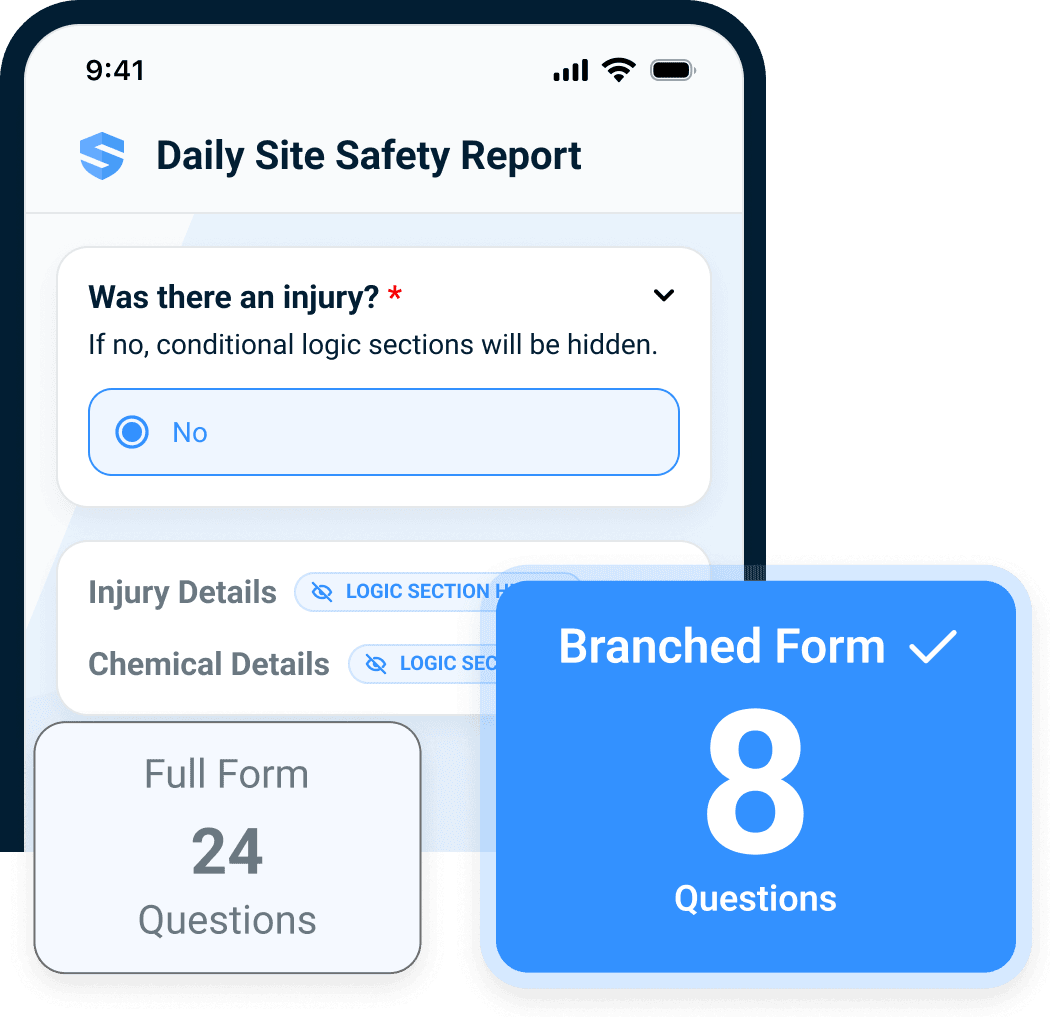
The form, branched to the task
Conditional logic hides what today's work doesn't trigger: 24 questions become 8 relevant ones — 60–70% shorter on every submission, every crew, every day. Crews read what they sign again.
The SDS, answered
No binder, no 16-page PDF. The worker asks in plain language and gets the containment and PPE steps in 8 seconds, cited from the data sheet — in their language.
Clear the area, get trained spill-response support, and use the PPE specified in the SDS. Contain the spill with compatible absorbent material; do not add water unless the approved procedure explicitly directs it.
- Immediate action
- Isolate area · notify supervisor · assess exposure
- Controls
- Chemical-resistant PPE · compatible absorbent
- Disposal
- Collect as regulated waste under the site procedure
Follow the product SDS and site emergency plan. Untrained workers should not attempt spill cleanup.
The manual, at the point of work
Rated capacity at 40 feet of reach? The number comes back with the operator's-manual page cited — 312 pages read so the crew doesn't have to. The load gets set; nobody walks to the trailer.
At 40 ft of reach, the rated capacity is 2,500 lb with the load centered and the boom at or below 45°. Confirm the load weight before lifting.
- Rated capacity
- 2,500 lb
- Configuration
- 40 ft reach · centered load · boom ≤ 45°
- At 50 ft
- Capacity drops to 1,200 lb
The operator still verifies the actual load, attachment, and machine configuration before the lift.
Cut the paper. The proof gets stronger.
This is the part that makes lean safe: the protection was never the paper — it was the record. When a dispute, an audit, or a records request lands, the answer used to be a week of digging through email threads, text messages, and three different software exports. Now Rosie aggregates it into one professional, chronological packet — with every timestamp intact.
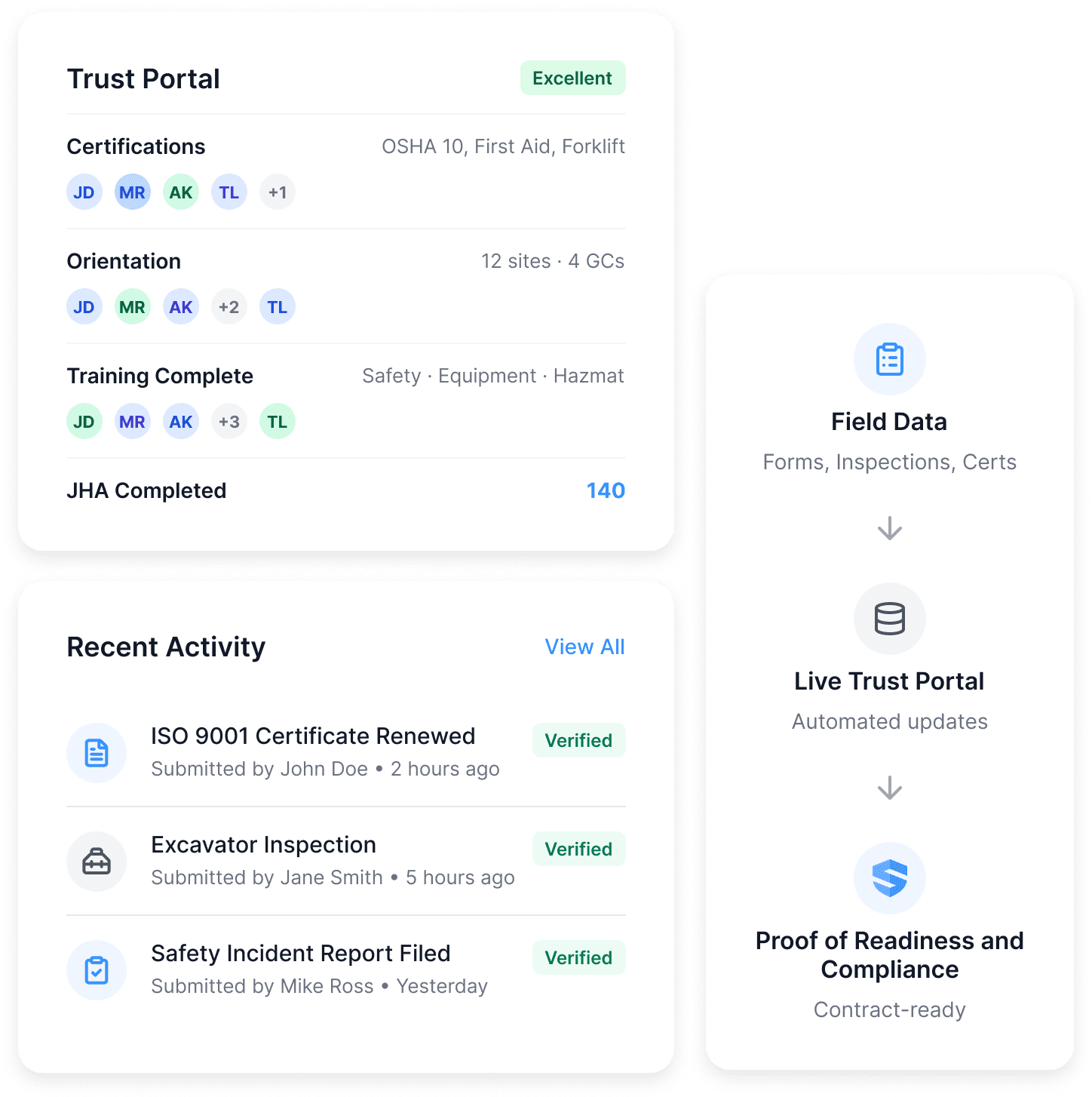
The record that proves itself
Every capture is timestamped, worker-identified, and connected to certs, training, equipment, and site. The Trust Portal turns it into a live link — GCs, owners, and insurers verify it themselves, so the request cycle ends before it starts.
The delay claim, answered professionally
The GC's claim meets a Rosie-prepared response: daily reports, timestamped photos, the notice and its acknowledgment — aggregated from sources that used to live in inboxes and text threads, sequenced into a packet that ends arguments.
The documented sequence shows the pour area was not released and the crew was redirected after written notice. The evidence does not support crew-caused delay.
- Oct. 14 · 7:02
- Photo: pour area occupied by predecessor trade
- Oct. 14 · 7:15
- Notice sent · GC acknowledgement at 7:41
- Oct. 15–17
- Redirected work + labor hours documented
The project team and counsel review the chronology and contract position before it is issued.
The insurer, answered in minutes
Renewal due diligence — forms submitted, corrective actions closed, cert compliance, citation history — compiled from the year's actual records and exported for the broker. 2–3 days of binder assembly, gone.
The due-diligence record is assembled. Daily hazard assessments cover 96% of active site-days, incident response averages 2.3 hours, and 23 fall-protection certificates need attention.
- Field evidence
- 12,847 forms · 96% active site-days covered
- Follow-through
- 94% of corrective actions closed
- Credential gap
- 23 fall-protection certificates expire within 30 days
The risk team reviews the source-linked packet before it is shared with the broker or insurer.
Everyone carries less. The record carries more.
Safety leaders
Gets back · A program that stays current
Stale SWPs flagged, one version of every document everywhere, audits assembled from daily operations — no clutter debt accruing behind your back.
Operations leaders
Gets back · Minutes back on every crew
Shorter forms, no re-entry, no binder hunts, no repeated orientations — the 30–45 minutes of daily safety admin per worker comes back to production.
Executives
Gets back · Overhead that stays flat
Automations and Rosie absorb the admin growth that used to arrive with every project. Scale the portfolio, not the back office.
Workers
Gets back · Forms worth reading
A dozen relevant questions in their own language instead of forty generic ones — signing goes back to meaning something.
Cut the program's weight, not its strength.
This isn't lighter-touch safety. Every cut replaces clutter with a connected record — leaner for the field, stronger under audit. Heavy was never the same as safe.
What gets cut
- Form length — 60–70% shorter by task branching
- Duplicate data entry across systems
- Binder hunts and document searches
- Repeated company orientations
- Hand-built weekly, exec, and GC reports
- Admin headcount growing with the project count
What gets stronger
- Timestamped, task-specific hazard records
- Audit and OSHA readiness, built from daily work
- Field adoption — and the data quality that follows
- Certification enforcement at the moment of work
- Proof on demand via the live Trust Portal
- The documented story behind your EMR
Leaner programs, proven where it counts.

Admin salaries never hired
250+ forms a day across 170+ sites, absorbed by the platform instead of headcount — “for a company our size, we would've needed 3 personal assistants to do what we're doing now.”

Field adoption
Adoption doubled when the forms got leaner — 98% of tasks pre-loaded, only relevant questions asked. The lean version is the one the field actually uses.
Less weight means more signal and stronger proof.
The connected workflows that take the weight.
Every cut above is a workflow doing the carrying. Go deeper on any of them.
Digital Forms
Conditional logic branches the full form down to the relevant questions — task-specific, multilingual, no blank pages.
Reporting & Insights
Reporting with no reporting step — dashboards fed by daily work, portfolio answers in seconds.
Searchable SDS
Retires the binder library — plain-language questions, cited answers, access logged.
Site Orientations
Orient once; only the site delta repeats. Idle first mornings end.
Certificate Management
Replaces the tracking spreadsheets — expirations alert, block, and renew from the phone.
Toolbox Talks & Meetings
Rosie drafts the talk from the field's own data — relevant beats recycled, attendance by QR.
Trust Portal
The compliance binder becomes a live link any GC, owner, or insurer can verify.
Automations & Integrations
Procore Daily Log sync, cert alerts, escalation triggers, scheduled reports — the follow-up runs itself.
Keep exploring the work SALUS gives back.
These pages use the same field-to-proof system from different operating angles.
Every worker on the same page — in their own language.
One channel for every crew, in 21+ languages — instructions confirmed by name, hazards answered with visible fixes, and the workers who feel heard stay.
Get crews ready to work faster.
Reduce non-productive field time caused by orientations, missing certificates, permit delays, safety questions, SDS lookup, and paper forms — while keeping OSHA-ready documentation organized. The SALUS Ready-to-Work system.
The whole world asks for proof. Rosie answers them all.
GCs, owners, auditors, insurers, and executives all ask for proof — but the evidence lives in binders, PDFs, photos, and inboxes, when it exists at all. SALUS captures crew-level facts with full context, and Rosie assembles them into packets, dashboards, and live portals in minutes.
Find the risk. Close the loop. Prove it.
Construction risk management software that connects hazard assessments, inspections, incidents, corrective actions, and verified closure across every jobsite.
Clutter was never protection. Cut it — and keep the proof.
Bring your heaviest form, your fattest binder, and your weekly reporting grind to a 15-minute demo — we'll show you the lean version of your program.
Cut clutter · Cut admin · Cut overhead · Keep the record